
Lieferung heute & morgen

Qualitätsgarantie

Willkommens-Angebote freischalten: KOSTENLOSE Lieferung | Bis zu 80 % RABATT | Kostenlose 30-Tage-JoyPlus-Testphase
App herunterladen
A LED light with motion sensor can automatically illuminate hallways, cupboards, stairs, entrances and patios. To make sure it’s genuinely practical for everyday use, however, don’t focus only on lumens, design or marketing claims. The key factors are where you’ll use it, the sensor range, power supply, installation and IP rating.
A higher brightness isn’t always better. A very bright light can be unpleasant in a bedroom, wardrobe or hallway at night. A garage or outdoor area, on the other hand, calls for more light output and suitable coverage.
So consider the specific location:
A PIR sensor light responds to changes in heat radiation, such as those caused by a person moving. A dusk sensor, by contrast, measures the ambient light level. The two functions can be combined, but they don’t have to be.
So check whether the light:
The range is also important. The cupboard lights featured here have a stated PIR detection range of 3 to 5 metres. That’s often enough for a short hallway, but a different sensor position may be needed for a front entrance.
A rechargeable LED light needs to be charged regularly. Battery-powered models have ongoing costs because the batteries need replacing. It’s also worth checking whether a USB cable or power adapter is included, or whether there’s just a charging port.
For a USB-rechargeable light, check the port and stated battery capacity. A 500 mAh model is more compact, while a light with 800 mAh or 1,100 mAh may last longer between charges, depending on how you use it. Actual battery life depends on brightness, sensor activity and charge level.
Light output is measured in lumens (lm). A light rated at 18 lm is better suited to use as a guide light. A 300 lm light may be enough for a small entrance or a portable outdoor wall light. Larger areas often need considerably more light.
Colour temperature is measured in Kelvin (K):
A dimmable LED light or a model with several colour temperatures gives you more flexibility. Even so, check whether you can adjust the brightness continuously or only in set steps.
If you rent your home or have already furnished a room, a no-drill installation may be a good option. Magnetic mounts and adhesive strips make installation easier, but they need a clean, dry and sturdy surface. They may not stick as well to rough plaster, damp tiles or delicate wallpaper.
Measure the installation area before you buy. Particularly slim models, around 10 mm deep, are suitable for the undersides of cupboards and shelves. Also make sure the PIR sensor won’t be blocked by covers, doors or decorations.
The level of protection is shown by an IP rating. IP44 includes protection against solid objects 1 mm or larger, as well as splashing water from different directions. It doesn’t mean the light is fully waterproof or resistant to high-pressure water.
An outdoor LED wall light with a motion sensor should therefore only be installed as directed by the manufacturer. Standing water, direct high-pressure cleaning and unprotected charging ports can damage the light. A covered entrance has different requirements from an exposed installation in the garden.

Why this product suits these needs: The two-pack can light up several small areas, such as kitchen cupboards, shelves or a hallway. The adhesive-strip mounting means there’s no need to drill.
The listed details include the sensor range, dimensions, battery capacity and three colour temperatures. This makes it easier to decide whether it’s right for your needs before buying.
Two lights, 20 cm long, PIR detection from 3 to 5 m and USB charging.

Why this product suits these needs: Its portable design makes it a good option for covered entrances, patios or garden areas where there’s no power socket nearby.
The IP44 rating is clearly stated. It provides protection against splashing water, but doesn’t make the light suitable for a completely exposed or constantly wet location.
300 lm, warm white light at 3,000 K, built-in battery, USB charging cable and magnetic mounting.
Why this product suits these needs: Its longer design is suited to wider kitchen cupboards, shelves and wardrobes, where a shorter light might not cover the whole area.
Its length of 300 mm and dimensions of 300 × 38 × 10 mm are listed, so you can check the available space before ordering.
41 LEDs, 1,100 mAh battery, three colour temperature settings and no-drill adhesive-strip mounting.
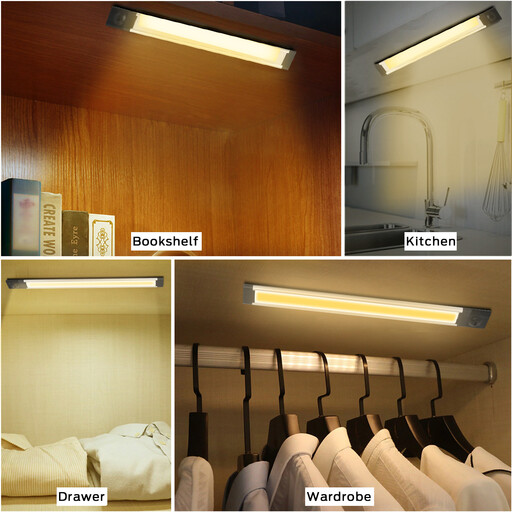
Why this product suits these needs: For bedrooms, children's rooms, hallways or stairs, this light offers several operating and mounting options without needing a fixed power connection.
The 2,800 to 6,500 K colour temperature range and dimming function are clearly described. You can adjust the light to suit the room and time of day.
400 lm, gesture control with continuously adjustable brightness, magnetic mounting and hook mounting.
We’ve put together a complete, regularly updated list of products that meet these strict selection criteria and fully comply with the safety regulations in force in the EU.
Position the light so that the sensor covers the area where you want to detect movement, without being blocked by doors, furniture or covers. If you’re using adhesive strips, clean and dry the surface first. Outdoor models need to be securely fixed and used in accordance with their stated IP rating.
Battery life per charge depends on the brightness setting, how long the light stays on and how often the sensor is triggered. Figures such as 500 mAh, 800 mAh or 1,100 mAh describe battery capacity, but don’t give a precise indication of actual running time on their own. Only charge the light using a compatible USB port or the cable provided.
LEDs use relatively little power when switched on. A motion sensor can reduce energy use by preventing the light from staying on all the time. For mains-powered models, the power rating in watts is what matters; with battery-powered and rechargeable models, charging frequency and battery replacement also play a part.