
Lieferung heute & morgen

Qualitätsgarantie

Willkommens-Angebote freischalten: KOSTENLOSE Lieferung | Bis zu 80 % RABATT | Kostenlose 30-Tage-JoyPlus-Testphase
App herunterladen
An LED light with a motion sensor switches on automatically when movement is detected. This is incredibly handy in hallways, bedrooms, stairwells, bathrooms, kitchen cupboards or on exterior walls. However, the available lights differ significantly in terms of sensor technology, power supply, brightness and installation.
If you only focus on a high LED count or a low price, you can easily overlook important details. Three typical buying pitfalls are:
A PIR motion sensor detects changes in infrared radiation, such as those caused by a person walking. The key factors are:
With a pure smart-home motion sensor, for example for Matter-over-Thread, the light itself is not necessarily switched directly. The sensor transmits the movement to a compatible hub or border router. Therefore, check the required platform and connection technology before purchasing.
For rented flats and cupboards, battery-powered LED lights are often a good choice because no electrical installation is needed. Pay attention to:
A USB-rechargeable sensor light can be more practical with regular use. Specifications like 500 mAh or 1,100 mAh describe the battery capacity, but alone they don't tell you how long the light will actually run. Brightness, sensor frequency and switch-on duration all affect the runtime.
For outdoor areas, a solar light with a motion sensor is an interesting option, provided the solar panel gets enough sunlight. For covered entrances or shady north-facing walls, this solution may be less suitable. Additionally, the stated IP rating must match the installation location. IP44, for example, protects against splashing water, but not against continuous rain or immersion in water.
Brightness is given in lumens (lm). A small LED night light with around 18 to 35 lm is better suited for orientation. For a kitchen worktop, a longer hallway or a large wardrobe, a longer LED light strip with a motion sensor can be more appropriate.
The colour temperature in Kelvin affects the light's feel:
When installing, the surface should be clean, dry and load-bearing. Adhesive strips are drill-free and therefore appealing for tenants. However, a light should only be used in damp areas if the manufacturer explicitly permits this.
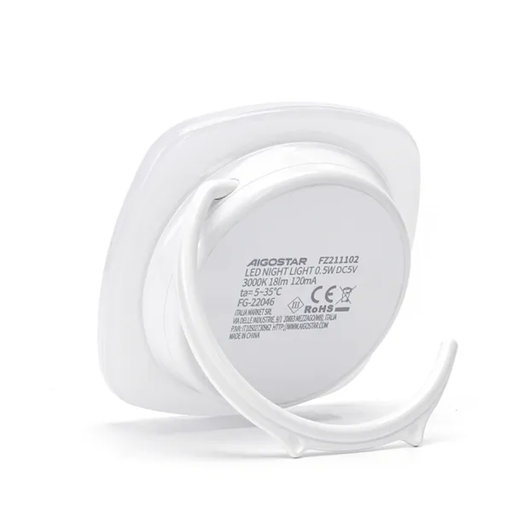
Why this product fits the profile: This compact indoor light with a motion sensor is designed for cupboards, hallways and similar areas. It features USB charging, warm white light at 3,000 K and a stated detection range of 3.5 metres.
The product details specify sensor range, colour temperature, battery and power consumption, rather than just boasting about the number of LEDs.
USB-rechargeable design, 18 lm, 0.5 W and a hook for flexible placement.
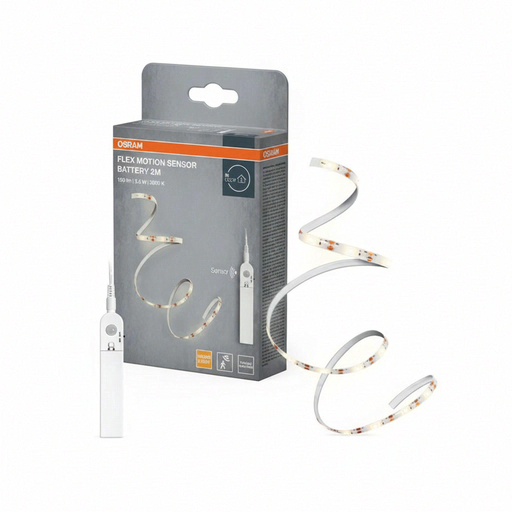
Why this product fits the profile: This 2-metre LED light strip with a motion sensor is ideal for longer cupboard fronts, shelves or walkways where a single spot light wouldn't cover the whole area.
The strip length is clearly stated. This means you can check before ordering whether the desired area can be evenly illuminated.
2-metre format and battery operation for installation without a fixed power cable.

Why this product fits the profile: For exterior walls with good sunlight exposure, this model combines solar power, motion-activated light and camera functions. The product description states IP66 and connection via 2.4 GHz Wi-Fi.
Outdoor installation doesn't require a power socket, but it does need suitable sunlight and secure mounting.
Solar operation, IP66 rating, app connectivity and local storage of recordings according to the product description.
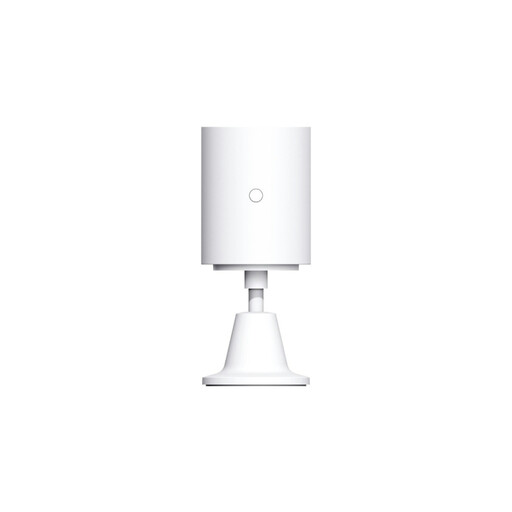
Why this product fits the profile: This sensor works with Matter over Thread, detects movement at an angle of 170° according to the product details, and requires a compatible border router or Aqara hub for full use.
The necessary Thread and Matter infrastructure must be clearly considered. This helps avoid buying the sensor without a compatible hub.
Detection angle of 170°, range of up to 7 metres and automations via Matter over Thread.
We've put together a complete, regularly updated list of products that fully meet these strict selection criteria and the safety regulations in force in the EU.
Mount the light so that the sensor covers the expected path of movement. For a hallway, a sideways orientation is often more effective than pointing it directly at the wall. Adhesive surfaces must be dry, dust-free and load-bearing. For a hardwired 230-volt solution, installation should be carried out by a qualified person in accordance with national electrical regulations.
The operating life depends on battery capacity, brightness, sensor range and switch-on duration. Frequent triggers shorten the runtime. For USB models, you should consider the charging indicator or the battery capacity stated by the manufacturer. If the brightness drops noticeably, it's usually time to recharge.
In sensor mode, the lamp only lights up when movement is detected. Models with low power consumption and automatic shut-off can limit energy usage. With solar lights, no external power supply is needed during operation, but the function depends on the available sunlight. Therefore, it's not just the LED technology that matters, but also the settings for the sensor, twilight threshold and shut-off time.