
Lieferung heute & morgen

Qualitätsgarantie

Willkommens-Angebote freischalten: KOSTENLOSE Lieferung | Bis zu 80 % RABATT | Kostenlose 30-Tage-JoyPlus-Testphase
App herunterladen
LED lighting now covers a wide range of applications: LED bulbs for existing fittings, LED spotlights for ceilings, LED under-cabinet lights for the kitchen, smart lighting systems and decorative RGB LED strip lights. However, the sheer choice can make it difficult to decide. Not every light is suitable for your existing installation, the room or the lighting effect you want.
Wattage mainly describes power consumption, not actual brightness. For comparison, the luminous flux in lumens (lm) is what matters. An LED bulb with 250 lm, for example, is better suited to a small table or accent lamp than as the sole light source for a large living room.
Also pay attention to the beam angle. A wide angle distributes light over a large area, while a narrow angle on LED spotlights highlights specific zones.
A light will not necessarily work with every dimmer. With dimmable recessed spotlights, the dimmer you use must be compatible with LED technology, for example as a leading-edge or trailing-edge dimmer. A non-dimmable LED bulb such as the Philips P45 with an E27 cap should only be operated via a standard on/off switch.
With smart products, brightness is often controlled via an app or voice control. That does not automatically mean a conventional wall dimmer is compatible.
The IP44 rating protects against splashing water and may be suitable for certain bathroom or kitchen areas. However, it does not offer protection against direct water jets or immersion in water. IP20, on the other hand, is intended for dry indoor spaces.
You should also check dimensions and connection type before buying. A recessed spotlight requiring a ceiling cut-out of 145 to 160 mm will not fit a 90 mm opening. A 12 to 24 V light will also need a compatible transformer.
Colour temperature is given in Kelvin (K):
For flexible use, look for lights with 3CCT selection. This lets you switch between warm white, neutral white and cool white. For colour rendering, the CRI or Ra value is important. A value of Ra 80 or higher is common for many household applications, while a higher value can be useful in areas where accurate colour assessment is needed.
The energy efficiency class is shown on the EU energy label. It should be considered alongside brightness and consumption. A light with higher brightness may be more suitable for a particular task than several weaker lamps, even if it uses more watts.
The Philips LED Candle Bulb, according to product specifications, uses 2.2 W, produces 250 lm and has an energy efficiency class of E. The bulb uses a standard E27 cap, is non-dimmable and has a stated lifespan of 15,000 hours. Details like these help you compare with your existing bulbs.
When working on 230 V lights, the power supply must be switched off at the fuse box. Fixed recessed spotlights should be installed by a qualified electrician in accordance with local regulations.
For furniture, cabinets and kitchen areas, flat LED under-cabinet lights or sensor lights are often easier to retrofit. Check whether installation is by adhesive tape, screws or clips, and whether the surface is suitable. For battery-powered lights, the charging port, battery capacity and charging interval are practical points for comparison.
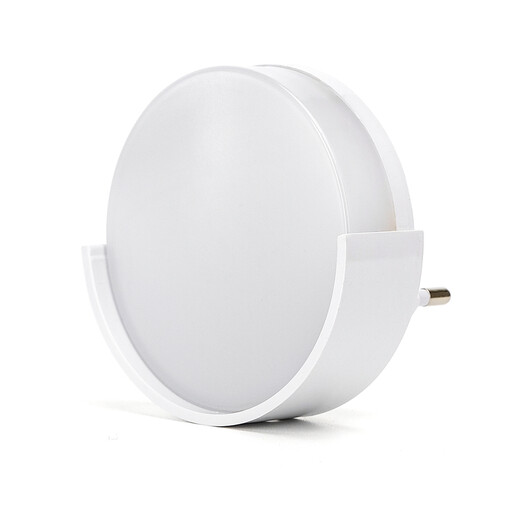
Why this product fits the profile: This plug-in night light requires no batteries and, according to the product description, switches on automatically when ambient light falls below 20 lux.
The technical specifications state 1 W, 40 lm, 6,500 K and IP20. This allows you to realistically assess its suitability for dry indoor spaces.
Plug-in operation with no battery changes, built-in light sensor and a stated lifespan of 25,000 hours.
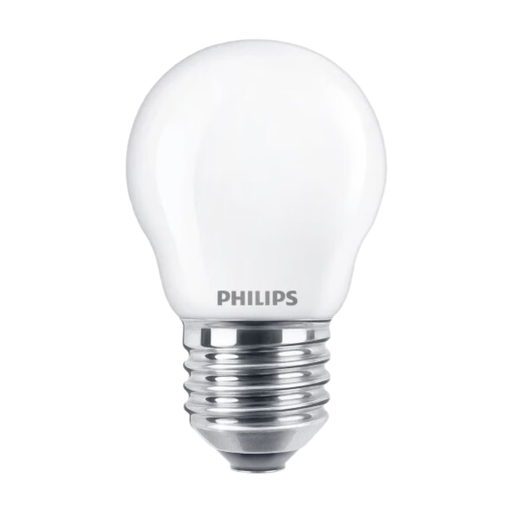
Why this product fits the profile: This LED bulb uses a common E27 cap and produces warm white light at 2,700 K, ideal for classic household light fittings.
The cap, colour temperature, luminous flux and lack of dimmability are clearly stated. This prevents it being used with an incompatible dimmer.
P45 shape, frosted glass, 250 lm, 2.2 W and a stated lifespan of 15,000 hours.
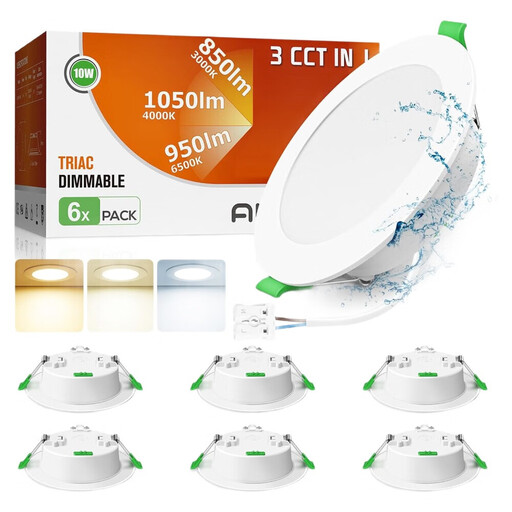
Why this product fits the profile: The six recessed spotlights each offer 10 W and 1,050 lm, plus three selectable colour temperatures for different rooms.
The required ceiling cut-out of 90 to 100 mm, the 230 V connection and the use of a compatible trailing-edge dimmer are all specified.
3CCT switching, dimmable from 10 to 100 per cent and IP44 for certain damp indoor areas.
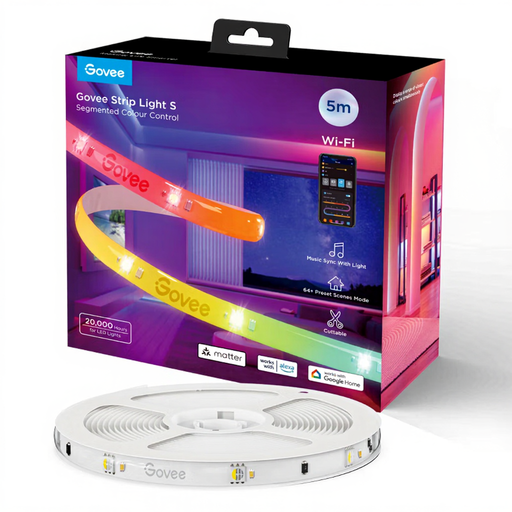
Why this product fits the profile: This 5 m RGBIC LED strip supports Wi-Fi, Bluetooth and Matter, as well as segmented colour effects, according to the product specifications.
The strip is intended for indoor use and must not be coiled while in operation. This requirement prevents unsuitable installation that could lead to heat build-up.
5 m length, 24 W power consumption, app and voice control, plus music synchronisation.
We have put together a full, regularly updated list of products that fully meet these strict selection criteria and the safety regulations in force in the EU.
That depends on the room size, its use and any existing background lighting. Work areas generally need more light than a decorative living room lamp. So compare luminous flux in lumens, not just wattage. Several lights can provide more even distribution than a single very bright source.
Lifespan varies depending on the model, operating time, heat dissipation and switching cycles. Product specifications show, for example, 15,000 hours for the Philips LED bulb, 25,000 hours for the Aigostar night light and 30,000 hours for certain recessed spotlights. These figures are manufacturer estimates and not a guarantee of identical service life in every household.
The running costs depend on the wattage, daily usage time and electricity price. The basic formula is: Wattage ÷ 1,000 × hours of use × electricity price. An LED bulb using 2.2 W will, for the same usage time, consume less than a conventional 25 W bulb. For a fair comparison, though, you should also consider brightness and operating time.