
Lieferung heute & morgen

Qualitätsgarantie

Willkommens-Angebote freischalten: KOSTENLOSE Lieferung | Bis zu 80 % RABATT | Kostenlose 30-Tage-JoyPlus-Testphase
App herunterladen
Whether it’s for your home, balcony, garden, garage or front entrance, LED lighting comes in a wide range of options. These include dimmable LED lights for indoors, solar lights and smart security lighting with app control. Choosing the right product is often easier than making sense of the specifications. A higher wattage doesn’t automatically mean more light, and an IP rating doesn’t make a light suitable for every outdoor location.
For LED products, wattage mainly indicates power consumption. Brightness is measured by luminous flux in lumens (lm). A light with 1,050 lm may be bright enough for a hallway, kitchen or small work area, while a large driveway may need an LED floodlight with a considerably higher lumen output.
Descriptions such as ‘35-watt equivalent’ shouldn’t be considered in isolation, either. The actual lumen output, beam angle and installation height are what matter.
The IP rating indicates protection against solid objects and water. For example, IP44 may be suitable for damp indoor areas such as bathrooms or for sheltered locations, but it doesn’t automatically make a light suitable for an exposed exterior wall. When choosing outdoor LED lighting, check whether the light is designed to withstand rain, splashes and frost, and is suitable for the intended installation location.
A solar light with an IP rating may be suitable for garden paths, but it needs enough daylight. Charging may be less effective under trees, on a north-facing wall or in the depths of winter.
Colour temperature is measured in kelvins:
An RGB+CCT LED bulb combines coloured light with adjustable white light. If you plan to control it via an app, also check whether it requires Bluetooth, Wi-Fi or another smart home system.
When choosing an LED light, consider lumens, beam angle and the distance to the surface being lit together. A focused LED spotlight directs light onto a specific area, while an outdoor wall light can illuminate a larger area more evenly. For an LED floodlight for a yard or driveway, the position of the light heads matters as well as the lumen output.
The energy efficiency rating on the EU energy label provides a standardised way to compare products. Running costs also depend on the power consumption in watts and how long the light is used each day. A solar light doesn’t need to be connected to the mains, but its performance depends on sunlight and battery capacity. For mains-powered lights, compare their electricity consumption per hour of use.
Aluminium can help dissipate heat, while polycarbonate or glass may be used for the cover. The stated IP rating must be suitable for the installation location. If the light is connected directly to 220–240 V or 230 V, anyone without the necessary electrical qualifications should have it installed by a suitably qualified person. Always switch off the power before working on an electrical installation.
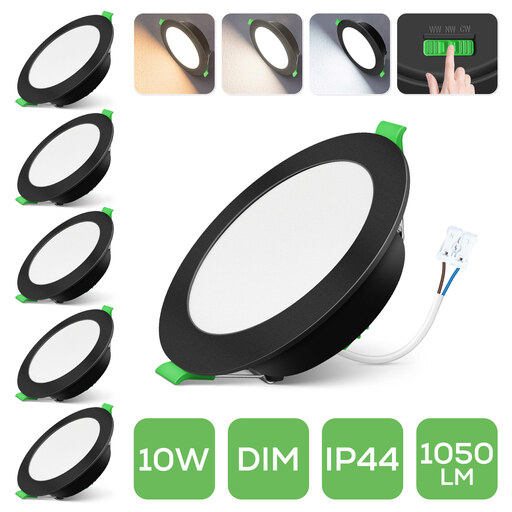
Why this product suits this profile: This slim recessed spotlight offers three selectable colour temperatures, making it a good choice for rooms where you want flexibility over the light colour.
The specifications state 1,050 lm, 10 W, 3,000/4,000/6,500 K and a dimmable function. This makes it easier to assess brightness and light colour than by looking at wattage alone.
230 V connection, dimming from 10–100 % with a compatible dimmer, 34 mm depth and IP44 rating.
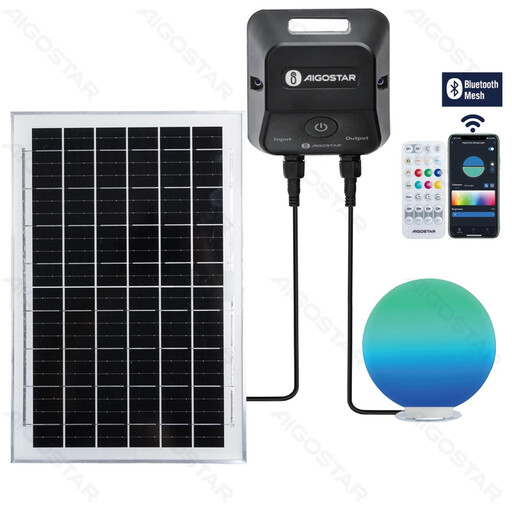
Why this product suits this profile: For garden owners looking for LED garden lighting with app control and no permanently installed power cable.
The product specifications include the solar panel, battery, luminous flux and IP rating. This lets you assess charging conditions and outdoor suitability separately from the colour features.
350 lm, RGBCCT from 2,700 to 6,500 K, Bluetooth Mesh control and a 10 W monocrystalline solar panel.

Why this product suits this profile: For homeowners who want to combine outdoor lighting and security at the same installation point.
The specifications clearly distinguish between the light, camera, app, Wi-Fi and local storage. They also state an IP66 rating for outdoor use.
Solar power, motion activation, person detection, 2.4 GHz Wi-Fi and local storage with no monthly cloud fee.

Why this product suits this profile: This slim desk lamp is designed to provide focused lighting at a workstation or reading desk.
Its compact dimensions and 5 W power consumption are stated. This helps you assess it as a lamp for a specific area rather than as room lighting.
Slim dimensions of 4,5 × 44,2 × 4,5 cm, Type-C cable and battery-powered operation.
We’ve put together a comprehensive, regularly updated list of products that meet these strict selection criteria and the safety regulations in force in the EU.
That depends on where it will be used, the size of the room and the beam angle. For work surfaces, focused lighting that’s bright enough for the task is a good choice. Outdoors, also consider whether the light needs to cover a driveway, a path or just a small area. Lumen figures from manufacturers are more useful for comparison than wattage alone.
Lifespan depends on factors including heat build-up, operating time, the power supply and the surrounding conditions. Some products, for example, state an average lifespan of 30,000 hours. This is a manufacturer’s claim, not a guarantee for every installation location. Good heat dissipation and an appropriate IP rating can help ensure the light performs well in its intended setting.
You can estimate the cost using this formula:
Power in kW × operating hours × electricity price = running costs
A 10 W light uses 0,1 kWh when it’s on for ten hours. For an accurate calculation, you’ll need the current electricity price and the actual daily usage time. Solar lights reduce mains electricity use, but need suitable light conditions and regular checks of the panel and battery.