
Lieferung heute & morgen

Qualitätsgarantie

Willkommens-Angebote freischalten: KOSTENLOSE Lieferung | Bis zu 80 % RABATT | Kostenlose 30-Tage-JoyPlus-Testphase
App herunterladen
LED lighting is versatile and can be used in flats, houses, offices and outdoor areas. However, specifications such as "50 watts", "particularly bright" or "suitable for outdoors" are not always directly comparable. If you only pay attention to design or wattage, you might end up buying a light that is too dim, cannot be dimmed properly, or cannot be used in your intended installation location.
This buying guide explains which technical specifications are actually relevant when choosing an LED lamp, an LED ceiling light, a ceiling fan with LED light or an outdoor light.
Wattage mainly describes energy consumption, not actual brightness. What matters is the luminous flux in lumens. A light with 1,700 lumens, for example, gives out significantly more light than a small 160-lumen clamp light, even if both use LED technology.
Be cautious with solar products too: a label like "50 W" could refer to an equivalent conventional incandescent bulb output or a theoretical maximum figure. For a practical comparison, look at luminous flux, battery capacity and run time.
The figure in Kelvin describes the light colour:
A CCT light with 3000 K, 4000 K and 6000 K can be adapted to different rooms and times of day. It is important that the switching is actually possible via remote control, switch or app.
A light with IP20 is intended for dry indoor spaces. It is not suitable for terraces, gardens or covered outdoor areas where moisture is present. For outdoor lighting, buyers should check the stated IP rating. An LED outdoor wall light or an LED floodlight must also be properly fixed and connected according to the installation instructions.
Even an IP44 spotlight is not automatically suitable for direct rain. The IP rating describes protection against solid foreign objects and water under defined conditions, not unlimited weather resistance.
When choosing energy-saving lighting, you should compare at least three values:
For workstations, CRI (or Ra) and glare rating are also relevant. A light with UGR < 19 is intended for many office applications, as this value describes lower direct glare. However, the specific suitability depends on room height, workstation layout and installation.
Before buying an LED recessed spotlight solution, you need to match the cut-out size, installation depth and supply voltage. The compact 12–24 V LED recessed light in our selection, for example, requires a separate transformer and must not be connected directly to 230 V.
For a ceiling light, consider the mounting surface, weight and existing wiring. A ceiling fan with LED light additionally needs sufficient clearance from walls and furniture, as well as a ceiling that can bear the weight. Electrical work in Germany should be carried out by a suitably qualified person.
A dimmable LED light is only flexible to use if the dimmer and light are compatible. With smart models, check whether control works via app, remote control or exclusively through a wall switch.
For integrated LEDs, it is also relevant whether the LED module is replaceable. Manufacturer data on lifespan, such as "L80/B10", are technical planning values and not a guarantee of identical service life in every household.
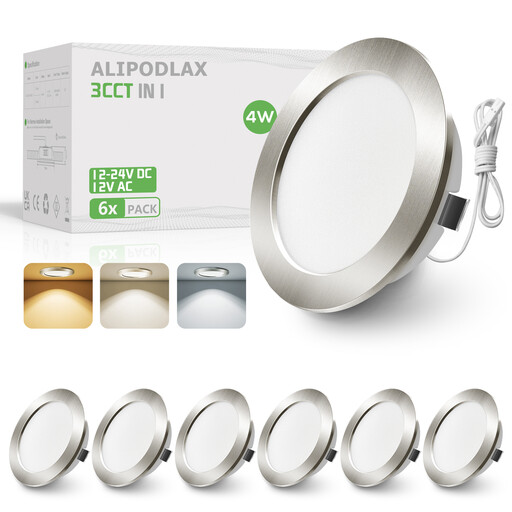
Why this product suits the profile: This flat recessed spotlight is ideal for cupboards, shelves, kitchen areas or compact indoor lighting, provided a suitable transformer is available.
The product data clearly states the required voltage of 12–24 V, the cut-out size of 55–58 mm and the installation depth of 14.5 mm.
4 W power, 270 lm, three selectable colour temperatures and IP44 for certain damp indoor areas.
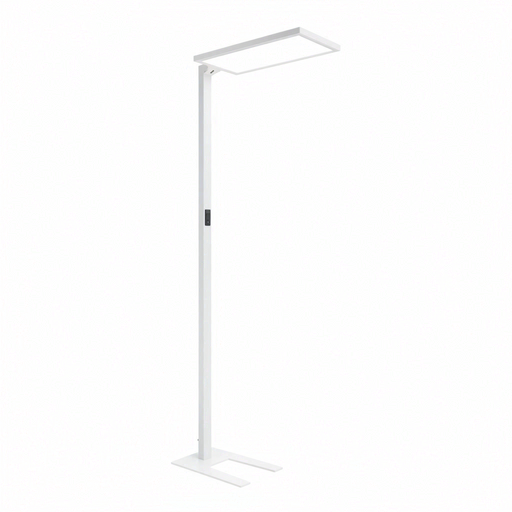
Why this product suits the profile: This floor lamp is designed for office workstations and open-plan work areas where even direct and indirect lighting is needed.
The light output is stated as up to 12,600 lm; additionally, UGR < 19, sensor control and separate light distribution are specified.
4000 K neutral white, dimming function, daylight and presence sensor, plus direct and indirect light components.
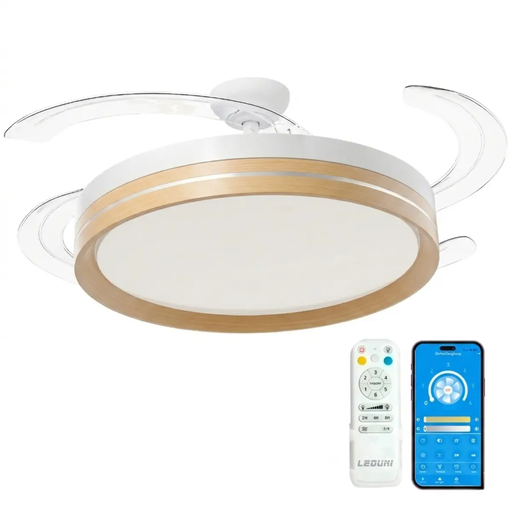
Why this product suits the profile: The combination of indoor lighting and fan is aimed at living rooms, bedrooms or rooms with limited floor space.
The technical data states IP20 for indoor use, a minimum distance of 2.3 m from the floor and 0.5 m clearance from obstacles.
36 W LED power, 8280 lm, six speed levels, app and remote control, plus CCT 3000 K/4000 K/6000 K.
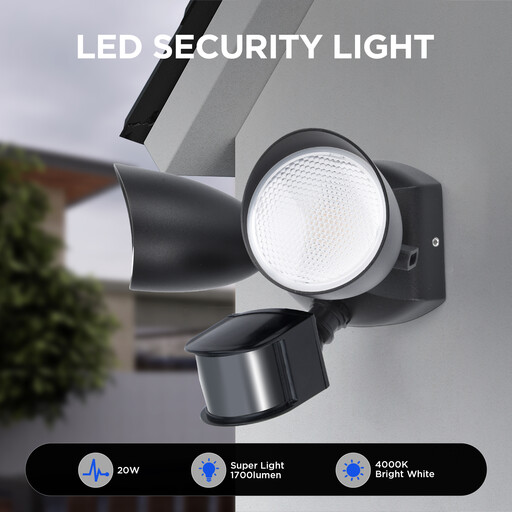
Why this product suits the profile: This outdoor wall light with two lamp heads and a sensor is intended for entrance areas, terraces, courtyards and gardens.
The product name states 1700 lm, 4000 K, sensor and the design as an outdoor wall light. Before installation, the full IP rating should be checked.
20 W power, 1700 lm, neutral white 4000 K light and two adjustable lamp heads according to the product specification.
We have put together a complete, regularly updated list of products that fully meet these strict selection criteria and the safety regulations in force in the EU.
The consumption depends on the power rating and the operating time. A 10 W light uses about 1 kWh over 100 hours of operation. For ongoing costs, the wattage, usage time and current electricity tariff are the key factors. The lumen figure also helps you compare the light output of different lights objectively.
For living rooms and bedrooms, warm white light at around 3000 K is often chosen. Kitchens, hallways and work areas can feel more functional with neutral white light at 4000 K. If you want to cover several usage scenarios, you can choose a CCT light with switchable 3000 K, 4000 K and 6000 K.
The lifespan is influenced by operating hours, heat dissipation, power supply quality and switching cycles. Figures such as 20,000 or 75,000 hours are manufacturer values under certain conditions. Good ventilation, the correct supply voltage and following the installation instructions help ensure proper operation. For outdoor lights, the housing, seals and IP rating should also be checked regularly.