
Lieferung heute & morgen

Qualitätsgarantie

Willkommens-Angebote freischalten: KOSTENLOSE Lieferung | Bis zu 80 % RABATT | Kostenlose 30-Tage-JoyPlus-Testphase
App herunterladen
A new LED lighting for the home should light the room reliably, suit your interior style, and not disappoint in daily use due to awkward controls or an unsuitable light colour. However, there are clear differences between decorative light panels, a classic LED ceiling light and a modern ceiling lamp.
If you focus only on design or high wattage, you’ll miss important details. Three typical buying pitfalls are especially common:
The lumen value shows how much visible light a light fitting emits. An LED ceiling light with 2300 lm is suitable, depending on the room layout, as general ambient lighting in smaller to medium-sized rooms. 4000 lm gives you more headroom and can make sense for larger areas or tasks that need more light.
Wattage, on the other hand, tells you the electrical power draw. One light with 24 W might produce 2300 lm, while another model with 36 W lists 4000 lm. A direct comparison only makes sense when you look at lumens and watts together.
Colour temperature is given in Kelvin:
A warm white LED lamp with 3000 K creates a subtle, homely lighting effect. A light with 6500 K, by contrast, looks clear and cool. When choosing, the specific use case should matter more than a blanket label like “modern light”.
With dimmable LED lighting, the product details should explicitly state a dimming function. Smart LED light panels are often controlled via app, Wi‑Fi, voice assistant or touch controls. That can be interesting for flexible living room lighting, but it does require a stable connection and suitable power supply.
Installation type also deserves attention. Ceiling lights are mounted permanently, while LED wall lighting is often attached with adhesive strips or a wall bracket. In rented properties, check adhesive solutions for residue-free removal and wall suitability. Light panels are not suitable for outdoor use unless an appropriate protection rating is stated.
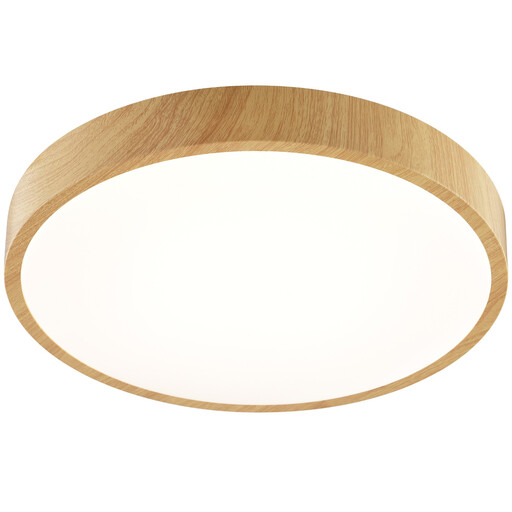
Why this product suits the profile: This permanently mounted light is intended for living rooms, bedrooms, hallways or dining areas and provides straightforward ambient lighting without an app or additional controls.
The specifications clearly state 2300 lm, 24 W and 3000 K. This makes it easier to judge the warm white lighting effect. Important: the model is not dimmable.
2300 lm, 3000 K, 24 W, 38.5 cm diameter and a decorative wood look. The energy efficiency class is stated as F.
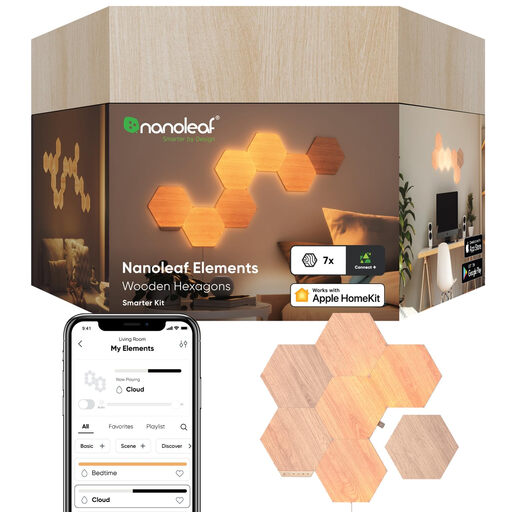
Why this product suits the profile: The modular wall design combines a decorative wood look with app and Wi‑Fi control. The starter kit is aimed at users who want personalised accent lighting rather than a central ceiling light.
The details make it clear that the panels are intended for indoor use and are not waterproof. With a light output of 154 lm, they should be planned as decorative lighting rather than the sole source of room lighting.
Seven hexagon panels, wood look, Wi‑Fi connectivity, app control and adjustable white tones from 1500 to 4000 K. The energy efficiency class is stated as G.
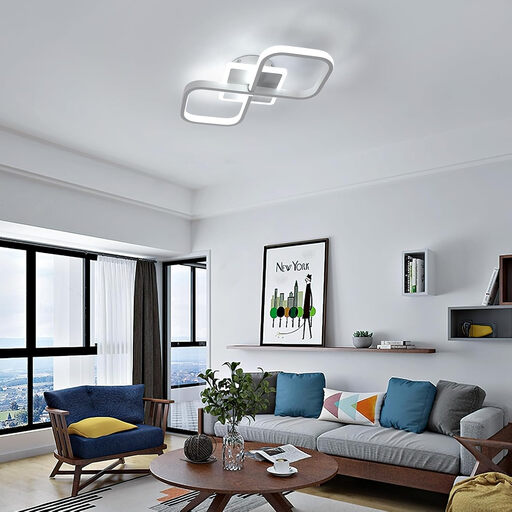
Why this product suits the profile: This model is listed for bedrooms, living rooms, dining rooms, hallways or home offices and delivers a high level of light for areas where clear visibility is needed.
The product information explicitly lists 4000 lm and 6500 K. This helps prevent accidentally choosing a cool white light for a purely cosy lighting mood.
36 W, 4000 lm, geometric acrylic cover and, according to the product details, an LED lifespan of 50,000 hours. A dimming function is not mentioned in the available information.
We’ve compiled a complete, continuously updated list of products that fully meet these stringent selection criteria and the safety regulations in force in the EU.
For electricity costs, power consumption matters. A 24 W light running for five hours a day uses around 43.8 kWh per year. Under the same conditions, a 36 W light comes to about 65.7 kWh. The actual costs depend on your individual tariff.
The stated lifespan is a manufacturer figure and not a guarantee for every scenario. Frequent switching, high ambient temperatures and unsuitable installation can affect service life. For integrated LEDs, also check whether the light source can be replaced or if the entire fitting has to be changed.
For general lighting, consider an LED ceiling light with an appropriate lumen output and a colour temperature of about 2700 to 3000 K. LED wall lighting or smart light panels can add decorative accents. In large or awkwardly shaped rooms, a combination of ceiling and accent lighting can be better than a single, extra-bright lamp.
That depends on the model and the stated light output. Some Nanoleaf light panels are primarily designed for mood and decorative lighting. A low lumen value usually isn’t enough for desk work, reading or even general, uniform lighting. Before buying, check whether the panels are intended as the main light or only as a supplement.
Key factors include compatible standards such as Wi‑Fi, the supported app and any voice assistants you already use. For RGBW lighting, also check whether a neutral or warm white mode is available in addition to colours. It’s also worth reviewing installation, power supply, suitability for indoor or outdoor use, and whether manual operation is possible if the internet connection is down.