
Lieferung heute & morgen

Qualitätsgarantie

Willkommens-Angebote freischalten: KOSTENLOSE Lieferung | Bis zu 80 % RABATT | Kostenlose 30-Tage-JoyPlus-Testphase
App herunterladen
LED lighting can make your hallway safer, illuminate your workspace evenly or create a flexible atmosphere in your living room. There’s plenty to choose from, from a dimmable LED lamp and an LED night light to smart LED lighting controlled via an app. But looks aren’t everything. The technical specifications, where you plan to install it and how easy it is to use all determine whether a light will really suit your everyday needs.
Wattage describes how much electricity a lamp uses, not how much light it produces. Brightness is measured in lumens (lm). For example, a 340 lm lamp is better suited to accent or guidance lighting, while a task light with several thousand lumens is designed to illuminate larger areas.
Colour temperature is measured in kelvins:
RGB ambient lighting creates colourful effects, but it doesn’t automatically replace functional room lighting. If you want to read, work or do crafts, make sure you also have enough brightness and suitable light distribution.
When buying a night light with a motion sensor, check whether it also has a dusk sensor, how wide its detection range is and whether you can adjust how long it stays on. For a rechargeable LED lamp, the battery type, charging port and expected run time are all important details.
Where you plan to use it matters, too. A product designed for indoor use shouldn’t be used on a balcony or patio unless it has the appropriate IP rating. For example, IP54 indicates limited protection against dust and protection against splashing water. It does not mean the product is fully waterproof.
Start by comparing lumens, kelvins and, where provided, the colour rendering index (CRI). A CRI above 80 may be sufficient for many everyday uses. For focused work, product photography or detailed craft projects, you may need a higher rating.
For a living room floor lamp, the beam angle and light distribution are also important. Direct light illuminates a specific area, while indirect light is spread across a wall or ceiling, for example. A light with an adjustable colour temperature can be more practical at different times of day than one with a single colour setting.
Stepless dimming lets you fine-tune the brightness more precisely than a small number of fixed settings. Touch controls, foot switches, remote controls and app controls each have their own advantages:
For lights with integrated LEDs, also check whether the LED module can be replaced. If it’s built in, you may need to replace the entire light if it develops a fault.
The EU energy efficiency rating shouldn’t be confused with brightness alone. A model with a higher light output may be designed for a different purpose, even if it uses more power. Figures such as 0.3 W, 1 W or 14 W refer to electrical power consumption.
Also check for:
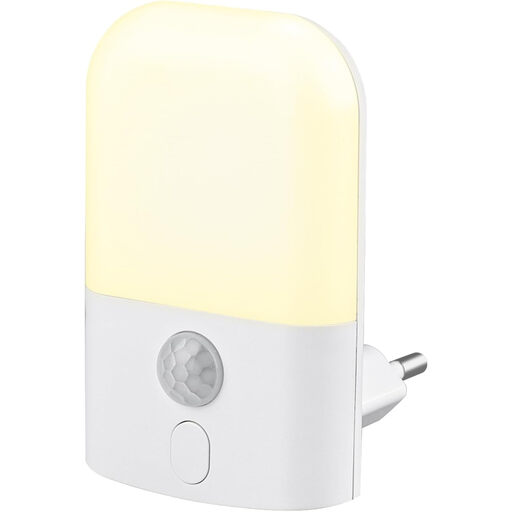
Why this product suits your needs: This plug-in night light for a child’s bedroom doesn’t need batteries and offers five brightness levels for hallways, stairs or children’s rooms.
According to the product information, the motion and dusk sensors work together; the light switches off after 60 seconds without movement.
0.5 W power consumption, warm white 2700 K light and a detection range of up to 3 m at 120°.
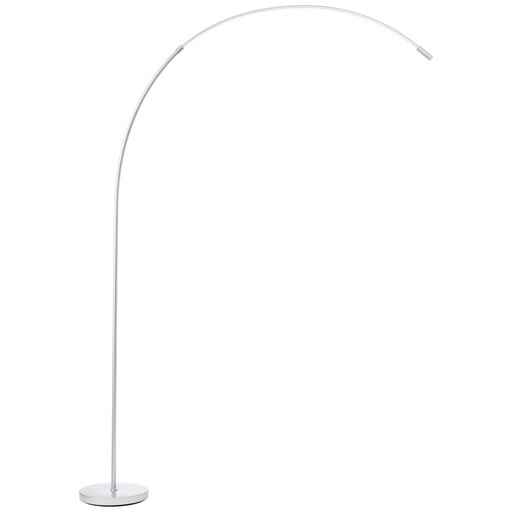
Why this product suits your needs: This LED floor lamp for your living room or workspace combines stepless dimming with an adjustable colour temperature.
The specifications state 1300 lm, 14 W, 3000–6500 K and a touch dimmer. This makes it easy to assess the brightness and colour temperature separately from the design.
179 cm high, with integrated LED, a 2.3 m cable and CCT adjustment from warm white to cooler light.
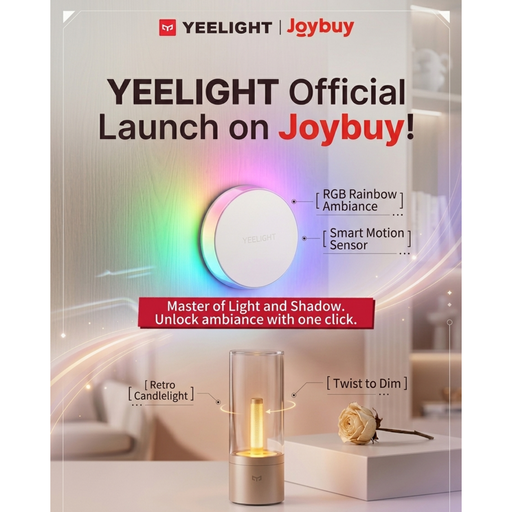
Why this product suits your needs: This compact ambient light offers several pre-set effects and flexible magnetic positioning for a gaming area, bedroom or living room.
The product description lists a motion sensor, USB-C charging and eleven pre-set effects, making the controls and power supply easier to assess.
RGB lighting effects, magnetic attachment and rechargeable USB-C operation.
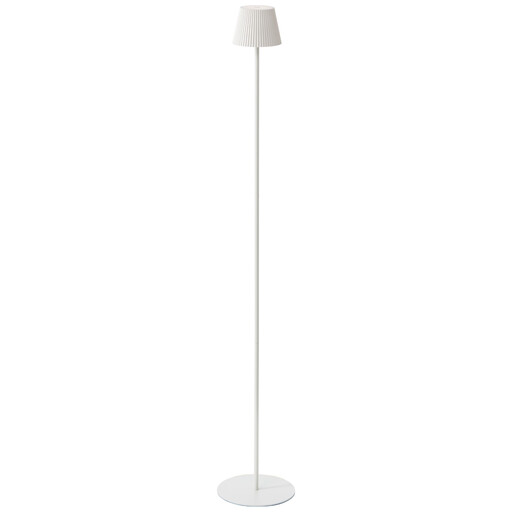
Why this product suits your needs: This battery-powered floor lamp can be used indoors and in sheltered outdoor areas without needing a mains connection.
Its IP54 rating and maximum brightness of 340 lm are clearly stated. However, the lamp isn’t designed for exposure to severe weather.
125 cm high, with warm white 3000 K light, a USB charging port and three-stage touch dimming.
We’ve put together a complete, regularly updated list of products that meet these strict selection criteria and fully comply with the safety regulations in force in the EU.
It depends on the size of the room, the number of lights and the kind of light distribution you want. A single 340 lm accent light serves a different purpose from a ceiling light or task light. When choosing, consider the total light output in the room rather than wattage alone.
Its actual lifespan depends on the number of hours it’s used, heat dissipation, the power supply and how it’s operated. Manufacturer estimates are based on defined operating conditions and don’t guarantee the same lifespan in every home. For integrated LEDs, it’s particularly important to check whether the module can be replaced.
Models with a power consumption of 0.3 to 0.5 W use relatively little electricity if left on continuously. A sensor can reduce consumption further by activating the light only when it’s dark or when it detects movement. Running costs also depend on how long the light is on and the price of electricity.