
Lieferung heute & morgen

Qualitätsgarantie

Willkommens-Angebote freischalten: KOSTENLOSE Lieferung | Bis zu 80 % RABATT | Kostenlose 30-Tage-JoyPlus-Testphase
App herunterladen
The right LED lighting for indoor spaces should be functional, complement your home décor and perform reliably every day. However, product descriptions do not always make the right purchase decision straightforward. For example, high wattage is often equated with high brightness, even though the actual luminous flux in lumens is what matters. Terms such as “Smart”, “RGB” and “energy-efficient” also say little on their own about installation, compatibility and running costs.
This buying guide explains what to look for when choosing LED lamps, smart LED ceiling lights and additional indoor lighting.
Wattage describes power consumption, not brightness itself. Depending on their design, two 6-watt LED lamps can produce different luminous flux levels. Always check the stated value in lumens (lm). As a practical guide:
Suitability also depends on the size of the room, beam angle and installation height.
Bluetooth Mesh, Wi-Fi, Matter and app control are different systems. A smart LED ceiling light cannot therefore automatically connect to every existing hub or voice assistant. Before buying, check the following:
Some Aigostar models require a hub, available separately, for remote access or voice control. This should be factored into your plans.
Recessed spotlights require a ceiling cut-out of exactly the right size. For example, one Aigostar model with 9 watts specifies a cut-out of 120 to 130 mm, while the 15-watt version requires 150 to 160 mm. An opening that is too large can affect how securely the light is fitted.
The IP20 rating is intended exclusively for dry indoor areas. It is not sufficient for bathrooms, utility rooms or other damp areas. Work on a 220 to 240-volt mains supply should be carried out by a qualified electrician in accordance with local regulations.
Warm white LED light of around 2,700 to 3,000 Kelvin is often well suited to bedrooms, living rooms and cosy seating areas. Neutral white light between approximately 4,000 and 5,000 Kelvin is suitable for kitchens, hallways and workspaces. Cool white light from around 6,000 Kelvin creates a more functional feel and can be suitable for certain task-lighting applications.
RGB-CCT lighting combines coloured lighting effects with different shades of white. The CRI or Ra value is also relevant when assessing colour accuracy. According to its product data, an Aigostar recessed spotlight has an Ra value of at least 80. This is a verifiable technical specification, but it does not replace an individual assessment of colour rendering in your room.
Dimmable LED lamps are useful when a room serves several purposes. Check whether dimming is controlled via:
Several Aigostar smart downlights specifically state that dimming is controlled via the app and that an external wall dimmer should not be used.
For rented homes, portable LED table lamps, battery-powered lights and LED light strips with adhesive backing are practical options. Permanently installed LED wall lights or recessed spotlights, on the other hand, require a suitable wall or ceiling surface and, in some cases, a mains connection.
The bulb fitting is also important: Atmosphera Keli wall lights use an E27 fitting and are supplied without a bulb. This allows you to choose the light source separately, but the fitting, maximum wattage and desired dimming capability must all be compatible.
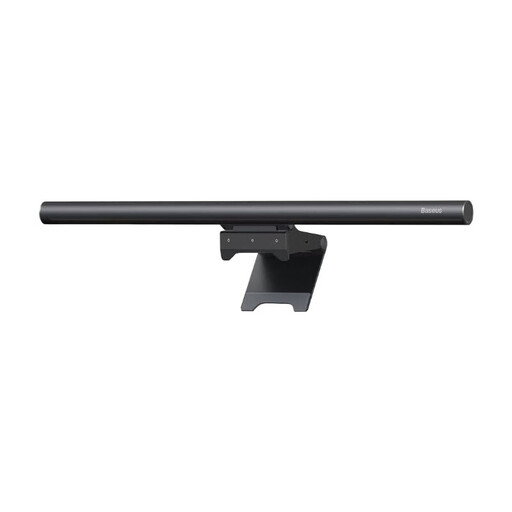
Why this product suits this profile: This compact desk lamp is designed for reading and working at a table, and can be positioned flexibly. It is ideal for anyone who does not need ceiling-mounted lighting.
The product data states 5 watts, dimensions of 4.5 × 44.2 × 4.5 cm and a Type-C connection. Buyers can clearly distinguish its intended use from whole-room lighting.
Compact design, black housing and Type-C cable. According to the product details, batteries are not included.
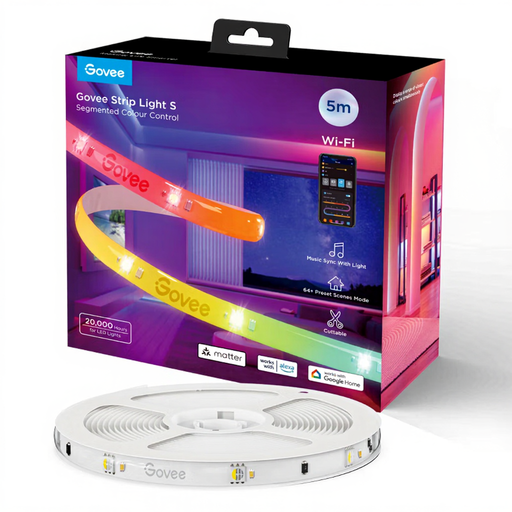
Why this product suits this profile: This 5-metre light strip is designed for smart home users looking for controllable accent lighting for living rooms, media walls or home offices.
The specifications state that it supports Wi-Fi, Bluetooth and Matter and is intended for indoor use. This makes it easier to check compatibility before ordering.
Segmented RGBIC colour control, Matter support and a protective coating. Power consumption is stated as 24 watts.

Why this product suits this profile: This motion-activated cupboard light is designed for kitchen wall units, wardrobes, shelving and hallways without a fixed power connection.
The PIR sensor, 3 to 5-metre detection range and adhesive-strip mounting are all clearly specified. This allows you to assess the installation effort in advance.
Two lights per pack, three colour temperatures and an integrated 800-mAh battery with USB charging.
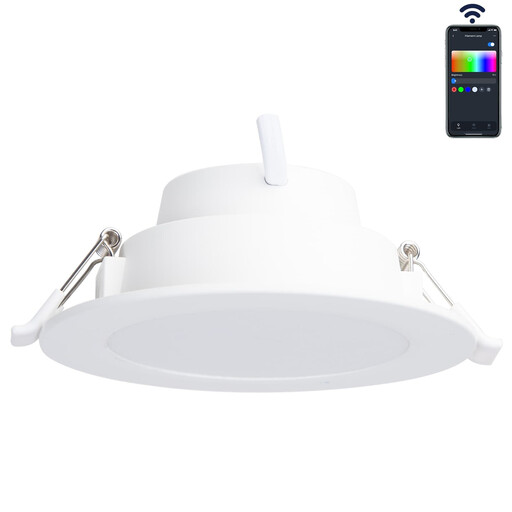
Why this product suits this profile: This recessed spotlight is suitable for planned ceiling lighting in hallways, living spaces and other dry indoor areas with a suitable cut-out.
The required ceiling cut-out of 120 to 130 mm and the IP20 rating are clearly stated. This makes it easy to identify damp areas as unsuitable for installation.
780 lm, 9 watts, RGB and an adjustable colour temperature from 2,700 to 6,500 Kelvin. It is controlled via Bluetooth Mesh and a compatible gateway.
We have put together a complete, regularly updated list of products that fully meet these strict selection criteria and the safety regulations applicable in the EU.
This depends on the size of the room, ceiling height and the lighting effect you want to create. For a small accent light, 100 to 300 lm may be sufficient. Stronger general lighting usually requires considerably more. The total output of several lights matters, not just the value of a single LED lamp.
Manufacturers state the lifespan in operating hours. For example, an Aigostar downlight specifies 30,000 hours. This is a product specification and depends on usage, heat dissipation, switching cycles and ambient temperature. Adequate ventilation and following the installation instructions help support the intended operation.
LED lamps often require less electrical power for a comparable level of brightness. To compare running costs, consider power consumption in watts, daily operating time and the electricity price. With smart lights, you should also take the stated standby consumption into account.