
Lieferung heute & morgen

Qualitätsgarantie

Willkommens-Angebote freischalten: KOSTENLOSE Lieferung | Bis zu 80 % RABATT | Kostenlose 30-Tage-JoyPlus-Testphase
App herunterladen
Modern LED lighting for living spaces should not only look appealing, but also work reliably day to day. A light fitting may look high-quality in product photos, yet later prove impractical: too cool for the bedroom, too dim above the dining table or lacking the right dimming function for different times of day.
Three common buying problems occur particularly frequently:
Luminous flux is measured in lumens. As a rough guide, around 100 to 150 lumens per square metre can be suitable for living rooms and bedrooms. This is not a binding planning value, as wall colours, ceiling height, light fitting covers and personal visual preferences all affect the brightness required.
For example, a light fitting with 2300 to 2400 lumens may be suitable as the main light source for a medium-sized room. A higher luminous flux may be useful for work areas or rooms where good visibility is essential. An additional table or floor lamp means the ceiling light does not have to handle every task on its own.
Colour temperature is measured in Kelvin (K):
A dimmable LED ceiling light is particularly flexible when several brightness levels are needed in everyday use. With a light fitting offering a fixed colour temperature, however, it is often easier to anticipate how the light will look over time.
The EU energy label ranges from A to G. The energy efficiency class should be considered together with wattage and lumens. An energy-efficient LED bulb is not automatically the right solution if it does not provide enough light for the room or support the control function you want.
You should also pay attention to:
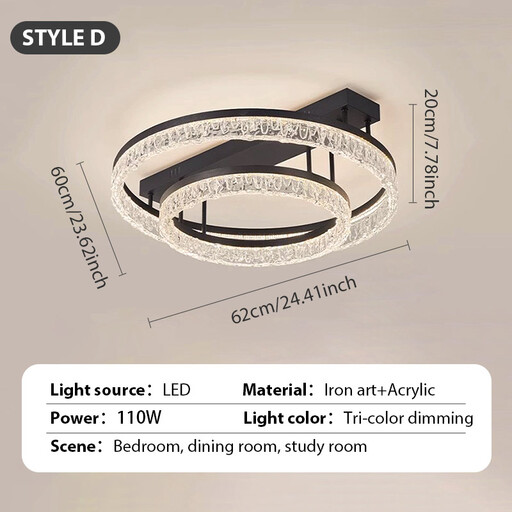
Why this product suits this profile: The round design is versatile enough for bedrooms, living rooms and hallways. Three colour temperatures allow you to adapt the light to different uses.
Being able to choose the colour temperature reduces the risk of having to use light that is permanently too warm or too cool. Check the specific brightness and dimming details before buying.
Round metal design; three selectable colour temperatures according to the product name.

Why this product suits this profile: The combination of wood, metal and plastic is suitable for living rooms, bedrooms, kitchens and hallways when you are looking for warm-white lighting with clear technical specifications.
The specifications state the luminous flux, colour temperature and three dimming levels. This makes it easier to compare the light fitting objectively with other models than products without these figures.
2400 lm, 3000 K and 24 W according to the product specification; 3-stage dimmer with memory function; wood-effect finish or wooden elements.
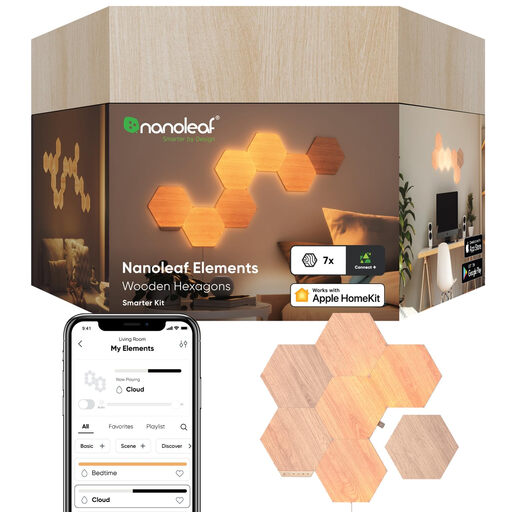
Why this product suits this profile: The modular Nanoleaf Elements panels are suitable as decorative wall lighting. They can be controlled via the app, touch control or a voice assistant, and mounted in a range of different arrangements.
This is an ambient lighting solution, not a replacement for the main light source. Keeping this distinction in mind helps avoid unrealistic expectations about the luminous flux.
7-piece starter kit; adjustable white tones from 1500 to 4000 K according to the product specification; Wi-Fi, app and voice control; wood-effect finish.
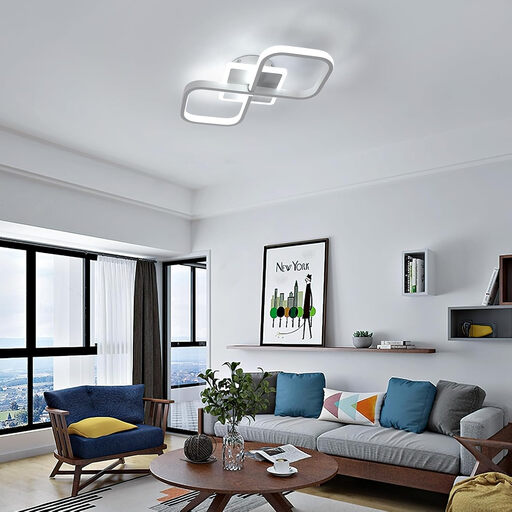
Why this product suits this profile: For home offices, reading areas or rooms where high brightness is needed, the model offers cool-white light and a high stated luminous flux according to the product description.
The fixed colour temperature of 6500 K is clearly stated. This allows you to check in advance whether the relatively cool light will suit the room. The specifications do not state that it has a dimming function.
36 W and 4000 lm according to the product description; acrylic cover; geometric design; stated LED service life of 50,000 hours.
We have put together a complete, regularly updated list of products that fully meet these strict selection criteria and the safety regulations applicable in the EU.
As a rough guide, around 100 to 150 lumens per square metre is recommended. For a 20-square-metre living room, approximately 2000 to 3000 lumens can therefore serve as a starting point. Several light sources allow for more flexible distribution than one very bright light fitting.
Service life depends on quality, heat dissipation, operating time and usage. Manufacturer specifications such as 50,000 hours should be understood as technical product information, not a guarantee of identical service life in every household. With integrated LEDs, check which replacement or servicing options are available.
Running costs depend on wattage, daily operating time and the electricity tariff. The simple calculation is: Wattage ÷ 1000 × operating hours × electricity price per kilowatt-hour. For example, a 24 W light fitting used for five hours a day consumes 0.12 kWh per day. Dimming and using the light only when needed can also affect actual consumption.