What should you consider when choosing?
First decide how much of the product and your hands you want in shot. Then check the available space, colour balance and power supply at your filming location.
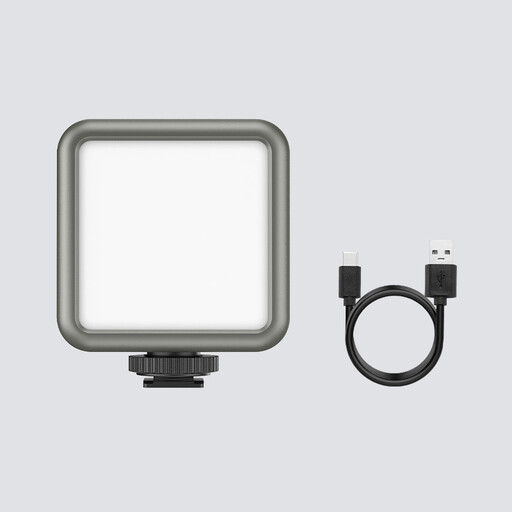
Compact bi-colour desk panel
A good fit if: You’re filming a small product on a crowded desk and want to put the light away afterwards.
Consider: Its low profile may limit where you can position the light. NEEWER quotes 600 lux at 0.5 m; this does not tell you how well it will light a larger subject.
Larger panel with diffuser
A good fit if: You want the product and the presenter’s hands in shot together, and have enough room to position the light securely.
Consider: The panel takes up more space, and the softer light described by Godox is no substitute for testing it with your own subject.
Directional bi-colour panel
A good fit if: You can position the light precisely and have room at your filming location for mounting and, if needed, a light modifier.
Consider: Aputure gives the amaran P60x a 45° beam angle; this does not guarantee even or soft lighting.
Flexible light mat
A good fit if: A rigid light is difficult to place at your filming location and you can position a flexible panel to one side.
Consider: The mat needs to be securely attached. You’ll also need to consider the right power supply and how much space it takes up for the Walimex pro Flex LED 500 Bi Color.
| What matters |
What to look for when buying |
Who should consider it? |
| Lighting and shadows |
Check the size of the light source and whether it has a diffuser. Test the product and your hands together in your planned frame. |
If I want to show product details while my hands are moving, I pay particular attention to the size of the light source and the shadows. Around 36% of consumers put lighting on the product and hands first. |
| Space and setup |
Check the desk space required, tripod height, mounting and cable routing. |
If I need my desk free for studying again after filming, setup and storage matter to me. Around 29% of consumers prioritise space requirements. |
| Product colours |
Check the white-light adjustment range for the exact model and take a test shot with a neutral reference. |
If I want colours to look accurate in my product video, I want to check the white balance and ambient light together. Around 21% of consumers put product colours first. |
| Video and power supply |
Test with your own camera using your planned recording and dimming settings; check the runtime and the power adapter you need. |
If I want to avoid banding in my video and use the right power source, I test the light and camera together. Around 14% of consumers prioritise video and power supply. |
Joybuy product option
A compact lighting option for small product shots.
 No image available
ULANZI VL49 LED video light
For compact product shots; the product title lists macro photography and product photography as suitable uses.
RGB, 2500–9500 K, dimmable, 2000-mAh battery and magnets on the back.
View at Joybuy
Frequently asked questions
Why do product colours look different despite a high CRI?
White balance and existing mixed lighting affect the image captured by your camera. Check a neutral reference under your actual lighting conditions. Nikon explains that automatic and manually selected white balance can produce different results.
How can I avoid banding in my video?
Test the panel and camera together using your planned recording and dimming settings. Sony explains that flickering light sources can cause banding depending on the camera and shutter; the right solution depends on your camera model and recording conditions.
What should I check when using battery or mains power?
Check what’s included with the specific version. NEEWER describes the NL-116AI kit as including a built-in battery and a mini tripod; Godox lists several possible power options for the P260C Pro. This doesn’t mean that every power adapter, battery or tripod you need will be included with the product.
Which markings are important on an LED panel?
For products covered by relevant harmonised EU rules, Your Europe explains the requirements for CE marking; the rules that apply to a specific device depend on the product. The EU also explains the crossed-out wheeled bin marking used on most electrical equipment sold in the EU. A CE mark is not a certificate from a central EU testing body.
What are my rights if an online purchase is faulty?
According to Your Europe, when you buy from a trader in the EU, you have at least a two-year legal guarantee from the date you receive the goods; this is separate from a manufacturer’s guarantee. For online purchases, the Council of the European Union explains that you generally have a 14-day right to cancel, although exceptions apply.


