
Lieferung heute & morgen

Qualitätsgarantie

Willkommens-Angebote freischalten: KOSTENLOSE Lieferung | Bis zu 80 % RABATT | Kostenlose 30-Tage-JoyPlus-Testphase
App herunterladen
An LED under-cabinet light with a motion sensor can illuminate dark worktops, cupboard interiors and passageways without the need for a fixed electrical installation. But the number of LEDs alone isn’t what matters. Unclear battery-life claims, unsuitable mounting surfaces and the wrong colour temperature can all make a light less practical in everyday use than you expected.
A figure such as 800 mAh or 2,200 mAh describes the battery capacity, but that’s only part of the story. Actual running time also depends on the brightness setting, sensor use and how long the light stays on. ‘Up to 80 hours’ should therefore be understood as a manufacturer’s claim under certain conditions, not a guaranteed running time for every situation.
For a rechargeable LED under-cabinet light, you should also check which charging port it has. USB-C makes recharging easier, while older USB connections may come with different cables.
A PIR sensor responds to changes in heat radiation within its detection area. Furniture edges, curtains or an unsuitable mounting height can limit its detection angle. Figures such as a 120° detection angle, a range of up to 3 metres or a 20-second shut-off time are useful guide values, but they don’t replace checking the specific mounting location.
Check the operating modes too: constant light is useful for worktops, while night or day modes may be more practical in hallways, wardrobes and on stairs.
A choice of LED lights with 3000K, 4500K or 6500K colour temperatures covers a range of uses:
A dimmable LED cupboard light gives you more ways to adjust the lighting. However, check whether several brightness levels are actually listed, rather than just a general dimming function being advertised.
A compact light with a smaller battery is often enough for occasional motion-activated lighting inside a cupboard. For daily use as LED kitchen lighting or on a staircase, a higher capacity is more practical. Consider the following details together:
A wireless LED strip light with a magnetic mount can be particularly versatile, provided the metal surface is clean and sturdy enough to support it.
The length needs to suit the mounting surface. Lights measuring 20 or 24 cm are a good choice for narrow cupboard compartments. Under longer kitchen wall units, a 30- or 40-cm light will usually spread the light over a wider area. However, the number of LEDs alone isn’t a reliable indicator of quality. The design, light cover and position of the LEDs also matter.
An aluminium housing can help dissipate heat. For plastic housings, the mounting location and ambient temperature should be within the manufacturer’s recommendations. None of the indoor lights mentioned should be exposed to damp or splashing water unless they have a suitable IP rating.
Magnets allow you to remove the light easily, while self-adhesive metal plates can also be used on non-metal surfaces. Before attaching the light, make sure the surface is clean, dry and as free from grease as possible. If you have delicate wallpaper or painted furniture, check whether the adhesive could damage the surface when removed.
An LED cupboard light shouldn’t be covered. Clean the housing with a soft, dry cloth and use only the charging accessories recommended by the supplier. Stop using the light if the battery swells, the housing is damaged or it becomes unusually hot.

Why this product suits this type of user: These two compact lights are ideal for cupboards, shelves and short hallways when you want to illuminate several small areas without drilling.
The specifications clearly list a PIR sensor, a detection range of 3–5 metres, an 800-mAh battery and three colour temperatures.
20 cm long, supplied as a 2-pack, USB charging, three colour temperatures and adhesive mounting without drilling.
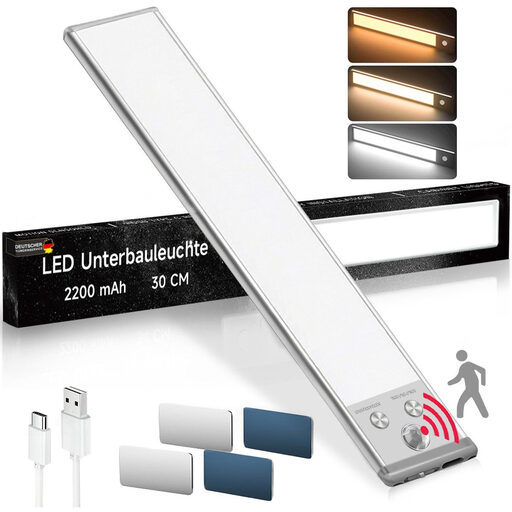
Why this product suits this type of user: This longer light bar is designed for kitchen units, work areas and larger cupboard fronts, and offers several adjustment options.
The product description specifies three brightness levels, three colour temperatures, three sensor modes and an automatic shut-off after 20 seconds.
88 LEDs, a 2,200-mAh battery, USB-C, an aluminium housing and magnetic mounting with metal plates included.
Why this product suits this type of user: These two 40-cm lights are a good option for long kitchen units, worktops or fitting out several rooms.
The 40-cm length, 1,100-mAh battery and PIR detection range of 3–5 metres are all clearly specified.
Supplied as a 2-pack, three colour temperatures, a slim 400 × 38 × 10 mm design and USB charging.
We’ve put together a complete, regularly updated list of products that meet these strict selection criteria and fully comply with the safety regulations in force in the EU.
Many models can be mounted using magnets, self-adhesive metal plates or adhesive strips. The surface should be dry, clean and sturdy enough to support the light. If you have delicate furniture surfaces, it’s a good idea to test the adhesive carefully in an inconspicuous spot first.
It depends on the battery capacity, brightness and how often the light is switched on. Manufacturer claims such as ‘up to 80 hours’ refer to specific operating conditions. With frequent use in constant-light mode, the battery will run down sooner than when the light is used briefly in sensor mode.
For a wardrobe night light or general cupboard lighting, 3000 K to 4500 K is usually comfortable and clear enough. 6500 K can be used for particularly high-contrast task lighting, but often feels noticeably cooler in bedrooms and living areas.