
Lieferung heute & morgen

Qualitätsgarantie

Willkommens-Angebote freischalten: KOSTENLOSE Lieferung | Bis zu 80 % RABATT | Kostenlose 30-Tage-JoyPlus-Testphase
App herunterladen
An LED night light should provide guidance at night without unnecessarily brightly illuminating the room. For families, parents and adults, suitable sensors, controllable brightness and a safe power supply therefore matter more than decorative promises. Whether used as a night light for bedrooms, hallways, stairs, kitchens or nurseries, requirements vary depending on where it is installed.
A night light with a motion sensor responds to movement within a defined detection range. It therefore does not necessarily stay on continuously, but usually switches on only when movement is detected. A night light with a dusk sensor, on the other hand, responds to the ambient light level and often remains active when it is dark.
For a hallway or staircase, a combination of a PIR motion sensor and a dusk sensor can be useful. For a bedroom where subtle continuous lighting is preferred, a light sensor is often sufficient. Check details such as range, detection angle and switch-off time.
More brightness does make it easier to find your way around, but it can be disruptive in a bedroom or child’s room. For a plug-in night light used at close range, just a few lumens are often sufficient, depending on the room. A model with 18 or 40 lumens may be more suitable for hallways or stairs, but it should be dimmable or easy to point in the desired direction.
Colour temperature is also relevant: warm white night lighting of around 2700 to 3000 Kelvin is more discreet in many living areas than neutral or cool white light. The way the light is perceived also depends on the casing, beam angle and wall colour.
A rechargeable night light can be placed flexibly and used away from a socket. However, battery capacity, charging time and runtime at the specified brightness level are crucial. A product offering six hours of runtime at maximum brightness may last longer on a lower setting, but an exact runtime for every level is not always provided.
With a plug-in model, there is no need to recharge it. However, its position is tied to the socket, and adjacent sockets may be partially covered depending on the design.
Check whether the light is activated only in darkness or also when the room is sufficiently bright. For a motion sensor, the following values are also important:
A motion sensor installed directly beside a staircase should cover the route people take, while a sensor in a nursery should not be blocked by curtains or furniture.
The lumen rating describes the luminous flux, not how bright the light feels to you in the room. A dimmable night light is therefore particularly versatile. Levels such as 20, 40, 60, 80 and 100 per cent make it easier to adjust the brightness, while stepless control allows finer adjustment.
For finding your way around in the dark, warm white versions with 2700 to 3000 Kelvin are often a practical choice. For a children’s night light, ease of use, touchable surfaces and a stable base may also be important. Decorative projections or RGB effects are more suited to creating ambience and do not automatically replace a light designed for orientation.
For a plug-in night light, check the specified mains voltage, design and suitability for indoor use. IP20, for example, indicates protection for dry indoor areas and not for use in damp locations. Even if a product is marketed as a bathroom night light, you must follow the manufacturer’s specific safety instructions.
For battery-powered models, the charging port, charging indicator and safe battery handling are important factors when choosing a product. Lights with a soft silicone body should still not be immersed in water or placed near heat sources.

Why this product suits the profile: The two-piece set is suitable for several areas, such as hallways, stairs or children’s rooms. The dusk sensor switches the light on automatically when it gets dark.
Three brightness levels prevent you from being limited to a single fixed setting that may be too bright.
Two lights, 2700 Kelvin warm white light, 0.5 watts and automatic on/off switching via the dusk sensor.
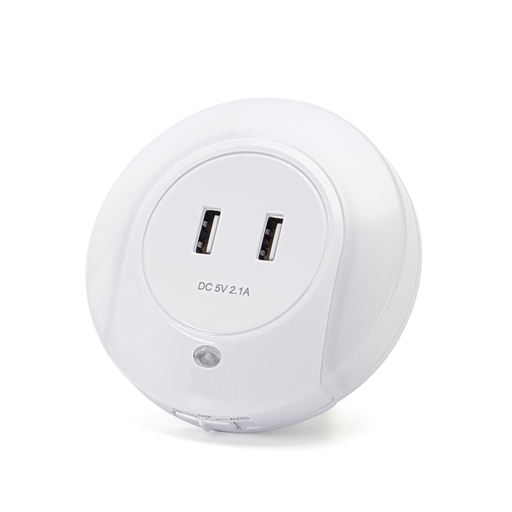
Why this product suits the profile: It combines warm white guidance lighting with two USB ports and is suitable for bedrooms, hallways or nurseries in dry indoor areas.
The product details specify 3000 Kelvin, 8 lumens and 0.4 watts instead of giving an unclear description of brightness. The instructions rule out use in damp environments.
Class II design according to the product description, 120-degree beam angle and two USB charging ports.
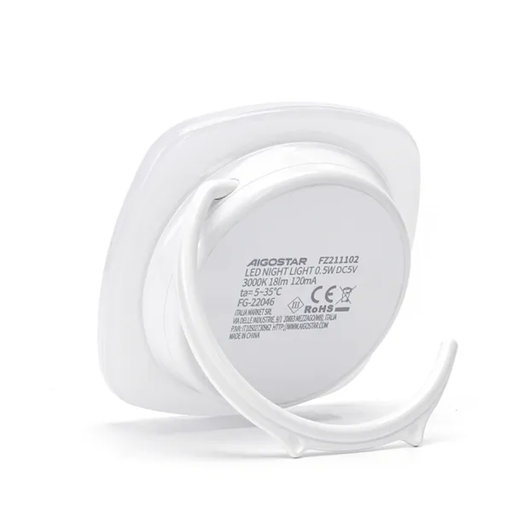
Why this product suits the profile: The rechargeable model is suitable for cupboards, hallways and areas without an easily accessible socket when light is only needed when movement is detected.
The combination of PIR and dusk sensors prevents the light from being activated by every movement in broad daylight.
500-mAh battery, USB charging, up to 6 hours of light when activated by movement and a detection range of 3.5 metres according to the product details.

Why this product suits the profile: The soft silicone casing, sloth shape and three brightness levels make it a good mobile children’s night light for bedrooms or nurseries.
The brightness can be adjusted across three levels. Charging time and runtime are also clearly specified, making battery requirements easier to plan for.
1200-mAh battery, Type-C charging port, charging time of around three hours and up to six hours of use at maximum brightness according to the product data.
We have put together a complete, regularly updated list of products that fully meet these strict selection criteria and the safety regulations applicable in the EU.
Consumption depends on power and operating time. A model rated at 0.4 watts uses 0.4 kWh over 1,000 operating hours in theoretical terms. With sensor operation, actual consumption may be lower because the light is not active continuously. Wattage, sensor control and daily usage time are therefore crucial for running costs.
That depends on where the light will be used. A motion sensor is suitable for hallways, stairs or cupboards where light is only needed when required. A dusk sensor is a good choice for areas that should remain subtly lit in the dark. Combining both sensors can reduce unnecessary activation.
Lifespan depends on the LED module, electronics, heat generation and usage. Depending on the model, the product details may specify 10,000, 15,000 or 25,000 hours, for example. These figures are manufacturer specifications and are not a guarantee of a particular service life in your individual household. For battery-powered lights, battery ageing must also be taken into account.
Ø polished.