
Lieferung heute & morgen

Qualitätsgarantie

Willkommens-Angebote freischalten: KOSTENLOSE Lieferung | Bis zu 80 % RABATT | Kostenlose 30-Tage-JoyPlus-Testphase
App herunterladen
An LED night light should provide enough light for orientation without unnecessarily brightening the room. At the same time, many families want a solution that does not require constant battery replacement, while adults are often looking for an LED table lamp for a bedside table, desk or living room. The choice ranges from small plug-in lights to portable, dimmable table lamps.
To avoid turning a practical purchase into a poor choice, it is worth checking the technical specifications and intended location. Marketing terms such as “soft”, “smart” or “particularly long-lasting” do not say much on their own. What matters are clear, verifiable details such as light colour, brightness control, power supply and IP rating.
A warm white night light of around 2700 to 3000 Kelvin will generally feel less cool than a 6500-kelvin light. The latter may be intended as a white orientation light for hallways or stairs, but that does not automatically make it suitable for every sleeping environment. With a children’s room night light, the light colour should suit how it will be used: warm light for short journeys and a more neutral setting for tasks where greater visibility is needed.
Terms such as “pleasant” or “eye-friendly” are not sufficient without a specific Kelvin or lumen figure. So check whether the manufacturer states the colour temperature and luminous flux in lumens.
With a cordless table lamp, battery life depends on brightness, light colour and battery capacity. “Up to” indicates a maximum figure under specific conditions. For planning purposes, it is also important to consider charging time, the charging connection and whether the lamp can be used while charging.
A rechargeable lamp with USB-C is practical if it is to be used flexibly around the room. However, in homes with small children, the charging cable should be positioned so that it cannot create a trip or pulling hazard.
A night light with a motion sensor switches on when movement is detected. This can be useful in a hallway or by the stairs, while a night light with a dusk sensor responds to ambient brightness and switches on automatically when it gets dark. Both systems need to be positioned appropriately.
If a sensor light is placed behind furniture or the sensor is covered, automatic control may become unreliable. With plug-in models, also make sure that the sensor is not blocked by curtains or decorations.
Low brightness settings are often sufficient for orientation. A dimmable table lamp is more versatile if it is to serve both as a bedside lamp and a reading light. Pay attention to the specific control method:
A table lamp with touch control should be placed on a stable, dry surface. In children’s rooms, it is also important to check whether the product specifications state that the lamp is suitable for children. The rechargeable model featured here is expressly not suitable for children under three years of age.
Plug-in night lights do not need a battery or regular charging. An Aigostar model plugs directly into a 220–240 V socket and, according to the product specifications, uses an integrated dusk sensor. By contrast, a mobile table lamp with a USB-C table lamp connection can be charged using a suitable mains adapter, computer or power bank.
Before buying, check:
Size determines whether a children’s room lamp will fit on a narrow shelf or bedside table. For damp areas, the IP rating is crucial. IP20 describes use in dry indoor spaces only and does not indicate water resistance.
For battery-powered lights, look for information about overheating, damage and suitable chargers. A battery must not be opened or modified. If it shows visible swelling or damage, stop using it.
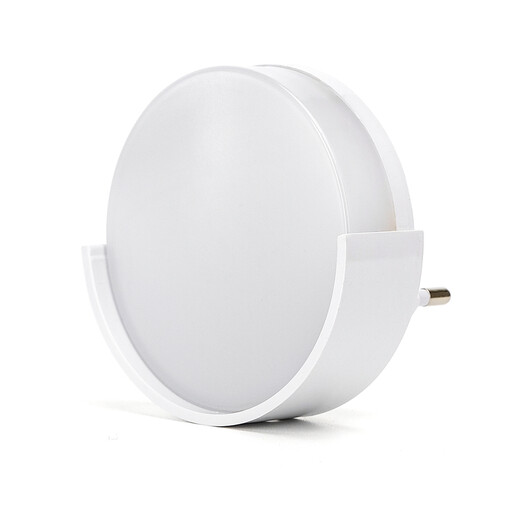
Why this product suits this profile: This plug-in model needs neither batteries nor a rechargeable battery and, according to the product specifications, switches on automatically below 20 lux.
Automatic brightness detection reduces the need for manual switching. Specific technical figures are provided: 1 W power consumption and 40 lm.
Plug-in operation, 6500 K light colour, 120° beam angle and stated IP20 indoor use.
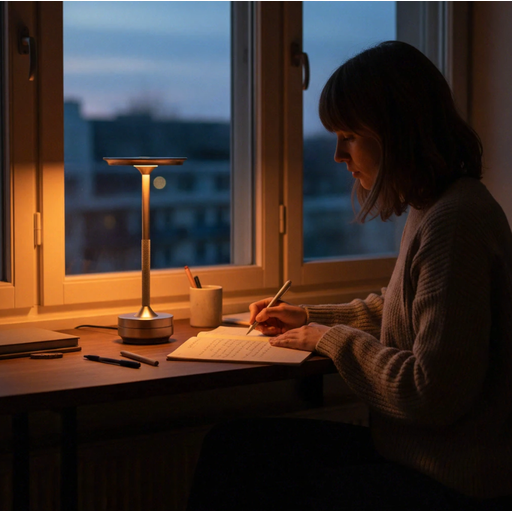
Why this product suits this profile: This portable light offers an adjustable colour temperature from 3000 to 6500 K and brightness control from 0 to 100 per cent.
Battery capacity, charging time and maximum operating time are clearly specified: 1800 mAh, around 3 hours’ charging time and up to 6 hours of operation.
USB-C connection, touch control, 28.5 cm height and use while charging, according to the product description.
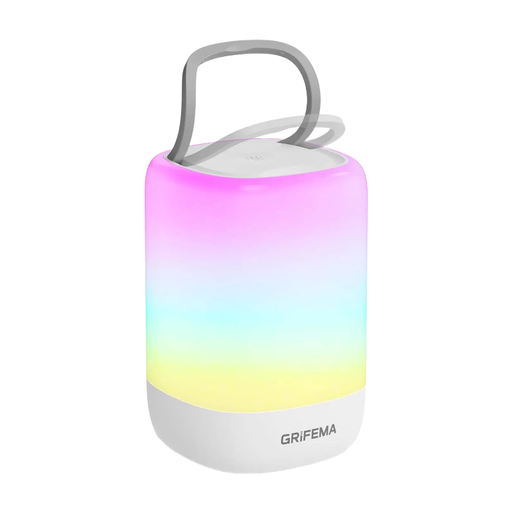
Why this product suits this profile: This compact model is designed for bedrooms, children’s rooms, camping and other flexible locations. It provides warm white light as well as seven RGB colours.
Dimming is controlled by holding the touch surface for longer, from 100 to 5 per cent. A 30-minute switch-off function and USB-C charging are also specified.
1500-mAh battery, touch control, RGB colour modes and silicone cover, according to the product specifications.
We have put together a complete, regularly updated list of products that fully meet these strict selection criteria and the safety regulations applicable in the EU.
An LED night light should be placed on a stable, dry surface or in a suitable socket. Cables should not run under carpets or extend into walkways. For battery-powered lights, use only a compatible charger and do not cover the lamp. Plug-in models with IP20 are intended exclusively for dry indoor spaces.
In a baby’s or child’s bedroom, lights should be positioned out of the reach of small children. A decorative table lamp made from ceramic, metal or plastic can be used as a children’s room lamp, but it is not automatically a toy. Check the recommended age, materials and operating instructions before buying.
Consumption depends on power rating and operating time. A 0.5 W model used for ten hours consumes approximately 5 Wh in theory. A 1 W light uses around 10 Wh over the same period. Battery-powered models also incur charging losses. For running costs, the stated wattage and daily usage time are therefore more relevant than general claims about energy efficiency.
That depends on the intended use. Warm white light between around 2700 and 3000 K is often perceived as more subtle and is suitable for orientation or a decorative table lamp. Cool white light around 6500 K can illuminate the surroundings more clearly. The specific choice should be based on the room, brightness and how you intend to use the light.
Product specifications often state service life in hours. For example, the Aigostar plug-in model is rated at 25,000 hours. This figure describes the intended service life of the light source under the stated conditions; it does not mean that the entire product, switch or battery will last just as long. With rechargeable lamps, you should also consider battery capacity and charging habits.