
Lieferung heute & morgen

Qualitätsgarantie

Willkommens-Angebote freischalten: KOSTENLOSE Lieferung | Bis zu 80 % RABATT | Kostenlose 30-Tage-JoyPlus-Testphase
App herunterladen
An LED night light should provide guidance at night without lighting up the room unnecessarily. Families look for different features than those needed to illuminate a wardrobe or kitchen. Common purchasing mistakes are not caused by the LED technology itself, but by unclear information about brightness, battery life, sensors and installation.
High light output is not automatically practical. In a baby’s room or bedroom, very bright light can be disturbing, while a wardrobe light with a motion sensor should provide enough brightness for finding your way around or locating items. Look for several brightness levels, a dimming function or clearly stated light output.
Manufacturer claims such as “up to several hours” often refer to a specific brightness level. With a rechargeable night light, you should also check the charging time, battery capacity and charging connection. A USB-C night light can usually be charged easily in everyday use with suitable power adapters, computers or power banks. For lights that are used continuously, a battery-powered model may be more suitable.
A night light with a motion sensor must be installed in the right place. Furniture, curtains or an unsuitable height can restrict detection. With adhesive lights, the condition of the surface is also crucial. On dusty, damp or uneven surfaces, the fixing may loosen. Before buying, decide whether you need wall mounting, magnetic attachment, adhesive tape or mobile use.
For bedrooms, baby rooms and children’s rooms, a warm white night light is often preferred. Depending on the model, warm white light is typically in the range of around 2,800 to 3,200 Kelvin in the product specifications. Neutral or cool white light may be more suitable for worktops, wardrobes and hallways.
A dimmable night light is useful if you want to use the same lamp both as subtle lighting for falling asleep and for brief orientation. An RGB night light also offers coloured modes. These are primarily a design and comfort feature; they do not automatically replace functional room lighting.
When comparing a rechargeable night light, you should check at least the following information:
An integrated battery reduces the need for disposable batteries, but it must be charged regularly. For an LED bedside lamp used every day, an easily accessible charging socket is particularly important.
A silicone night light feels comfortable in the hand and can provide a softer outer surface for decorative children’s lights. Silicone, ABS or PP are often combined. However, the material alone is not sufficient proof of safety. Check the manufacturer’s information on CE marking, intended use, power source and warnings.
The VIVREAL models mentioned here are stated to comply with CE and RoHS requirements. This is a product-specific manufacturer claim and should not be applied generally to other lights. Electrical night lights must not be placed in water and should be protected from excessive heat, damage and incompatible chargers. For products intended for young children, use under adult supervision should be observed.

Why this product suits the profile: This compact sloth-design LED night light is suitable for bedrooms, baby rooms or use as a portable light. Three brightness levels allow easy adjustment without complicated settings.
The three brightness levels avoid the inflexibility of a single fixed brightness. The integrated 1,200-mAh battery and stated usage time of up to 6 hours at maximum brightness make the power supply easy to understand.
Soft silicone combined with ABS and PP, USB-C connection, charging status indicator and dimensions of 15.8 × 12.3 × 7.1 cm.
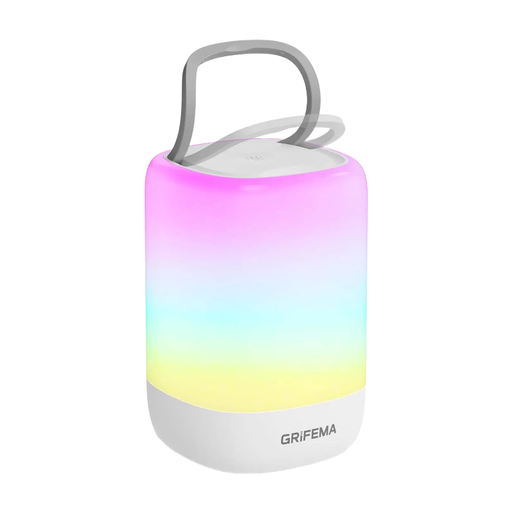
Why this product suits the profile: This portable LED bedside lamp combines touch control with warm white and coloured light. It fits neatly on a bedside table, in a child’s room or in your luggage when travelling.
Continuous dimming from 100 to 5 per cent offers more control than fixed brightness levels. The 30-minute timer can prevent the lamp from being left on unnecessarily.
USB-C charging, 1,500-mAh battery, stated battery life of up to 15 hours, seven RGB colours and warm white light.

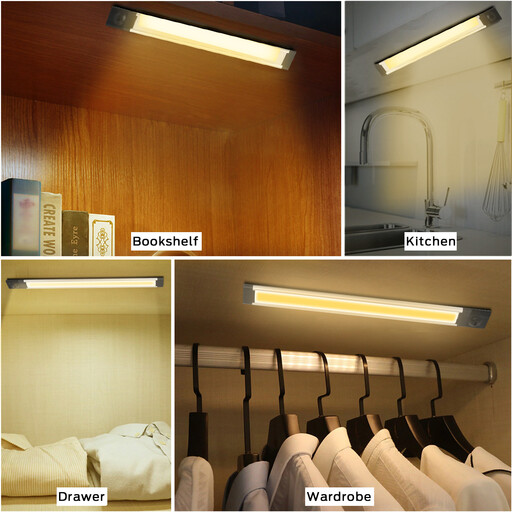
Why this product suits the profile: The two slim lights are designed for kitchens, wardrobes, shelves and hallways. The PIR sensor switches the lights on and off automatically when movement is detected.
The dimensions of 300 × 38 × 10 mm can be checked before installation. The stated detection range of 3 to 5 metres and three colour temperatures make the intended use clearer.
41 LEDs, 1,100-mAh battery, USB charging and tool-free adhesive-tape installation.
Why this product suits the profile: This model is suitable for hallways, staircases, wardrobes, baby rooms or storage rooms when touch-free operation is preferred.
Magnetic or hook attachment avoids drilling holes, but still requires secure installation. Brightness can be adjusted using gesture control.
36 Epistar-4014 SMD LEDs, stated output of 400 lm, adjustable colour temperature from 2,800 to 6,500 K and USB charging.
We have put together a complete, regularly updated list of products that fully meet these strict selection criteria and the safety regulations applicable in the EU.
Before installation, decide on the lighting effect you want to achieve. A children’s room night light should ideally be positioned so that the cable and charger do not become a trip hazard. Rechargeable lights should be charged out of the reach of young children and checked regularly for damage to the casing or battery.
For wardrobes and hallways, choose a position where the sensor covers the area of movement without being triggered constantly by passing vehicles, pets or sources of heat. With a permanently mounted wardrobe light with a motion sensor, the adhesive surface should be clean, dry and able to support the light securely.
Consumption depends on the power rating, brightness and operating time. A model rated at 0.9 or 2 watts uses comparatively little energy during brief nighttime use. With rechargeable lights, most of the electricity is used during charging. A timer or motion sensor can reduce the lighting time in everyday use.
This depends on the battery capacity, brightness level and age of the battery. Actual runtime may be lower than the manufacturer’s stated figure if the highest setting is used continuously. Check the charging time, usage duration and automatic switch-off information. If performance declines, the light should not be opened or the battery modified yourself.
Warm white light in the region of around 2,800 to 3,200 Kelvin is often chosen for bedrooms and baby rooms. Neutral white or cool white light can provide clearer visibility in wardrobes, on worktops and in hallways. A model with several colour temperatures is useful if you want to use one light in different areas.