
Lieferung heute & morgen

Qualitätsgarantie

Willkommens-Angebote freischalten: KOSTENLOSE Lieferung | Bis zu 80 % RABATT | Kostenlose 30-Tage-JoyPlus-Testphase
App herunterladen
An LED night light should provide guidance at night without unnecessarily brightening the room. However, choosing the right one is not always straightforward for families, people who need help finding their way at night, or anyone looking for a cordless indoor or outdoor light. Many product descriptions emphasise terms such as “smart”, “energy-efficient” or “long-lasting”, while leaving out key details.
Three common buying problems occur particularly often:
Brightness is measured in lumens (lm). Lower values are often sufficient for a guidance light in a hallway or bedroom than for a work or reading lamp. Colour temperature is described in Kelvin (K):
A dimmable night light, or a model with several brightness levels, can be adapted more easily to different situations. For a night light in a child’s room, rounded housings, a stable base and guidance on supervised use are also important.
A night light with a motion sensor switches on automatically when movement is detected. Check the range, detection angle and switch-off time. According to the product specifications, the 2-pack with PIR sensor detects movement from approximately 3 to 5 metres away and operates at an ambient brightness of no more than 20 lux.
An LED night light with a dusk sensor, by contrast, responds to the brightness in the room. According to the product description, an Aigostar plug-in model switches on below 20 lux and switches off again when there is sufficient light. A PIR sensor and a dusk sensor therefore perform different tasks: one responds to movement, while the other responds to ambient brightness.
A plug-in night light does not require a battery and is ready to use immediately, but depending on its design it may block part of the socket. A rechargeable night light can be used more flexibly, but needs to be charged regularly via USB or USB-C.
For bathrooms, balconies, patios or gardens, the IP rating is crucial. IP20 is intended for indoor use and offers no protection against water. IP44 or IP54 provide protection against splashing, depending on the design, but are not suitable for immersion. A solar garden light should be installed in a location with sufficient daylight, as its operating time depends on how much charge the solar panel receives.
The following recommendations categorise specific models by everyday situation and verifiable product specifications.
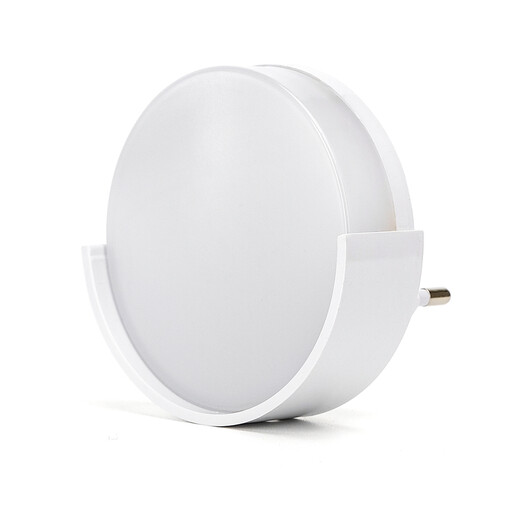
Why this product suits this profile: This compact plug-in night light works without batteries or a charger. It is suitable for indoor use in hallways, on stairs, in bedrooms or in children’s rooms.
The product specifications state the 20-lux switch-on threshold and the IP20 indoor protection rating. This makes it easier to identify the right place to use it before buying.
1 W power consumption, 40 lm, a 120° beam angle and a stated lifespan of 25,000 hours according to the product specifications.
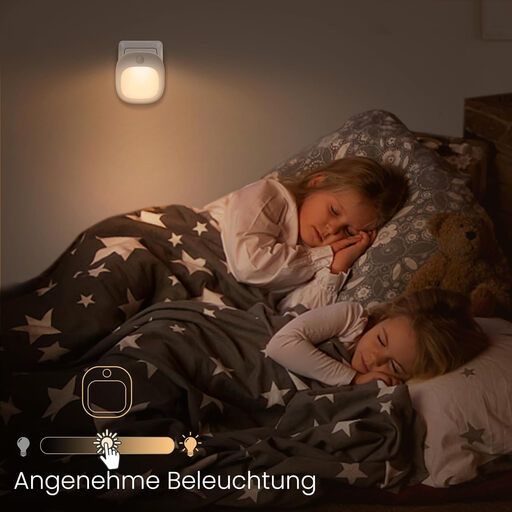
Why this product suits this profile: Two battery-powered lights with motion and dusk functions can cover, for example, a hallway and children’s room, or two sections of stairs.
The brightness can be adjusted across five levels. Warm white, neutral and cooler colour temperatures are also available, rather than offering just one fixed lighting mode.
30 lm, CRI above 85, a 500-mAh battery and up to 10 hours of operating time in sensor mode according to the product information; charging is via 5 V/1 A USB.
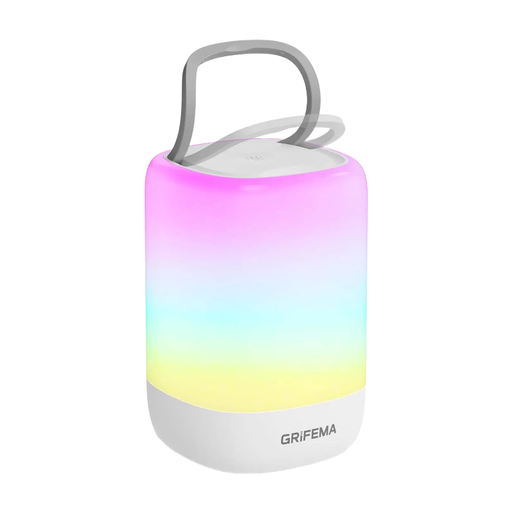
Why this product suits this profile: This cordless table lamp can be used in the bedroom, children’s room, while camping or as a decorative guidance light.
Brightness can be adjusted from 100% down to 5% using the touch control. A 30-minute timer can prevent the lamp from staying on continuously.
RGB colour selection, warm white light, USB-C charging and a 1500-mAh battery with up to 15 hours of operating time according to the product information.
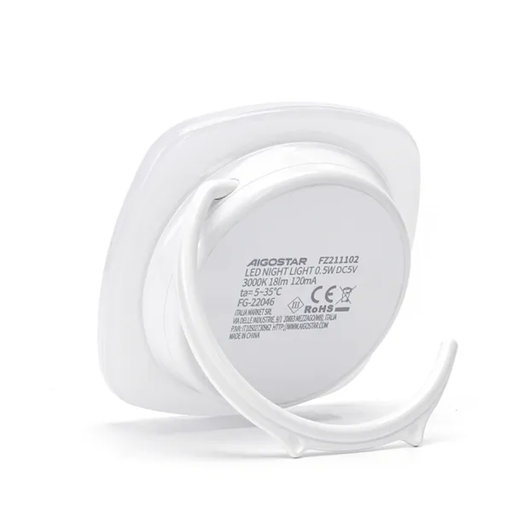
Why this product suits this profile: This compact model with a hook can be used in hallways, cupboards or beneath wall units when automatic activation is required.
The product data lists separate sensor specifications: a range of 3.5 metres and a 120° detection angle for the light. This makes it easier to plan where to position it.
3000 K warm white light, 18 lm, a 500-mAh battery and up to 6 hours of light when movement is detected, according to the product information.
For outdoor areas, a solar garden light is a different product category from a night light for the bedroom. The Aigostar model with a stainless-steel effect uses a polycrystalline solar panel, a NiMH battery and an IP44 rating. According to the product description, around 8 to 12 hours of illumination are expected after 4 to 6 hours of charging. The ground spike should be placed somewhere with direct sunlight. The panel may need cleaning.
For a balcony or patio, a cordless table lamp with 3000 K, USB-C charging and stepless dimming from 5% to 100% is a suitable alternative. However, the stated outdoor-use guidance for this model should be observed; according to the product information, it is not intended for use in high humidity or immersion in water.
We have put together a complete, regularly updated list of products that fully meet these strict selection criteria and the safety regulations applicable in the EU.
Consumption depends on the power rating and operating time. A model rated at 0.5 W uses approximately 5 Wh over ten hours of operation. Sensor mode can reduce actual consumption because the light is not active continuously. With battery-powered models, the energy required for charging must also be taken into account.
A colour temperature of around 2700 to 3200 K is often chosen for bedrooms, hallways and children’s rooms. Whether the brightness is suitable depends on the room and your personal needs. A dimming function or several brightness levels offers more flexibility than a fixed light intensity.
Some products state the LED lifespan in hours, for example 10,000 or 25,000 hours. With rechargeable models, battery capacity is also important. Actual operating time varies depending on brightness, sensor mode, charge level and frequency of use. For outdoor lights, sunlight and weather conditions also affect the available illumination time.