
Lieferung heute & morgen

Qualitätsgarantie

Willkommens-Angebote freischalten: KOSTENLOSE Lieferung | Bis zu 80 % RABATT | Kostenlose 30-Tage-JoyPlus-Testphase
App herunterladen
An LED night light with a motion sensor switches on automatically when someone enters the room. It’s handy in hallways, on stairs, beside the bed or inside a kitchen cupboard. However, models can differ considerably in sensor range, power supply, brightness and installation.
If you focus only on a high number of LEDs or a particularly low price, you can easily overlook important details. Here are three common buying mistakes:
A PIR sensor detects movement by registering changes in heat radiation. The key is whether the stated detection range suits the intended location. A range of 3 to 5 metres may be enough for a short hallway. In a larger room, you should also consider the detection angle.
Check the shut-off delay, too. With a model that switches off automatically after around 20 seconds, the light won’t stay on unnecessarily. A dusk sensor or a setting that activates the light only in the dark can help reduce power consumption further.
A rechargeable night light with a USB port can be charged using a mains adaptor, laptop or power bank. However, battery capacity alone doesn’t tell you exactly how long the light will run. Brightness, how often the sensor is triggered and the operating mode all affect run time.
A battery-powered night light is a good choice if you don’t want to rely on a charger. Check whether batteries are included and which size you need. A USB night light may be more convenient in cupboards or hallways that are used frequently, while battery-powered models offer flexibility in less-used areas.
A warm white night light in the region of 2,800 to 3,200 Kelvin creates a softer feel in living rooms and bedrooms. Neutral or cool white light may be more suitable for LED cupboard lighting, a kitchen under-cabinet light or finding things in drawers.
A dimmer function gives you more ways to use the light. Some models offer several brightness settings. Adhesive strips, magnets and hooks are common ways to install a light without drilling. Magnetic fittings make it easier to remove the light for charging. Clean the surface and let it dry completely before fitting the light.
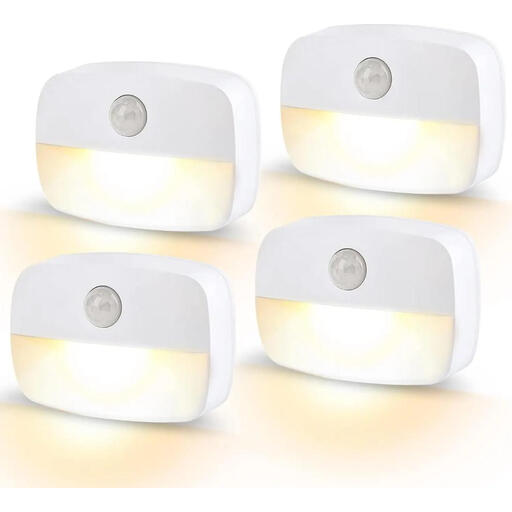
Why this product suits this profile: Four lights let you illuminate several areas, such as a hallway, cupboard, stairs and bathroom. Each light is powered by three AAA batteries.
The specifications state 35 lumens, warm white light at 2,800 to 3,200 Kelvin and automatic shut-off after 20 seconds. This makes it easier to assess how the light performs, rather than relying on marketing claims alone.
Four lights, a 120° detection angle and no-drill installation with double-sided adhesive tape.
Why this product suits this profile: With 400 lumens, adjustable light colour and gesture control, this light is well suited to anyone looking for a flexible option for different rooms.
The product specifications state the brightness as 400 lumens and give a colour temperature range of 2,800 to 6,500 Kelvin. It can be fitted with a magnet or hook, without screws.
Aluminium and ABS casing, PMMA light guide, gesture control and stepless dimming, according to the product description.

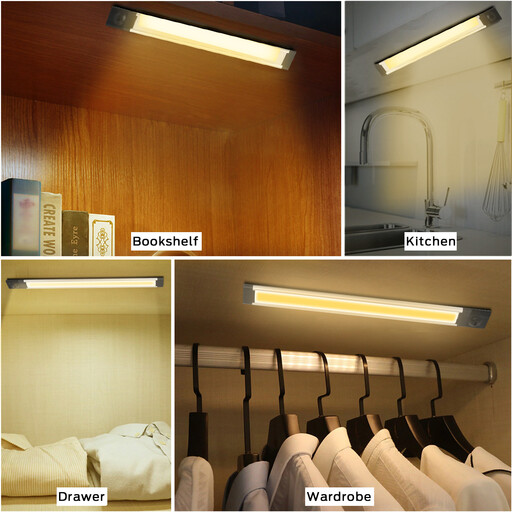
Why this product suits this profile: Its elongated design is intended for wide kitchen cupboards, wardrobes or shelves. The two lights can be used in different areas.
The light measures 400 × 38 × 10 millimetres, so you can check before buying whether it will fit the intended space. The PIR sensor range is listed as 3 to 5 metres.
61 LEDs, three colour temperatures and a built-in 1,100 mAh battery with USB charging, according to the product description.
An LED light that requires no drilling should be attached to a stable, grease-free surface. Position the sensor and light so that furniture edges or doors don’t obstruct detection. In bathrooms, check whether the model is suitable for damp conditions. Many indoor lights are not designed to withstand splashes.
Rechargeable lights should only be charged using compatible USB power sources. Do not open or modify the casing. Stop using the light if you notice visible damage, unusual heat or a swollen battery. For a night light for a child’s room, small parts, cables and charging accessories should also be kept out of reach of young children when unsupervised.
We’ve put together a complete, regularly updated list of products that meet these strict selection criteria and fully comply with the safety regulations in force in the EU.
Choose a clean, dry and preferably smooth surface. Point the sensor towards the expected path of movement, making sure it isn’t blocked by doors or other objects. Once the light is installed, test that it works from different distances.
Run time depends on battery capacity, brightness and how many times the light is triggered. According to the product specifications, a 500 mAh model can last up to 10 hours in sensor mode. Treat this as a guide, as actual performance may vary in everyday use.
If the light only comes on when it detects movement and switches off again shortly afterwards, it may run for less time than a lamp that stays on continuously. Actual power consumption depends on the wattage, how often it switches on, its brightness and its power source. So the number of LEDs isn’t the only thing that matters: the sensor, shut-off time and operating mode all work together.