
Lieferung heute & morgen

Qualitätsgarantie

Willkommens-Angebote freischalten: KOSTENLOSE Lieferung | Bis zu 80 % RABATT | Kostenlose 30-Tage-JoyPlus-Testphase
App herunterladen
An LED night light with motion sensor can provide guidance at night without having to leave the main lighting switched on continuously. However, there are various options for hallways, stairs, bedrooms, children’s rooms and cupboards: plug-in models with twilight sensors, battery-powered lights, rechargeable versions and RGB night lights.
Not every light is suitable for every location. Before buying, you should therefore check the sensor type, light output, power supply and whether the light is suitable for dry indoor areas.
A motion-sensor night light switches on when movement is detected. By contrast, a night light with a twilight sensor responds to the ambient light level and often remains switched on continuously when it is dark. Some products combine both functions, while others have just one sensor.
For a hallway that should only be illuminated when someone walks through it, a PIR motion sensor is usually the more suitable choice. For a socket next to a child’s bedroom or in an entrance area, a twilight sensor may be more practical.
Light output is measured in lumens (lm). A value of 18 to 35 lm is typically suitable for subtle orientation lighting, but it does not replace room lighting. Colour temperature, beam angle and mounting position are also important.
A warm white night light of around 2,800 to 3,200 Kelvin is often perceived as more discreet than cool white light. An RGB night light offers changing colours, but that does not automatically make it the most suitable option for glare-free orientation.
A battery-powered night light can be installed independently of power sockets. However, the batteries need to be checked and replaced regularly. Rechargeable models, on the other hand, require a USB connection and time to recharge.
With plug-in models, there is no need to replace batteries. However, they require an available socket and should be positioned so that the sensor and LED are not obscured by furniture, curtains or dust.
For PIR sensors, detection range, detection angle and switch-off delay are important specifications. According to the product details, the Aigostar model with PIR sensor detects movement up to 3.5 m away and has a detection angle of 120 degrees. The actual range depends, among other things, on the installation height, direction of movement and layout of the room.
A shorter range is often sufficient for cupboards and short hallways. A wider angle can be more useful on stairs or in longer passageways.
The lumen rating describes the luminous flux. An 18-lm night light is designed for localised orientation lighting, while 30 to 35 lm can illuminate a slightly larger area. In bedrooms and children’s rooms, the light should not be installed directly at eye level or facing the bed.
The warm white night lights available in the selection include models with 3,000 Kelvin and others with 2,800 to 3,200 Kelvin. RGB models are more suitable when a decorative lighting effect is also desired.
A plug-in LED night light runs directly on 220 to 240 V. Check whether the light is intended exclusively for dry indoor areas. The Aigostar plug-in model is rated IP25, but the product information expressly advises against exposure to water and moisture.
A simple calculation helps with energy consumption: a device with a power rating of 0.5 W theoretically uses 0.5 kWh over 1,000 operating hours. An energy-saving night light with a twilight sensor can therefore operate continuously with low power consumption. For battery-powered lights, you should also take battery costs and the desired lighting duration into account.
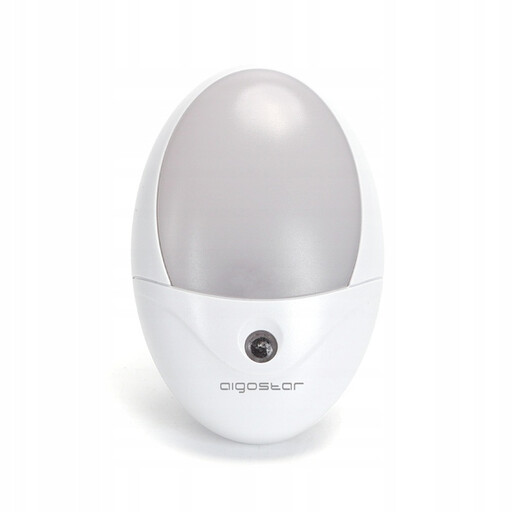
Why this product suits this profile: This plug-in light requires neither batteries nor USB charging and, according to the product description, switches on and off depending on the ambient light level. This makes it suitable for hallways, bedrooms and children’s rooms with an available socket.
The sensor type is clearly identified as a twilight sensor. This makes it clear that the light does not respond only to movement, but also activates automatically when it is dark.
1 W power consumption, 20 lm luminous flux, 3,000 K warm white light and operation at 220–240 V.
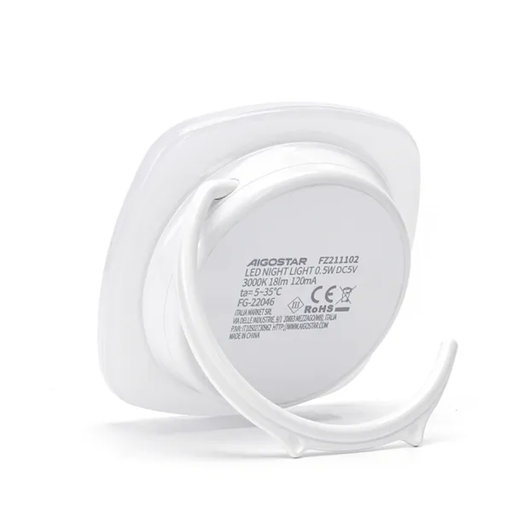
Why this product suits this profile: The combination of PIR and twilight sensors enables movement-activated use in dark surroundings. USB charging and a 120-degree beam angle support flexible installation in hallways, cupboards or beneath wall cabinets.
The product details specify the sensor angle, range, colour temperature and luminous flux. This makes it easier to compare the light’s suitability with the intended installation location.
0.5 W LED, 18 lm, 3,000 K, 500-mAh battery, USB charging and a stated range of up to 3.5 m.
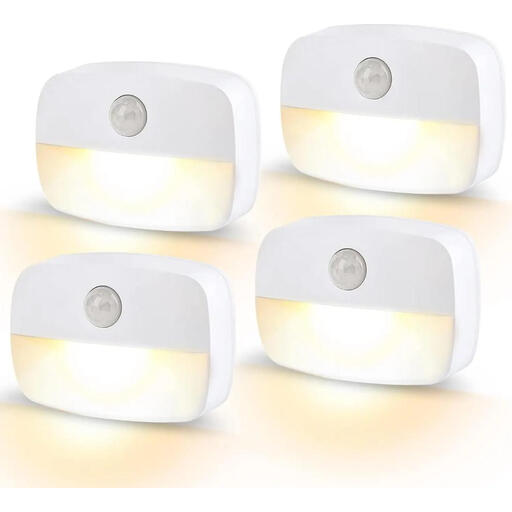
Why this product suits this profile: The four-pack is suitable for several areas, including stairs, hallways, cupboards and bathrooms outside wet zones. The adhesive-strip installation is designed for rented homes and locations without a power socket.
The three AAA batteries required for each light are clearly specified and are not included. The automatic switch-off after 20 seconds is also stated transparently.
Four lights, 35 lm, warm white light at 2,800–3,200 K, 120-degree sensor angle and tool-free installation.
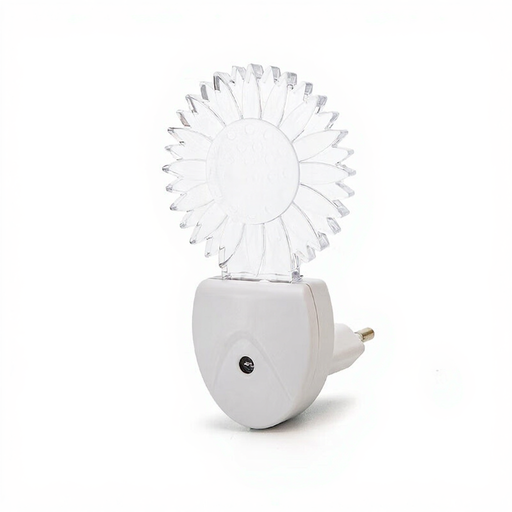
Why this product suits this profile: This RGB night light combines a twilight sensor with a decorative design. It is intended for dry indoor areas such as hallways, bedrooms and children’s rooms, and plugs directly into a 230-V socket.
The product data specifies the maximum power consumption of 0.5 W, the sensor threshold of less than 20 lux and the intended use in dry indoor areas.
RGB light, 30 lm, twilight sensor, 0.5 W maximum power consumption and a stated lifespan of 25,000 hours.
We have put together a complete, regularly updated list of products that fully meet these strict selection criteria and the safety regulations applicable in the EU.
Many models do not require manual setup. Once the batteries have been inserted, the light has been switched on or it has been charged via USB, movement activates the light. It is important to keep the sensor area clear and choose an installation height that allows the detection range to cover the desired route. A twilight sensor also requires sufficiently dark surroundings.
Runtime depends on the battery type, how often the light is triggered, lighting duration and light output. It is therefore not possible to give one general figure in hours for every product. Models with a short switch-off time, such as the stated 20-second setting of the VIVREAL set, can use less energy per activation when used occasionally.
Running costs depend on power consumption, operating time and your electricity tariff. A night light with a power rating of 0.5 W theoretically uses 0.5 kWh over 1,000 hours. Battery-powered versions also incur the cost of replacement batteries, while a USB model needs to be recharged regularly. The key factor is therefore not just the wattage, but also the actual time the light is switched on.