
Lieferung heute & morgen

Qualitätsgarantie

Willkommens-Angebote freischalten: KOSTENLOSE Lieferung | Bis zu 80 % RABATT | Kostenlose 30-Tage-JoyPlus-Testphase
App herunterladen
An LED night light with motion sensor can automatically provide guidance in hallways, children’s bedrooms and bedrooms. However, not every model is suitable for every location. A plug-in sensor light works differently from a rechargeable night light with magnetic mounting. Brightness, colour temperature and ingress protection are also often overlooked when making a purchase.
The following points will help you avoid common buying mistakes and choose a night light with sensor that suits your living situation.
A motion sensor responds to movement, usually within a specific detection angle and defined range. A night light with dusk sensor, on the other hand, switches on depending on the ambient light level. Some models combine both functions: they only illuminate in darkness and also respond to movement.
For a hallway where light is only needed when someone walks past, this combination is often more practical than a continuously illuminated guide light. In a child’s bedroom, however, a dim, continuously lit light may be more comfortable.
Luminous flux is measured in lumens (lm). A model with 400 lm is more suitable for a larger area, such as a cloakroom, staircase or workshop. For a bedroom or child’s bedroom, 18 to 40 lm may be enough to provide orientation without brightly lighting the whole room.
Light distribution is also important. An PMMA light guide plate can distribute light more evenly. With small plug-in models, the position of the device is particularly important: if furniture or curtains cover the sensor, detection may be restricted.
A plug-in night light needs neither a battery nor a charging cable, but it may block the second socket. A wireless LED night light can be mounted more flexibly on a cupboard, wall or staircase, but it needs to be recharged regularly.
Before buying, you should therefore answer the following questions:
With a PIR sensor, motion detection is usually described by the detection range and detection angle. A model with a range of up to 3 m and a 120° angle is designed for short hallways or bathrooms. For a long staircase, a greater range or a second light may be useful.
Also pay attention to the switch-off time. A light that switches off after 60 seconds without movement saves energy and prevents unnecessary continuous illumination. For cupboard lighting with a motion sensor, the response time should be short so that the interior is visible as soon as the door is opened.
Colour temperature is measured in Kelvin (K):
A warm white night light with 2700 to 3000 K is often perceived as less intrusive than cool white light. A dimmable night light is worth considering for flexible use. The product details should specify particular dimming levels or a brightness range, such as 10 to 100 per cent.
For plug-in models, note the 220 to 240 V supply and the intended indoor use. The IP20 protection rating means that the product is not protected against water. It should therefore not be used in the immediate vicinity of a shower, washbasin or outdoors.
For patios, entrances or balconies, an explicitly designated IP44 light is more suitable. IP44 protects against solid foreign objects measuring 1 mm or more and against splashing water. The installation and safety instructions for the particular product remain decisive in every case.
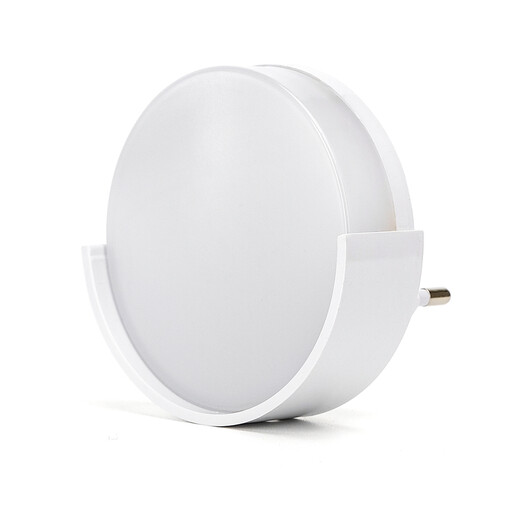
Why this product suits the profile: This plug-in model uses a dusk sensor and needs neither batteries nor charging. It is suitable for hallways, children’s bedrooms or staircases when you want an automatic guide light that is simple to install.
The product details explicitly state the activation threshold of below 20 lux and indoor use with IP20 protection. This makes it easier to assess the intended application.
1 W power consumption, 40 lm luminous flux, 6500 K and a stated lifespan of 25,000 hours.
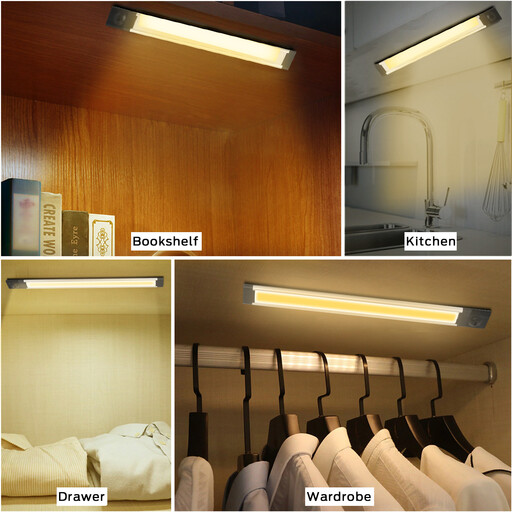
Why this product suits the profile: Measuring 26 x 4 x 1 cm, this LED light offers magnetic mounting and an adjustable colour temperature from 2800 to 6500 K. It is suitable for bedrooms, nurseries, wardrobes or hallways when different brightness levels are required.
The material, dimensions, luminous flux and colour temperature are all specified clearly. The light is designed for drill-free installation using a magnet or hook.
36 SMD LEDs, 400 lm, gesture control with dimming and PMMA light guide plate.
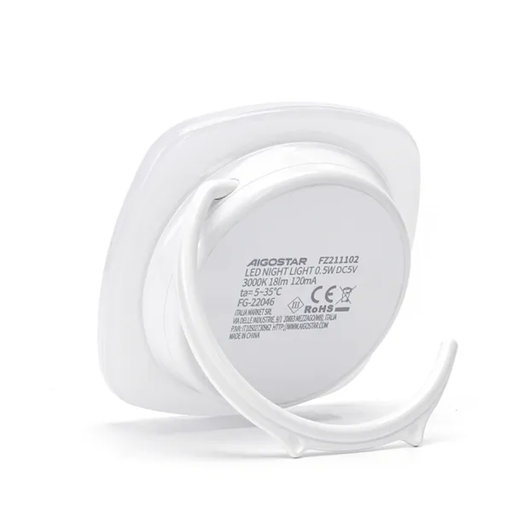
Why this product suits the profile: This rechargeable night light is designed for cupboards, hallways or under-cupboard mounting and can be installed without a permanent socket. Its compact design makes it suitable for adding light points in several areas.
The 500 mAh battery capacity, USB charging function and 3.5 m detection range are specified. This makes it easier to plan the maintenance required before buying.
3000 K warm white, 18 lm, USB charging and PIR detection for indoor use.

Why this product suits the profile: This battery-powered LED wall light with motion sensor is designed for entrance areas, patios and gardens. Magnetic mounting and a USB cable mean it does not depend on a permanent socket.
The IP44 protection rating is specified. This distinguishes the light from indoor-only IP20 models; direct jets of water and immersion must still be avoided.
300 lm, 3000 K, integrated battery, magnet and USB connection with 4 W power consumption.
We have put together a complete, regularly updated list of products that fully meet these strict selection criteria and the safety regulations applicable in the EU.
A sensor should not be positioned directly behind a piece of furniture, curtain or cover. With a plug-in model, the socket must be mechanically undamaged and suitable for 220 to 240 V. In a child’s bedroom, the light should be positioned so that cables, power supplies and small parts are out of reach.
For staircases and hallways, mounting the light at an even height is advisable. In cupboards, the sensor should point towards the opening movement. Lights with magnetic mounting require a stable contact surface. Before cleaning, disconnect the device from the power supply or switch it off; a soft, dry cloth is generally sufficient.
Consumption depends on the power rating, operating time and sensor control. A model rated at 0.3 W or 0.5 W uses less energy when activated for short periods than a light that remains on continuously. A motion or dusk sensor can limit operating time, but it does not replace checking the specific wattage.
In principle, an LED night light for children’s bedrooms can be used if it is designed for indoor use and installed safely. Warm white colours between 2700 and 3000 K and low brightness are often suitable for night-time orientation. The product should not be used as a toy and must not be covered.
The stated LED lifespan is a guideline based on the product data and depends on usage, heat dissipation and the surrounding environment. For battery-powered models, the capacity of the integrated battery is also relevant. A plug-in model does not need recharging, while a rechargeable night light requires regular charging cycles.