
Lieferung heute & morgen

Qualitätsgarantie

Willkommens-Angebote freischalten: KOSTENLOSE Lieferung | Bis zu 80 % RABATT | Kostenlose 30-Tage-JoyPlus-Testphase
App herunterladen
An LED night light with motion sensor can make the journey to the bathroom at night, finding your way in the hallway or reaching into a kitchen cupboard much easier. At the same time, models differ significantly in terms of sensor technology, power supply, light colour and installation. If you only focus on a high number of LEDs or a particularly low price, you may end up buying a light that doesn’t work reliably in its intended location.
A PIR sensor light reacts to detected movement. With many models, activation is also linked to the ambient brightness. If a twilight sensor is missing or the sensitivity isn’t right, the lamp may switch on during the day or stay off in a dark area.
So look out for specific details on:
The number of LEDs alone doesn’t describe the light output. More meaningful are lumens, light distribution and installation position. A small light with 18 or 30 lm may be sufficient for a cupboard, whereas a longer hallway or work surface needs more light. A light with 400 lm, however, isn’t automatically suitable for a bedroom if the light feels too bright there.
A wireless night light can be powered by AAA batteries or a built-in rechargeable battery. With battery-operated models, ongoing costs arise from replacement batteries. A rechargeable LED night light, on the other hand, regularly needs a USB charger, power bank or computer connection.
Before buying, also check whether batteries or a charging cable are included. According to the product information, the VARTA Motion Sensor Slim Light (Upgrade) does not include batteries. The VIVREAL model requires three AAA batteries, which also need to be purchased separately.
For sleeping areas, stairs and a night light for children’s rooms, warm white light in the range of around 2700 to 3200 K is often chosen. For an LED under-cabinet light in the kitchen, neutral white or cool white light can be more practical if objects and work surfaces need to remain clearly visible.
Models with multiple colour temperatures offer more flexibility. According to the product data, the 20 cm cabinet light in a 2-pack features warm white light at 2800–3200 K, natural white at 4500–5000 K and cool white at 6500–7000 K. A dimming function is particularly handy when the same lamp is used during the day as an LED cupboard light with motion sensor and at night as a subtle orientation light.
With a rechargeable battery, the capacity, charging port and stated runtime in sensor mode all matter. A 500 mAh battery is compact and suitable for short nighttime uses. A 1100 mAh battery can allow longer intervals between charges with comparable use. However, the actual runtime depends on the frequency of triggers, brightness and operating mode.
A USB night light should be charged at the specified voltage. For several products in the selection, 5 V is given as the charging source. Only use compatible USB power sources and follow the safety instructions of the respective manufacturer.
For inside cupboards and shelf surfaces, flat light strips are ideal. The 20 cm, 30 cm and 40 cm models in the selection are each 10 mm deep and are attached with adhesive tape without drilling. Before mounting, the surface must be clean, dry and load-bearing. On delicate wallpaper or porous surfaces, adhesive tape may behave differently than on smooth furniture surfaces.
For rented accommodation, an adhesive or magnetic solution is often simpler than a screw-mounted one. On stairs or in walkways, the light should be fixed so that it cannot fall down and create a trip hazard.

Why this product fits the profile: The 2-pack is suitable for two cupboards, shelves or a short hallway. It is mounted with adhesive tape without drilling.
The product data specifies PIR detection with a 3–5 m range, three colour temperatures and a built-in 800 mAh battery. This means key buying criteria are clearly stated.
20 cm length, 21 LEDs, USB charging function and two lights per pack.
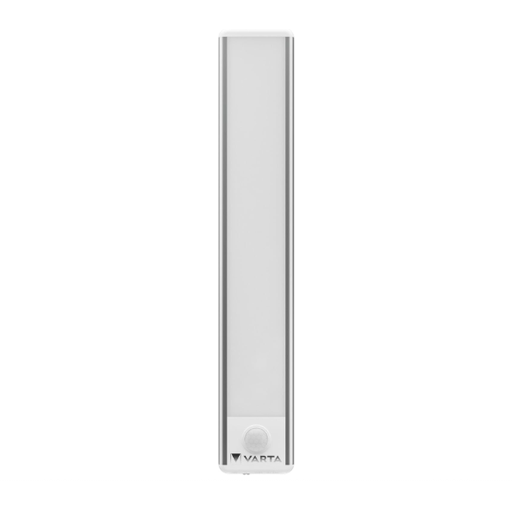
Why this product fits the profile: The light is intended for cupboards, hallways and stairs, and can be stuck on or screwed in place.
The product description mentions an automatic shut-off and two mounting methods. This allows the installation to be adapted to the location.
Slim format of 24 × 4 × 1.66 cm, motion sensor and self-adhesive or screw-mountable fixing.
Why this product fits the profile: Two longer light strips are suitable for kitchen wall cupboards, wardrobes or several rooms with regular movement needs.
Length, number of LEDs, range, battery capacity and charging parameters are listed in the product data. This makes it easier to match the light to the planned mounting surface.
30 cm length, 41 LEDs, 1100 mAh battery, three colour temperatures and PIR range of 3–5 m.
We have put together a complete, regularly updated list of products that fully meet these strict selection criteria and the safety regulations in force in the EU.
A PIR sensor detects changes in heat radiation caused by moving people. Depending on the model, the light is only activated when the ambient brightness is low and switches off again after a set time without movement.
That depends on the battery capacity, brightness level and number of triggers. The product data for the 500 mAh model states up to 10 hours in sensor mode; other models give up to 6 hours. These figures are manufacturer values for the respective operating conditions.
LED lights with a short switch-on time use relatively little energy in sensor mode. With battery models, however, ongoing costs arise from battery replacement. A USB or rechargeable model can be a sensible choice if the light is triggered frequently and a charging source is available.