
Lieferung heute & morgen

Qualitätsgarantie

Willkommens-Angebote freischalten: KOSTENLOSE Lieferung | Bis zu 80 % RABATT | Kostenlose 30-Tage-JoyPlus-Testphase
App herunterladen
An LED night light with motion sensor is designed to provide light exactly when you need it at night – without a switch, harsh ceiling lights or unnecessary continuous operation. In British homes, it is commonly used in bedrooms, children's rooms, hallways, staircases, bathrooms or wardrobes. However, not every sensor night lamp is suitable for every room.
If you only focus on a low price or a high lumen count, you often overlook important details. The following points will help you avoid typical buying mistakes and choose the right automatic night lighting.
A night light motion sensor can also activate during the day if it only detects movement. For hallways or bedrooms, this is usually unnecessary. A combination of motion detection and a brightness sensor is far more practical. In this case, the light only switches on when the ambient light is low.
Look for specific details such as "activates at ≤20 lux" or a separately described twilight function. If the range and trigger threshold are completely missing, it is difficult to assess how the product actually works.
High brightness is not automatically a good thing. A night light for the bedroom should provide orientation without unnecessarily illuminating the room. For short trips, low to medium brightness levels are often sufficient, depending on where it is mounted. A dimmable night light offers more flexibility than a model with only one fixed light level.
Colour temperature also affects how you use it. A warm white night light of around 2700 to 3000 Kelvin is often chosen for sleeping areas. More neutral values between 4000 and 4500 Kelvin can provide clearer orientation in hallways, bathrooms or entrance areas. Claims about eye protection or effects on sleep should not be taken as technical facts without verification.
A model that sits permanently in a socket is practical for a hallway with an existing socket. For wardrobes, shelves or areas without a socket, a battery-operated night light or a USB night light with a rechargeable battery is more suitable. Check before you buy:
Magnetic mounts are flexible, but they need a suitable metal surface. Adhesive pads may be less reliable on delicate or uneven surfaces.
A stated range of, for example, 3 to 5 metres does not automatically describe every movement situation. Walls, furniture and the mounting angle all affect detection. For a short hallway, a moderate range is sufficient. On staircases or in larger rooms, the sensor should be positioned so that the direction of movement is as perpendicular as possible to the detection area.
The unit lumens (lm) describes the light output. A higher value means more light is emitted, but it does not necessarily mean it is better suited as a night light. A night light for the bathroom or a wardrobe requires a different brightness level than one for an external wall.
Stepless touch dimming or several brightness levels make adjustment easier. Models with a memory function save your last chosen setting. Also check whether the manufacturer specifies the colour temperature in Kelvin and, where applicable, the colour rendering index (CRI or Ra) .
For dry indoor rooms, a model without any special moisture rating is usually sufficient. In the bathroom, the light may only be used in accordance with the specified protection rating and the installation zone. For outdoor areas, an IP rating is required. IP44 means protection against solid objects larger than 1 millimetre and against splashing water from any direction. It is not a guarantee against submersion, high-pressure water or unprotected continuous exposure to rain.
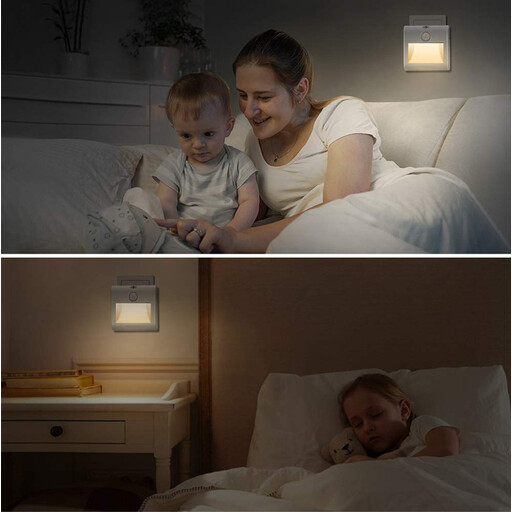
Why this product fits the profile: The 2-pack is ideal for households wanting to equip bedrooms, hallways or toilets at the same time. The socket-mounted design requires no additional installation.
The product details mention two operating modes, activation at ≤20 lux and a range of 3 to 5 metres. This makes it easier to assess the sensor function before buying.
1 W power consumption, 20 lm brightness and stepless touch dimming with memory function according to the product description.
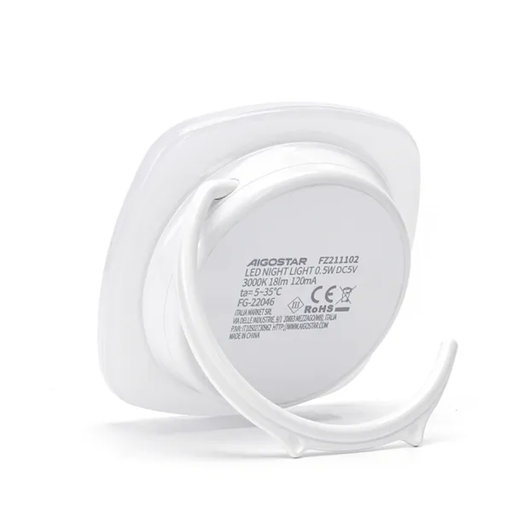
Why this product fits the profile: For wardrobes, hallways or under-cupboard spaces without a permanently occupied socket, this compact USB-rechargeable design offers a flexible solution.
The specifications list both a PIR motion sensor and a twilight sensor. This means the automatic night lighting is not solely dependent on movement.
500 mAh rechargeable battery, USB charging, 18 lm, 3000 K, 120-degree beam angle and a stated sensor range of 3.5 metres.
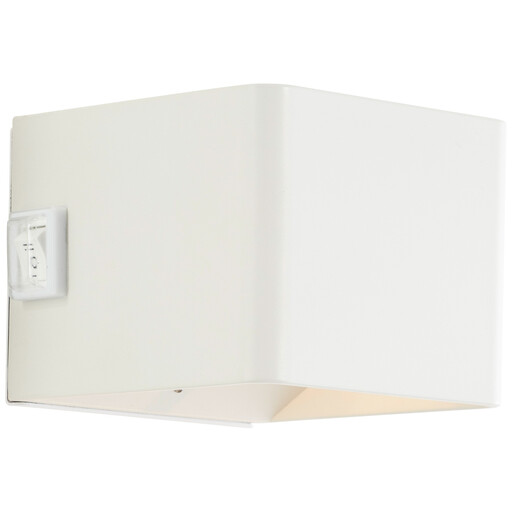
Why this product fits the profile: For entrance areas, patios or garages, this mobile sensor light is suitable for both indoor and outdoor use, provided the mounting and protection guidelines are followed.
The IP44 rating, integrated rechargeable battery and USB cable are all clearly stated. This means the light is not the same as a model intended only for dry indoor rooms.
300 lm, 3000 K, integrated rechargeable battery, magnetic mount, USB connection and IP44 according to the manufacturer's specifications.
We have put together a complete, regularly updated list of products that fully meet these strict selection criteria and the safety regulations in force in the EU.
The consumption depends on the power, lighting duration and operating mode. A model with 1 W uses 1 Wh when running continuously for one hour. In sensor mode, it usually only lights up intermittently, which can mean the actual consumption is lower. For rechargeable or battery models, charging losses or battery replacement also need to be considered.
For a hallway, a position where the sensor can detect the walking path is recommended. In the bedroom, the light should not be directed at eye level or towards the bed. In the bathroom, the distance to water sources and the specified protection rating are crucial. On staircases, the detection area should not be blocked by handrails or walls.
The actual lifespan depends on operating hours, heat dissipation, electronics, battery quality and the environment. LED components do not necessarily fail at the same time as the sensor or battery. Therefore, do not only look at the advertised lifespan, but also consider warranty information, the availability of spare parts and the type of power supply.