
Lieferung heute & morgen

Qualitätsgarantie

Willkommens-Angebote freischalten: KOSTENLOSE Lieferung | Bis zu 80 % RABATT | Kostenlose 30-Tage-JoyPlus-Testphase
App herunterladen
An LED night light with motion sensor should switch on when you need it – and otherwise stay off. In practice, however, poor purchases often happen because of unclear information about range, power supply or installation. That's why it's worth taking a close look at the technical specifications, especially for hallways, bedrooms, children's rooms, bathrooms, staircases and entrances.
A stated range of several metres alone tells you little about the actual coverage. What also matters are the detection angle, mounting height and direction of movement. A PIR motion sensor reacts to changes in infrared radiation. Movements across the sensor are often detected differently from a direct approach.
For a narrow hallway, a night light with motion sensor with a limited angle can be sufficient. In an entrance area or under a carport, however, a wider detection range makes more sense. Ceiling-mounted models can monitor a room from several directions, while a wall light with motion sensor is more precisely aimed at a passageway.
A light with a high lumen count isn't automatically right for every situation. In a bedroom or children's room, moderate brightness can be more pleasant than a very bright lamp. For kitchen worktops, cellars or staircases, on the other hand, more light may be needed.
Pay attention to the colour temperature:
A dimmable night light or a model with several brightness levels can be adapted more flexibly to the room. Figures such as lumens and Kelvin are more meaningful here than general advertising claims about "gentle" or "powerful" lighting.
A battery-powered model can be mounted without drilling, but it needs to be charged regularly. So check the battery capacity, charging port and stated run time. A USB rechargeable night light can be charged via a mains adapter, laptop or power bank. For frequently used passageways, a hardwired system is often more practical.
A wired 230 V motion sensor is integrated directly into the electrical installation. Mounting and wiring must be carried out in accordance with current national regulations and should be done by a qualified electrician. Before working on the electrical system, the power supply must be disconnected at the fuse box.
A PIR motion sensor typically detects heat movements. An additional twilight sensor can prevent the light from activating when there is sufficient ambient brightness. Also relevant are:
A motion sensor light for a wardrobe needs different values than a sensor for a house entrance. So always check the intended location, not just the product name.
For cupboards, shelves and under-counter kitchen units, flat lights with adhesive strips or magnetic fixings are practical. An LED cupboard light with motion sensor should be mounted so that the sensor is not blocked by doors, side panels or objects.
Wall and ceiling models require a secure fixing. For hardwired products, pay attention to the housing material, connection type and installation dimensions. An indoor and outdoor motion sensor with IP44 is protected against splashing water from various directions, but is not suitable for immersion or direct high-pressure water. For fully enclosed indoor spaces, a model with IP20 may be sufficient.
A battery-powered night light with sensor is suitable for rented flats or places without an existing socket. With frequent switching, charging intervals can be shorter than with occasional use. A mains-powered model works without charging breaks, but requires a socket or a fixed wiring connection.
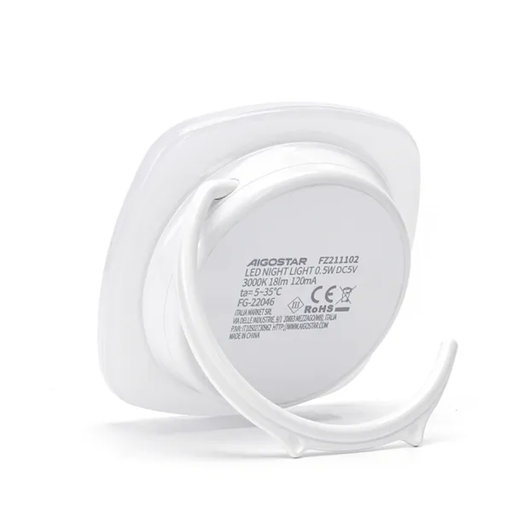
Why this product fits the profile: This compact model is designed for cupboards, hallways and small passageways and can be charged via USB.
The product details state a 3.5-metre detection range, a twilight sensor and USB charging operation. This means the key selection criteria are transparently provided.
500 mAh battery, 3,000 Kelvin, 18 lumens and a hook for flexible placement.

Why this product fits the profile: The combination of three colour temperatures and five brightness levels allows precise adjustment for bedrooms, nurseries, hallways or bathrooms.
Instead of a fixed light colour, this set offers 2,800–3,200, 4,000–4,500 and 5,000–5,500 Kelvin as well as five dimming levels.
500 mAh battery, USB charging, up to 10 hours of run time in sensor mode and 30 lumens according to the product details.
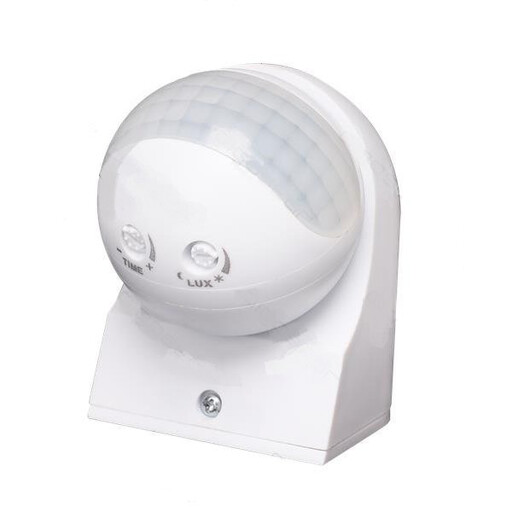
Why this product fits the profile: This wired wall sensor is intended for permanently installed lighting in hallways, entrances, garages and sheltered outdoor areas.
The details state the voltage, IP44 protection, range up to 12 metres, adjustable follow-up time and lux range. Installation should be left to a qualified electrician.
220–240 V, 180° wall mounting, up to 400 W LED load according to the product details and an adjustable sensor head.
We have put together a complete, regularly updated list of products that fully meet these strict selection criteria and the safety regulations in force in the EU.
Mount the sensor so that the detection area is not blocked by furniture, doors or curtains. With battery-powered models, the charging port should remain accessible. Plug-in and 230 V devices must not be used in damp areas unless the product details expressly permit this.
The run time depends on the battery capacity, brightness, switch-on duration and the number of daily activations. Manufacturer claims such as "up to 6" or "up to 10 hours" should therefore be understood as guide values under certain conditions. If the brightness drops, the battery should be charged or, in the case of non-replaceable batteries, the device should be handled according to the instructions.
A sensor can limit the lighting duration because the light only activates when movement is detected. The actual consumption depends on the power, switch-on time, frequency of use and power supply. With hardwired systems, you should also check the maximum load and compatibility with the LED light being used.