
Lieferung heute & morgen

Qualitätsgarantie

Willkommens-Angebote freischalten: KOSTENLOSE Lieferung | Bis zu 80 % RABATT | Kostenlose 30-Tage-JoyPlus-Testphase
App herunterladen
An LED night light with motion sensor is designed to switch on automatically at night, so you don't have to fumble for a switch. In practice, however, poor purchases often happen because of unclear information about sensor range, battery life or installation. Especially in rented flats, children's rooms, hallways and cupboards, it's not just brightness that matters – the right design and straightforward operation are equally important.
A claimed runtime can't be judged without knowing the specific conditions. Brightness level, sensor operation, frequency of activation and battery capacity all affect how often a rechargeable night light needs to be charged. A model with a USB port can be charged flexibly via a laptop, power bank or mains adapter. Still, check whether the charging method and required charging current are compatible with the accessories you already have.
A PIR sensor detects movement within a certain area. A contactless sensor lamp with gesture control, on the other hand, responds to a hand wave or similar signal. Both solutions are practical, but they serve different purposes: the PIR sensor is ideal for hallways or cupboards, while gesture control replaces manual operation by your bed or desk.
Adhesive tape, magnetic mounts and hooks are appealing for tenants, as no drilling is required. However, on dusty, rough or damp surfaces, adhesion can weaken over time. For bathrooms or other damp areas, you should specifically check the moisture resistance ratings. A standard LED cupboard light isn't automatically suitable for splashes.
Pay attention to the stated range and whether the sensor only works in the dark. With the PIR models described here, the detection range is around 3 to 5 metres. A night light that keeps activating during the day wastes energy unnecessarily. For bedrooms, children's rooms or stairs, it's also important whether the activation time can be sensibly integrated into your daily routine.
The unit lumens (lm) describes the light output. For a cupboard or a short hallway, a lower light output is often sufficient compared with a kitchen. A dimmable LED lamp offers more flexibility if the light shouldn't be too bright at night.
Three colour temperatures are typically used as follows:
Colour temperature describes the light colour, not automatically the brightness. That's why Kelvin and lumen specifications should be considered together.
A flat magnetic LED light measuring around 20 to 30 centimetres can be useful under wall-mounted cupboards, on shelves or in wardrobes. Before buying, check whether the light will fit in the intended spot and whether the sensor might be blocked by an edge.
For battery-powered models, capacity and charging port are important comparison points. A 500 mAh battery is more compact than an 1100 mAh battery, but the actual usage time also depends on brightness and operating mode. For the kitchen, an LED under-cabinet light with higher light output may be appropriate, while a small portable bedside lamp is designed more for flexible use.

Why this product suits the profile: The set includes two compact lights with PIR sensor, USB charging and three colour temperatures. This means you can equip, for example, the kitchen and hallway with a single purchase.
The product details state a range of 3 to 5 metres, a capacity of 800 mAh and adhesive tape mounting without drilling.
Two lights, 21 LEDs per unit, USB charging and a slim format of 200 × 38 × 10 mm.
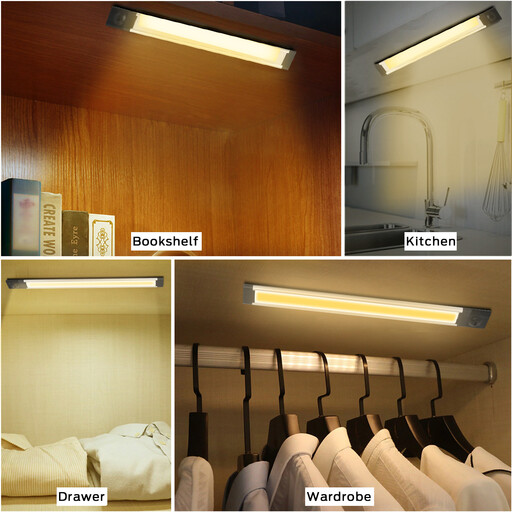
Why this product suits the profile: The light combines gesture control with stepless brightness adjustment and is suitable for bedrooms, nurseries, cupboards or stairs.
The control method is clearly described as gesture control and is not to be confused with a classic PIR motion sensor.
36 Epistar 4014 SMD LEDs, stated light output of 400 lm, colour temperature range from 2800 to 6500 K, plus magnetic and hook mounting.

Why this product suits the profile: This compact model is aimed at households that want to combine automatic lighting with variable brightness and multiple colour temperatures.
The specifications mention five dimming levels, three colour temperatures, USB charging and sensor operation with up to 10 hours of runtime.
30 lm light output, CRI above 85, 500 mAh battery, 3 to 5 metre detection range and normal mode for constant light.
We've put together a full, regularly updated list of products that fully meet these strict selection criteria and the safety regulations in force in the EU.
Clean the mounting surface before attaching the light and check that the adhesive tape or magnet will hold securely. The sensor should face the direction of movement and not be blocked by furniture edges. For a night light for the bedroom, a low brightness level is usually best. In a children's room, the device should be positioned so that cables and the light itself are out of reach or not easily pulled down.
A USB night light should only be charged with a compatible power source. Damaged casings, swollen batteries or unusual heat build-up are reasons to stop using the device. Clean the light with a soft, dry cloth and avoid water as well as abrasive cleaning products.
Depending on the model, installation is done with adhesive tape, a magnetic mount or hooks. The surface should be clean, dry and sufficiently smooth. Before final attachment, it's a good idea to do a quick function test in the intended position.
The runtime depends on battery capacity, brightness level, frequency of activation and operating mode. Manufacturer claims such as "up to 10 hours" refer to specific usage conditions. For a realistic estimate, you should consider the daily movement activity in the location where it's used.
In sensor mode, the lamp only lights up when movement is detected and, where applicable, only in the dark. This can reduce consumption compared with constant light. For an accurate assessment, you need the power consumption in watts and the daily operating time of the specific model.