
Lieferung heute & morgen

Qualitätsgarantie

Willkommens-Angebote freischalten: KOSTENLOSE Lieferung | Bis zu 80 % RABATT | Kostenlose 30-Tage-JoyPlus-Testphase
App herunterladen
An LED night light with a motion sensor should switch on automatically when needed while using as little energy as possible at other times. In practice, however, it is not just the number of LEDs or a high brightness rating that matters. Sensor performance, installation, power supply and light colour all determine whether the product is genuinely suitable for everyday use.
A high lumen rating is not necessarily the right choice for every application. A bright LED under-cabinet light can be practical for a wardrobe, while a considerably softer, warm white light may be more pleasant in a bedroom or nursery. Light that is too bright or cool white can feel disruptive at night.
That is why you should focus on the intended area rather than just the maximum light output. A model with 400 lm is more suitable for illuminating larger areas, while a 17 lm night light is designed for finding your way around a hallway or bedroom.
A PIR motion-sensor light responds to changes in the heat radiation emitted by moving people. Its range and detection angle are therefore crucial. Some products only switch on in dark surroundings, while others also respond in daylight or offer an additional continuous-light mode.
If the range, switch-off time or required ambient brightness is not clearly stated, it is difficult to assess how practical the product will be in everyday use. In hallways and on staircases, for example, a wide detection angle and a defined switch-off time are helpful.
A wireless cupboard light can often be installed using adhesive strips. This can be practical on clean, dry and smooth surfaces. However, adhesion may be reduced on rough plaster, wallpaper, damp surfaces or warm installation locations. A light that falls down is not only annoying; it may also damage the casing or battery.
Magnetic solutions or models with hooks offer an alternative mounting method. Before buying, you should also check whether the mounting materials are included.
For a night light for hallways and staircases, a sensor range of 3 to 5 metres is sufficient for many applications. It is also important to consider whether the sensor reliably detects movement from the front or the side. Automatic switch-off after 30 seconds, as with the VARTA model, can help limit battery consumption.
A shorter distance is often more suitable for cupboards and drawers. On the other hand, a sensor that is too sensitive may be activated by movement outside the intended area, draining the battery or rechargeable battery more quickly.
A battery-powered night light is ready to use straight away, provided you have the right batteries. The VARTA Motion Sensor Night Light, for example, requires three AAA batteries, which are available separately. Batteries can be a sensible choice if there is no regular charging facility where the light is installed.
A rechargeable LED night light is usually charged via USB. Check the battery capacity, stated operating time and charging connection. A 500 mAh battery is compact, but offers a different operating time from a model with 800 or 1100 mAh. Actual runtime depends on factors including brightness, how often the light switches on and the operating mode.
Warm white typically falls within the range of around 2800 to 3200 Kelvin and is often well suited to bedrooms and finding your way around at night. Neutral or cool white can provide clearer visibility on worktops, in kitchens and inside cupboards.
A dimming function is useful when one light needs to serve several purposes. Slim designs are important for narrow furniture spaces: the 30 cm model in the selection measures 300 × 38 × 10 mm, for example. During installation, you should also check that the light does not obstruct the sensor or interfere with doors and drawers.
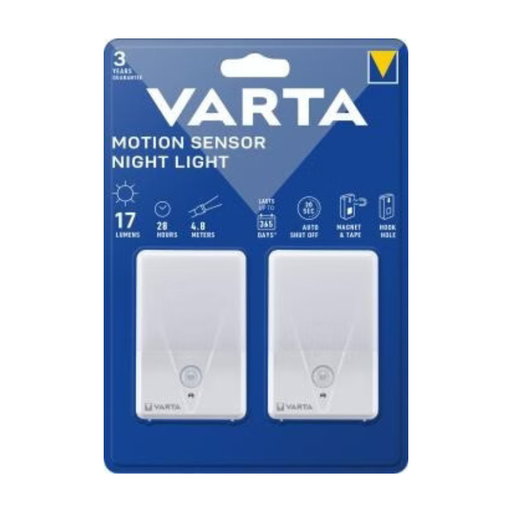
Why this product suits this profile: The twin pack is ideal for users who need two small lights to help them find their way around a hallway, bedroom, bathroom or wardrobe and prefer operation with AAA batteries.
The range, detection angle and switch-off time are clearly specified: up to 3 m, 120° and automatic switch-off after 30 seconds.
17 lm, warm white light, magnetic, adhesive and screw mounting, plus two lights per pack.
Why this product suits this profile: This light delivers greater brightness and an adjustable colour temperature for different rooms, including bedrooms, nurseries, cupboards and stairwells.
The product specifications state 400 lm, 2800–6500 K, 26 × 4 × 1 cm, as well as magnetic mounting and hooks.
Stepless gesture control, a PMMA light guide plate and installation without drilling or screws.

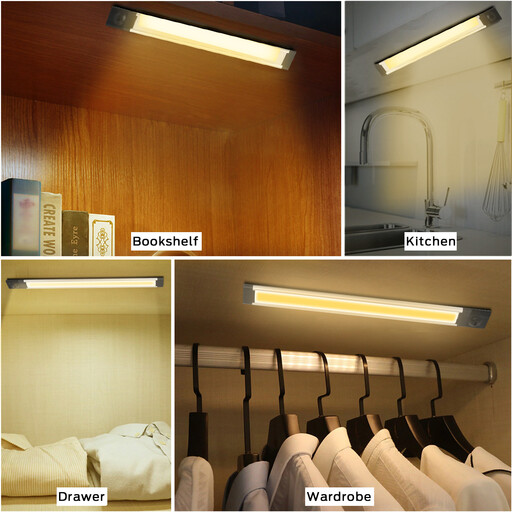
Why this product suits this profile: This set is designed for kitchens, wardrobes and shelving when you need two slim lights with PIR detection and several light colours.
The PIR range of 3–5 m, 1100 mAh battery capacity and USB charging are clearly specified.
41 LEDs, three colour temperatures and a twin pack with a 300 × 38 × 10 mm design.
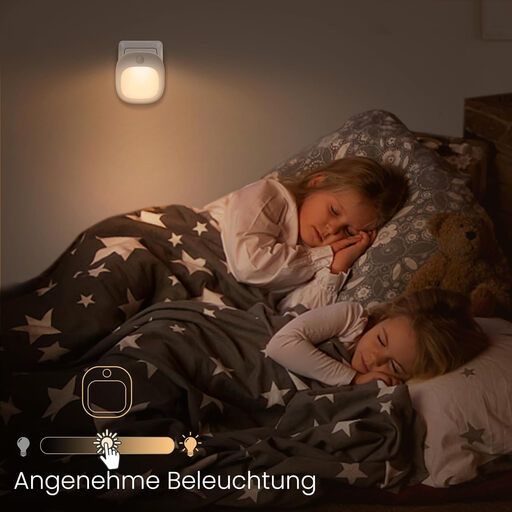
Why this product suits this profile: For bedrooms or a nursery, the compact design, five dimming levels and three colour temperatures offer plenty of flexibility.
The specifications state sensor operation in darkness, a range of 3–5 m, 30 lm, five brightness levels and up to 10 hours of runtime in sensor mode.
500 mAh battery with USB charging, warm, mixed and cool white light, plus an additional continuous-light mode.
We have put together a complete, regularly updated list of products that fully meet these strict selection criteria and the safety regulations applicable in the EU.
Before installation, the surface should be free from dust and grease. A magnetic LED light requires a ferromagnetic surface; hooks or adhesive strips can be used as alternatives. Install the light so that the sensor is not obstructed by doors, furniture edges or decorations.
For bathrooms, cellars and other damp areas, the following applies: according to the product specifications, the products mentioned here should be protected from water and excessive moisture. They are therefore not automatically suitable for direct use in wet areas. When charging a rechargeable model, only a compatible USB power source should be used. Batteries should be kept out of children’s reach.
The range depends on the particular sensor. The products in this selection specify ranges of up to 3 m or 3–5 m. Furniture, walls and positioning affect the actual detection area. In a hallway, the light should be positioned so that movement passes across the sensor’s field of detection.
There is no standard runtime. It depends on battery capacity, brightness level, colour temperature and the number of times the light switches on each day. The 500 mAh model is specified as offering up to 10 hours in sensor mode. The battery should be charged when the brightness starts to fade.
LEDs use little energy compared with many conventional light sources. Actual consumption is determined mainly by how long the light operates. Automatic switch-off and activation only in darkness can extend battery or rechargeable battery life. When choosing a product, switch-off time, sensor conditions and brightness level are therefore just as important as LED output.