
Lieferung heute & morgen

Qualitätsgarantie

Willkommens-Angebote freischalten: KOSTENLOSE Lieferung | Bis zu 80 % RABATT | Kostenlose 30-Tage-JoyPlus-Testphase
App herunterladen
An LED night light with motion sensor should automatically provide light at night without staying on continuously. In practice, however, disappointing purchases are often not caused by the LED technology itself, but by unsuitable sensors, an inappropriate power supply or light colours that are too bright. If you are looking for a night light for a bedroom, children’s room, hallway, bathroom, stairs or cupboards, you should therefore check a few technical details before buying.
A PIR motion sensor responds to movement within a specific detection area. A dusk sensor, on the other hand, measures the ambient light level. The two functions can be combined, but they are not the same.
A night light with a sensor alone may switch on even when the room is sufficiently bright if it only detects movement. For bedrooms and hallways, combining a motion sensor with a dusk sensor is often more practical: the light only activates when it is dark and movement is detected. With a night light with dusk sensor, you should also pay attention to the specified lux value. According to some product descriptions, certain models switch on at 20 lux or below.
More light is not useful in every room. A bright LED motion sensor night light can be helpful in a hallway, but may be distracting in a bedroom or children’s room. Low light outputs are often enough for finding your way around. Models with 18 to 20 lm are designed for short routes, while a 400 lm light is more suitable as a cupboard light, task light or LED under-cabinet light.
The colour temperature and any dimming function are also important. Warm white light between around 2700 and 3000 K is generally less intrusive in living areas than cool white light. Adjustable colour temperature is particularly useful if the same light is intended both for finding your way around and for practical tasks.
A plug-in model does not need charging, but it is tied to a power socket. A rechargeable night light can be mounted more flexibly on cupboards, shelves or walls. However, its charge level needs to be checked regularly. For rechargeable lights, capacity, charging connection and mounting method are all relevant details.
The mounting method can also determine how practical the light is in everyday use. Magnetic holders make it easier to remove the light for charging. Adhesive strips, on the other hand, require a clean, dry surface and may come loose in heat or high humidity.
Check how far and at what angle the sensor detects movement. The stated figures vary considerably: some lights cover up to 3 m, others specify 3 to 5 m or up to 7 m. A large detection area is not always beneficial, for example if pets, passing vehicles or movement in adjacent areas could trigger the light.
Also pay attention to how the light switches off. According to the product description, the GRIFEMA model switches off automatically after 60 seconds without movement. Other products only state that they switch off automatically, without specifying an exact time.
The unit lumen (lm) describes luminous flux. For a subtle night light, 18 to 40 lm is often sufficient. A 400 lm light is more suitable as stronger indoor illumination. Colour temperature in Kelvin (K) indicates the colour of the light:
A dimmable night light offers additional adjustment options. When buying, distinguish between fixed brightness levels and continuously variable dimming. A high CRI or Ra value supports more natural colour rendering; the product details provided specify values from Ra 80 or CRI above 85 for some models.
For bathrooms, cellars or outdoor areas, the description “splashproof” is not sufficient. The models listed are mainly intended for dry indoor spaces, with some rated IP20. They should therefore not come into direct contact with water or high levels of moisture.
Aluminium, ABS, PC and PMMA are used for the housing or light guidance, depending on the model. With a magnetic LED light, you should also check whether the mounting surface is magnetic or whether a metal plate is required. For adhesive mounting, the surface should be free from dust and grease.

Why this product suits this profile: This plug-in model is designed for children’s rooms, hallways, stairs and bathrooms, and does not require batteries.
According to the supplier, the motion and dusk sensors work together; the light switches on in dark surroundings and switches off after 60 seconds without movement.
Five brightness levels, 2700 K warm white light and a detection range of up to 3 m.
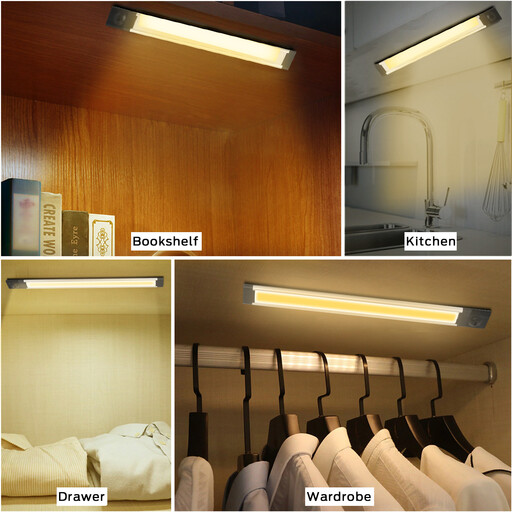
Why this product suits this profile: This light combines higher light output with adjustable colour temperature and flexible mounting.
The product details specify 36 Epistar-4014-SMD LEDs, a PMMA light guide plate and even light distribution.
400 lm, 2800 to 6500 K, gesture control with dimming, plus magnetic and hook mounting.

Why this product suits this profile: Two compact lights are suitable for kitchen cabinets, cupboards, shelves and hallways where lighting needs vary.
According to the product details, the PIR detection covers 3 to 5 m; three colour temperatures prevent a fixed light colour.
800 mAh battery, USB charging, 20 cm length and adhesive-strip mounting without drilling.
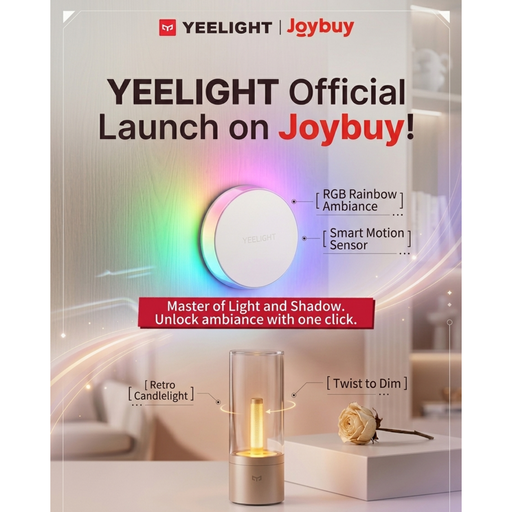
Why this product suits this profile: For living rooms, bedrooms and gaming areas, magnetic, rechargeable ambient lighting with several light effects is an appealing option.
The USB-C charging function reduces reliance on disposable batteries, while magnetic mounting makes flexible positioning easier.
Eleven preset effects, RGB lighting, USB-C charging and magnetic mounting according to the product description.
We have compiled a complete, regularly updated list of products that fully meet these strict selection criteria and the safety regulations applicable in the EU.
For the night-time journey from the bedroom to the bathroom, low light output, warm white light and reliable darkness detection are important criteria. In a children’s room, the light should be mounted out of children’s reach. For kitchens, wardrobes or pantries, longer rechargeable lights with magnetic or adhesive mounting are often more practical than a plug-in model.
For older people or stairways, the key consideration is whether the sensor fully covers the route of movement. Before mounting the light, you should therefore point it towards the expected walking line as a test. The sensor and LED should not be obstructed. For cleaning and care, the product details recommend using a dry, soft cloth; water, harsh cleaning products and opening the unit yourself should be avoided.
Plug-in models are inserted directly into a suitable indoor power socket. Depending on the design, rechargeable lights are attached magnetically, with hooks or using adhesive strips. The surface should be clean, dry and able to support the light. Position the sensor so that furniture, doors or curtains do not block its detection area.
The service life depends on the LED module, electronics, operating time and power supply. Some product details specify, for example, 10,000 or 25,000 hours. These figures are manufacturer specifications and are not a guarantee of identical service life under all conditions. With rechargeable lights, the ageing of the battery must also be taken into account.
Consumption depends on the model and how long it remains switched on. Plug-in models using 0.3 to 1 W require little power when operating continuously. A motion sensor can reduce actual operating time further because the light only activates when movement is detected in darkness. With rechargeable models, electricity consumption mainly results from the charging cycles.