
Lieferung heute & morgen

Qualitätsgarantie

Willkommens-Angebote freischalten: KOSTENLOSE Lieferung | Bis zu 80 % RABATT | Kostenlose 30-Tage-JoyPlus-Testphase
App herunterladen
An LED night light with a motion sensor can make it easier to find your way at night without having to search for the light switch every time. For families, automatic guidance from a children’s room night light can be particularly useful, while adults can benefit from targeted lighting in hallways, stairways or bathrooms.
However, buying the wrong product can lead to unnecessary expense. Models often differ not only in brightness and design, but also in sensor type, power supply and controls. Checking these points in advance can help you avoid unsuitable purchases and choose a night light with sensor that matches the room in question.
A motion sensor responds to movement, but often only when the surrounding light level is low. A dusk sensor, on the other hand, switches the light on and off depending on the available ambient light. A motion-sensor night light is therefore not automatically active in every situation.
For a hallway or staircase, combining motion detection with a dusk sensor is practical. In a child’s bedroom, however, a permanently dimmed light may be more suitable if the child needs some orientation at night without the light activating automatically with every small movement.
The wattage indicates energy consumption, not the perceived brightness directly. Luminous flux in lumens (lm) is a more informative measure. A night light offering between 18 and 40 lm may be enough for gentle orientation, while higher values can be helpful in a bathroom or longer hallway.
Colour temperature also affects how the light is used. A warm white night light of around 2700 to 3200 K provides discreet lighting in living areas. Cool white light at around 6500 K can make contours easier to see, but not every household finds it pleasant in bedrooms.
An LED plug-in night light is always ready to use, but occupies a socket and is restricted to a fixed location. A rechargeable night light can be positioned more flexibly or attached to furniture, but must be charged regularly. Battery-powered models do not require a USB connection, but they involve ongoing costs for replacement batteries.
Check the distance at which the sensor detects movement and whether activation only occurs in the dark. For a model with a PIR sensor, specifications such as 3 m range, a 120° detection angle or automatic switch-off after 60 seconds can help you assess its suitability. Actual detection also depends on the mounting height, room layout and direction of movement.
A dimmable night light is more versatile than a model with just one brightness level. Five levels or stepless adjustment allow for discreet lighting beside the bed and higher light output in the hallway. Also check whether the selected setting is saved or needs to be adjusted again after every activation.
Housings made from ABS or PC are common for indoor use. For plug-in models, pay attention to the stated mains voltage, whether the product is intended for indoor use and its IP rating. IP20, for example, indicates use in dry indoor areas and not directly next to water. A bathroom night light should therefore not be installed where it is likely to be exposed to splashing water.
For USB models, use compatible chargers. Products with lithium batteries should not be opened or exposed to extreme temperatures or moisture. The manufacturer’s instructions always take precedence.
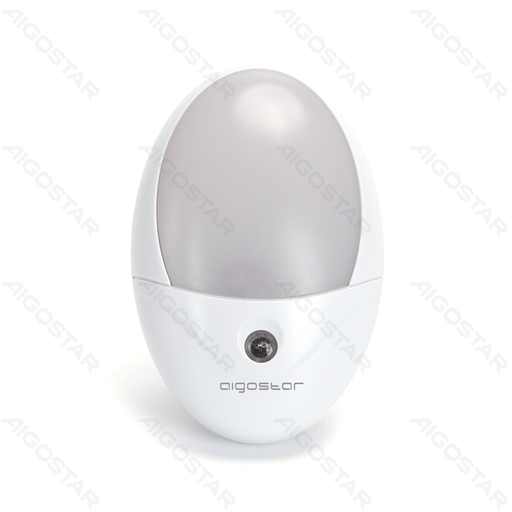
Why this product suits this profile: This plug-in model requires neither batteries nor a charger and is designed for indoor use in hallways, bedrooms, bathrooms or stairways. According to the product specifications, the PIR sensor operates in low light and detects movement up to 7 m away.
The sensor type and intended indoor use are clearly stated. At 3000 K and 20 lm, the lighting effect is easier to assess than by looking at the wattage alone.
Plug-and-play operation, a warm white colour temperature of 3000 K and stated detection up to 7 m at 120°.
Why this product suits this profile: This two-pack combines rechargeable operation, motion and dusk sensors, three colour temperatures and five brightness levels. This makes it suitable for different rooms and changing lighting requirements.
The light output is specified as 30 lm, the sensor range as 3 to 5 m and the activation threshold as no more than 20 lux. This makes it easier to check the specifications before buying.
500-mAh battery, USB charging at 5 V/1 A, three colour temperatures and five dimming levels; stated runtime in sensor mode of up to 10 hours.
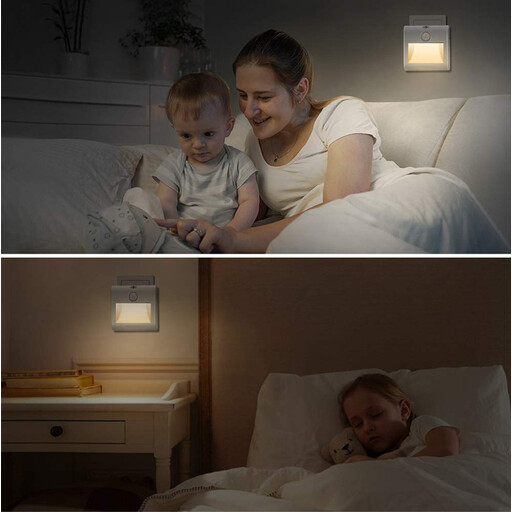
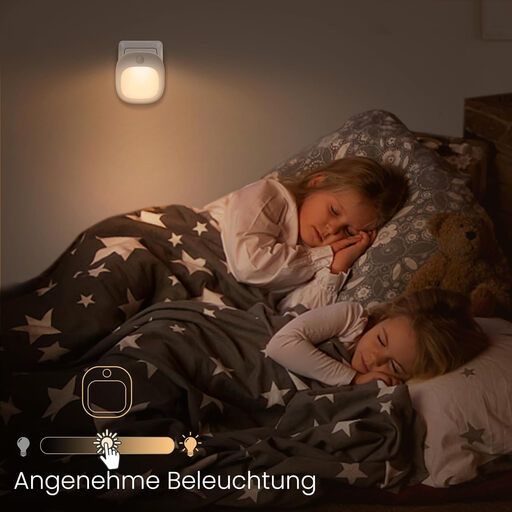
Why this product suits this profile: Two plug-in lights with continuous and sensor modes can be used at the same time in bedrooms, children’s rooms, hallways or lavatories. The touch dimming with memory function is ideal for users who regularly adjust the settings.
The dimming function is stepless, and the last selected brightness level is saved. This means buyers are not limited to a single setting that may be too bright.
Two-pack, 1 W power consumption per light, 20 lm, 4000 to 4500 K, plus sensor mode at no more than 20 lux and a range of 3 to 5 m.
We have put together a complete, regularly updated list of products that fully meet these strict selection criteria and the safety regulations applicable in the EU.
Position the light so that the sensor covers the usual route and is not blocked by furniture, curtains or decorations. In a hallway, positioning it at a low to medium height is sensible. For plug-in models, the socket should be secure and dry. After installation, check that the light only activates when the surrounding light level is sufficiently low.
Service life depends on the model, usage and power supply. Integrated LEDs generally do not require the light source to be replaced. Rechargeable models also have a limited battery capacity and need to be charged regularly. Manufacturer specifications such as 10,000 or 25,000 operating hours are technical guidelines, not a guarantee of a specific service life in the home.
Ongoing electricity costs depend on power consumption, operating time and your electricity tariff. A 0.3 W model uses considerably less energy during continuous operation than a 1 W model. With sensor-controlled operation, the actual switch-on time is usually shorter. For an accurate estimate, use the formula “wattage × operating hours ÷ 1000” and multiply the result by your own price per kilowatt-hour.