
Lieferung heute & morgen

Qualitätsgarantie

Willkommens-Angebote freischalten: KOSTENLOSE Lieferung | Bis zu 80 % RABATT | Kostenlose 30-Tage-JoyPlus-Testphase
App herunterladen
An LED night light with a motion sensor should switch on automatically, illuminate only when needed and require no complicated installation. In practice, however, unclear sensor specifications, unsuitable brightness or an inappropriate power supply can quickly lead to a disappointing purchase. This guide explains which technical details matter for UK homes and which options suit different living situations.
A PIR sensor detects heat movement from people. It can also trigger the light during the day if no additional brightness sensor is fitted. A dusk or twilight sensor, on the other hand, responds to the brightness of the surroundings. For a hallway or bedroom, combining both sensors is often a sensible choice: the motion-sensor night light only switches on when it is dark and movement is detected.
A stated range of, for example, 3 to 5 metres does not suit every installation. Narrow hallways, cupboard interiors and staircases involve different directions of movement. Furniture, doors or an inconvenient mounting position can also restrict the detection field. The key factors are therefore range, detection angle and mounting height.
A light with a high lumen rating can be uncomfortably bright when used for finding your way at night. For a night light in a children's room or bedroom, warm white tones between around 2700 and 3200 Kelvin are often suitable. Neutral or cool white light may be more practical for work areas, kitchens or cupboard compartments. A dimming function or several brightness levels makes it easier to adjust the light.
Pay close attention to the exact sensor description:
For a cupboard light with a motion sensor, a short run-on time is often sufficient. For the journey from the bedroom to the bathroom, a longer illumination period may be more practical.
A battery-powered night light can be mounted flexibly, but requires regular battery replacement. A USB-rechargeable night light with a lithium-ion battery avoids disposable batteries and can be charged using a USB mains adapter, laptop or power bank. Check the capacity, charging port and stated operating time.
Plug-in models are suitable for positions with an accessible socket. They require neither a rechargeable battery nor standard batteries, but they do occupy a socket and cannot be attached to cupboard bases or shelves.
The lumen rating describes the luminous flux, not how the light is subjectively distributed around the room. The number of LEDs, beam angle and diffuser are also relevant. A dimmable night light or a model with three colour temperatures can be used in several areas.
For a cable-free LED light, magnetic mounts, hooks or adhesive strips are practical. Before installation, the surface should be clean, dry and able to support the light. The relevant IP ratings apply in damp rooms. Several of the models described here are intended exclusively for indoor use and should not come into contact with water or high humidity.

Why this product suits this profile: Two compact 20 cm lights are suitable for cupboards, shelves, kitchen areas and short hallways. They can be installed with adhesive strips, without drilling.
The PIR range of 3 to 5 metres and three colour temperatures make your choice less dependent on a single lighting mood.
800-mAh battery, USB charging, 21 LEDs per light and three colour temperatures ranging from warm white to cool white.
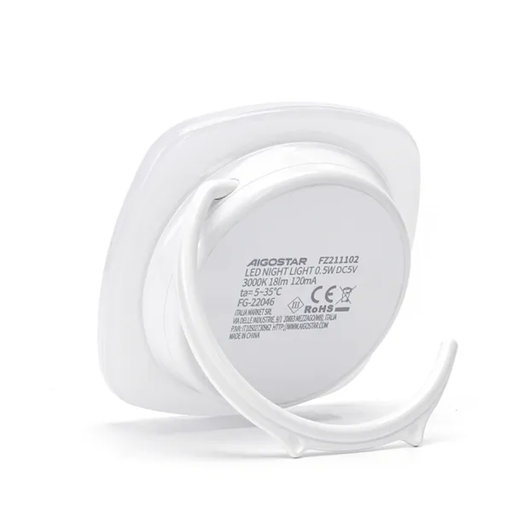
Why this product suits this profile: The combination of warm white light, PIR detection and USB charging is well suited to bedrooms, hallways and under-cabinet lighting.
The manufacturer specifies a 120-degree beam angle, a detection range of 3.5 metres and a warm white colour temperature of 3000 Kelvin.
500-mAh battery, 18 lumens, 0.5 watt power consumption and USB charging function.
Why this product suits this profile: The longer design is suitable for kitchen wall units, wardrobes, shelves and wider wall areas.
This version features 41 LEDs, a stated detection distance of 3 to 5 metres and three selectable colour temperatures.
1100-mAh battery, USB charging, dimensions of 300 × 38 × 10 mm and tool-free adhesive installation.

Why this product suits this profile: This plug-in model is intended for children's rooms, hallways, stairs and indoor bathrooms when you do not want to charge a battery.
The integrated Twilight sensor limits operation to dark surroundings. Brightness can also be adjusted across five levels from 20 to 100 per cent.
2700-Kelvin warm white light, 3-metre detection range, 120-degree detection angle and automatic switch-off after 60 seconds without movement.
We have put together a complete, regularly updated list of products that fully meet these strict selection criteria and the safety regulations applicable in the EU.
Position the light so that the sensor faces the expected route of movement and is not obstructed by doors, furniture or covers. Adhesive surfaces should be clean and dry. If using magnetic mounting, check that the contact surface provides sufficient support. Plug-in models are inserted directly into a suitable indoor socket.
Runtime depends on the rechargeable battery or standard battery capacity, brightness, frequency of sensor activation and run-on time. A higher capacity, such as 1100 mAh instead of 500 mAh, may allow longer intervals between charges, but it does not guarantee a specific runtime. For a realistic assessment, compare the manufacturer's stated operating time and charging time.
An LED sensor light only operates while activated and uses comparatively little energy thanks to its low power consumption. A USB model also incurs charging losses, while a plug-in model keeps its electronics running continuously. Running costs therefore depend mainly on power consumption, activation duration and the number of times it switches on each day.