
Lieferung heute & morgen

Qualitätsgarantie

Willkommens-Angebote freischalten: KOSTENLOSE Lieferung | Bis zu 80 % RABATT | Kostenlose 30-Tage-JoyPlus-Testphase
App herunterladen
An LED night light with motion sensor can illuminate walkways at night, cupboards and worktops without having to search for a wall switch. However, there are clear differences between products when it comes to sensors, batteries, light colour and installation. Anyone who focuses solely on a high LED count or an especially low price may overlook important details.
This buying guide explains which specifications matter before you buy and which model is suitable for different home environments.
The description ‘with motion sensor’ alone says little about how a product will perform in practice. The key factors are the detection range, activation conditions and the effect of ambient light. Some models only activate in the dark, while others also work in continuous-light mode. For a hallway or wardrobe, it is also important to know whether movement can be detected from several metres away.
Several of the lights presented here specify a PIR range of 3 to 5 metres. Depending on the installation position, this is sufficient for a short hallway, a cupboard area or access to a staircase. Before installation, check whether doors, shelves or furniture obstruct the detection area.
A high lumen rating is not automatically suitable for every situation. An LED bedroom night light will generally provide guidance lighting, while an LED under-cabinet light in the kitchen needs to illuminate a worktop more evenly. For drawers and small compartments, a compact light with a lower output may be sufficient.
The light colour also affects how the product can be used: according to the product specifications, 2,800 to 3,200 Kelvin creates a warm effect, while 6,500 to 7,000 Kelvin produces cooler, clearer light. Adjustable colour temperature offers greater flexibility, but it cannot replace suitable positioning.
A rechargeable LED lamp needs to be charged regularly. Specifications such as 500 mAh, 800 mAh or 1,100 mAh describe battery capacity, but do not on their own indicate the actual operating time. Brightness level, activation frequency and operating mode all affect power consumption.
When installing without drilling, the surface is an important consideration. Adhesive strips do not adhere equally well to every rough, dusty or damp surface. Magnetic mounts are more flexible, provided a suitable metal surface or mounting plate is available.
For cupboards, hallways and stairs, a motion-sensor night light with automatic switching on and off is practical. Check the following:
A model with an ambient light sensor can prevent the lamp from switching on unnecessarily when there is sufficient light. For example, the 2-pack with a 500-mAh battery is specified to activate at 20 lux or less.
For kitchens and wardrobes, being able to choose between warm, natural and cool white is useful. A dimmable LED night lamp can be set to a lower brightness level in a bedroom or child's room. RGB functions, on the other hand, are more suitable for decorative lighting than for detailed tasks.
The product specifications for the 2-pack with a 500-mAh battery state a CRI value above 85. The colour rendering index describes how distinctly colours appear under the light. It is particularly relevant for clothing, food and small objects.
Measure the available area before buying. A 40-centimetre-long LED cupboard light without drilling may be ideal beneath a wide kitchen wall unit, but may not fit inside a narrow shelf. For small alcoves, 20 or 26 centimetres are often easier to position.
Also pay attention to:

Why this product suits this profile: The 2-pack is suitable for small cupboards, shelves and hallways. Its compact 200 mm length and tool-free adhesive-tape installation are ideal for rented homes and straightforward upgrades.
The specifications state a PIR range of 3 to 5 metres, three colour temperatures and an 800-mAh battery instead of making a vague claim about ‘long battery life’.
Two lights per pack, 21 LEDs per light and USB charging at 5 V/0.5 A.
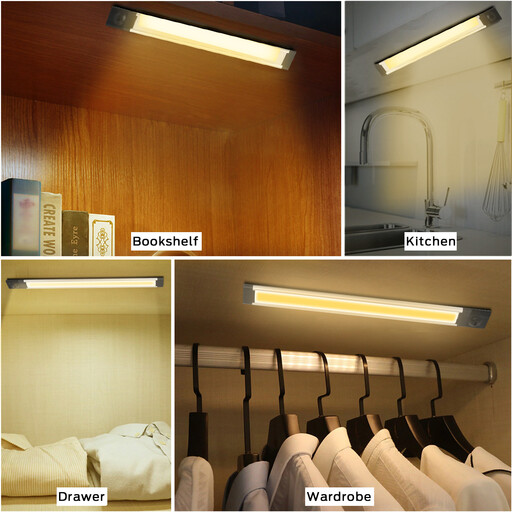
Why this product suits this profile: This light combines a slim design with gesture control, dimming and magnetic mounting. It is suitable for bedrooms, nurseries, wardrobes and hallways.
Rather than offering just one fixed brightness level, the product features stepless gesture control and a colour-temperature range of 2,800 to 6,500 Kelvin.
36 Epistar 4014 SMD LEDs, 400 lm according to the product specifications, plus drilling-free mounting with a magnet or hook.
Why this product suits this profile: The 40-centimetre version is designed for wider kitchen areas, wardrobes and shelves where a short light bar would not cover the entire surface.
The product data clearly lists the dimensions, LED count, sensor range and battery capacity. This makes it easier to check whether the light is suitable for the intended installation location before buying.
61 LEDs per light, three colour temperatures and an integrated 1,100-mAh battery in the 2-pack.
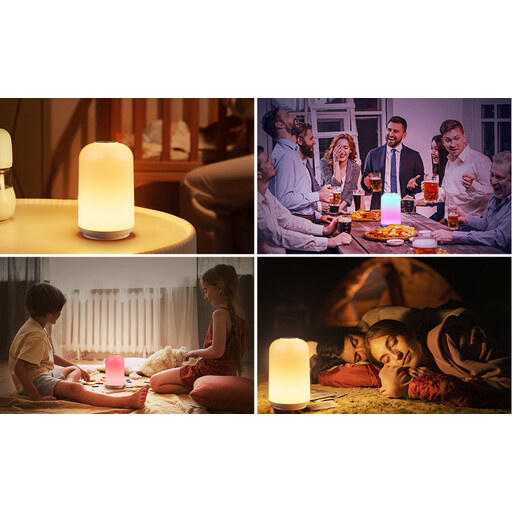
Why this product suits this profile: This compact light is designed for bedside tables, shelves and children's furniture. Warm white light, seven RGB colours and an automatic colour-change function provide a range of uses.
The product description clearly distinguishes between warm white and RGB modes and specifies the dimming function. This makes it easier to choose between guidance lighting and decorative use.
USB-rechargeable lamp with 40 lm, stepless dimming in warm white mode and seven RGB colours.
We have put together a complete, regularly updated list of products that fully meet these strict selection criteria and the safety regulations applicable in the EU.
Choose a position where the PIR sensor has an unobstructed view of the area where movement is expected. If using adhesive tape, the surface should be clean, dry and as smooth as possible. Magnetic models are easier to remove, but require a suitable mounting surface. We recommend carrying out a brief function test before securing the light permanently.
This depends on battery capacity, brightness, activation frequency and operating mode. One product specification states that the 500-mAh model can provide up to 10 hours in sensor mode. This figure should be understood as the manufacturer's stated performance under the described conditions, not as a general operating time for every usage scenario.
In sensor mode, the lamp only lights up when movement is detected and, where applicable, when ambient light levels are low. As a result, its consumption may be lower than that of a light which remains switched on continuously. For running costs, the main factors are power consumption, how long the light stays on and how often it needs charging. One model is specified as having a power consumption of 1 watt; the actual cost depends on your electricity tariff and charging habits.