
Lieferung heute & morgen

Qualitätsgarantie

Willkommens-Angebote freischalten: KOSTENLOSE Lieferung | Bis zu 80 % RABATT | Kostenlose 30-Tage-JoyPlus-Testphase
App herunterladen
An LED night light with a motion sensor can automatically light your way in the dark, so you don’t have to fumble for the light switch. However, choosing the right one isn’t always straightforward, whether you’re shopping for a family, an older person, a rented home or a small space. Product names often promise “intelligent sensors”, “long battery life” or especially gentle light, but important details may only become clear in the small print.
Many models combine a motion sensor with a dusk sensor. This is useful because the light stays off during the day. However, sensors respond differently to ambient light depending on the model. Check whether automatic activation is explicitly linked to darkness or a particular lux level.
A night light that switches on with every movement, even in a bright room, wastes energy. On the other hand, a sensor that’s not sensitive enough can be inconvenient in a hallway or on the stairs.
A high lumen rating doesn’t automatically mean a night light is suitable for a child’s bedroom. For a short walk, a low brightness setting is usually enough. A powerful under-cabinet LED light for the kitchen or wardrobe has a different purpose from a gentle light beside the bed.
Look for adjustable brightness levels or a dimming function. A low setting may be more comfortable for a child’s bedroom night light than a light that stays bright all the time.
A battery-powered night light is easy to position, but you’ll need to replace the batteries regularly. A rechargeable night light charges via USB, but you’ll need to connect it to a power source in good time. Plug-in models avoid battery and recharging costs, but take up a socket.
For rented homes, adhesive strips, magnetic mounts or hooks can be useful. Before fitting the light, make sure the surface is clean, dry and sturdy enough. In bathrooms, check whether the model is intended for dry indoor use only. According to their product information, the products listed here are not designed for direct contact with water.
A sensor night light usually uses a PIR motion sensor. Key details to look for include:
A short shut-off time is enough for a quick trip to the loo. A slightly longer run-on time may be more practical on the stairs.
A warm white LED night light is often in the region of 2,700 to 3,200 Kelvin. Product specifications describe this light colour as warm white. Models with 4,000 to 7,000 Kelvin produce neutral to cool white light and are more suited to worktops, cupboards or kitchens.
Also check whether brightness is given in lumens and whether there are several settings. A light with five brightness levels can be adjusted more precisely to suit the room and time of day. Figures such as 18, 30 or 35 lumens should be treated as product specifications, not as a guarantee that the light will be suitable for every situation.
A battery-powered night light that uses AAA batteries doesn’t rely on a plug socket. A USB night light with a built-in battery can be charged using a mains adapter, laptop or power bank, if these power sources are listed in the product description. Check the battery capacity, charging method and stated run time in sensor mode.
For cupboards and kitchen units, slim, cordless LED lights with adhesive strips or magnets are practical. If you’re choosing a longer light, check the dimensions of the space where you plan to fit it. A 40-centimetre model won’t fit every cupboard, while a 20-centimetre light will illuminate a smaller area.
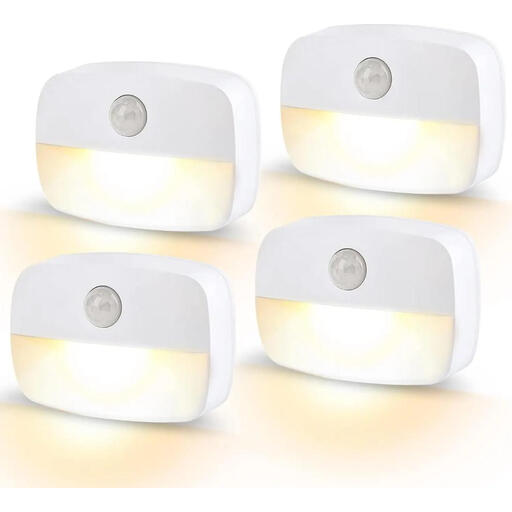
Why it suits this type of buyer: The four-pack is ideal for several spots, such as the hallway, cupboard, stairs or bathroom entrance. The lights can be fitted with double-sided adhesive tape, with no drilling required.
The product specifications state a 120-degree detection angle, a range of 13 to 20 feet and an automatic shut-off after 20 seconds without movement.
Four lights, warm white light at 2,800 to 3,200 Kelvin and battery power, with three AAA batteries required for each light.

Why it suits this type of buyer: This plug-in model is designed for children’s bedrooms, bedrooms, hallways, stairs and kitchens. According to the product description, it doesn’t need batteries.
The motion and dusk sensors work together to limit automatic activation to dark surroundings. According to the product specifications, the light switches off after 60 seconds without movement.
Five brightness levels from 20 to 100 per cent and warm white light at 2,700 Kelvin; stated power consumption: 0.5 watts.

Why it suits this type of buyer: These lights are designed for cupboards, kitchens or hallways, with motion sensing and no-drill adhesive mounting.
The product description specifies PIR detection with a range of 3 to 5 metres, three light colours and a built-in 1,100 mAh battery instead of replaceable batteries.
30 centimetres long, with 41 LEDs, USB charging at 5 V and three colour temperatures from warm to cool white.
We’ve put together a complete, regularly updated list of products that meet these strict selection criteria and the applicable EU safety regulations.
Position the light so that its sensor covers the route you usually take. In a hallway, it’s often best placed to the side of the path, while a cupboard light should be fitted directly above the area it needs to illuminate. Make sure adhesive surfaces are clean, dry and free from grease. For plug-in models, the wall socket must be undamaged and easy to access.
Run time depends on the sensor range, brightness setting, time switched on and battery capacity. With the same pattern of use, a model with a shorter shut-off time uses less energy than one that stays on for longer. For rechargeable models, compare the manufacturer’s stated run time in sensor mode with how you plan to use the light.
Energy use depends on the model. A low-wattage plug-in model may use very little electricity, even if left connected, while battery-powered lights have ongoing replacement battery costs. USB-rechargeable models reduce the need for disposable batteries but still need charging regularly. So it’s worth considering not just the purchase price, but also the power rating, how long the light stays on and its power supply.