
Lieferung heute & morgen

Qualitätsgarantie

Willkommens-Angebote freischalten: KOSTENLOSE Lieferung | Bis zu 80 % RABATT | Kostenlose 30-Tage-JoyPlus-Testphase
App herunterladen
An LED night light with a motion sensor should provide guidance at night without staying on continuously or unnecessarily disturbing sleep. In practice, however, people often buy models that do not work well in their intended location: the light is too bright, the sensor responds during the day or the mounting does not hold on the chosen surface.
The most important buying decisions therefore concern more than just the design. The key factors are sensor type, light output, colour temperature, power supply and mounting.
A PIR motion sensor responds to movement, while a twilight sensor measures the brightness of the surrounding area. A motion-sensor night light without twilight detection can switch on even when there is sufficient daylight. Conversely, a night light with only a twilight sensor stays on as soon as it gets dark, regardless of whether anyone is moving.
For hallways and stairs, a combination of both sensors is often useful. For a wardrobe light with a motion sensor, however, a PIR sensor on its own may be sufficient, provided the area is mostly dark.
High brightness is practical for a wardrobe or work surface, but can be disruptive in a child’s room or beside the bed. Check whether the model is dimmable and which colour temperature it uses. Warm white light between around 2700 and 3000 Kelvin is generally more discreet in living areas than neutral or cool white light.
Descriptions such as ‘soft’ or ‘glare-free’ should not be the only deciding factors. Specific values such as lumens, Kelvin, beam angle and dimming levels are more informative.
A plug-in night light is ready to use straight away and requires neither batteries nor regular charging. However, it occupies a socket and is less flexible in terms of positioning. A cordless night light can be fitted to cupboards, shelves or stair walls, but may need regular charging depending on the battery.
For rechargeable models, you should pay attention to the battery capacity, charging connection and expected operating mode. Actual illumination time depends on how often the sensor is triggered and which brightness setting is selected.
Pay attention to the sensor type and range. With a PIR sensor, the detection angle and switch-off time are also important. A model with a range of 3 to 5 metres is suitable for a short section of hallway or a wardrobe. For longer stairways, a wider angle or installing several lights may be worthwhile.
A night light with a twilight sensor should state a specific threshold. According to the product description, one of the available plug-in models switches on at below 20 lux. This means the light switches on automatically when ambient brightness is low and switches off again when there is sufficient daylight.
For an LED night light for a child’s room or for finding your way around the bedroom at night, warm white versions with 2700 to 3000 Kelvin are often suitable. Neutral white light of around 4000 to 4500 Kelvin can provide clearer illumination in kitchens, hallways or bathrooms. Cool white light of up to 6500 Kelvin is intended for wardrobes and work areas, but appears noticeably brighter beside the bed.
Do not compare lumen values in isolation. A model with 20 lumens may be sufficient for a plug-in orientation light, while a longer light strip for a wardrobe will require considerably more light. A dimming function or several brightness levels make it easier to adjust the light to the room in question.
For installation without drilling, you can use magnetic surfaces, hooks or adhesive strips. Before mounting, the surface must be clean, dry and able to support the product. With adhesive strips, frequently changing the position may reduce their grip.
For indoor use, models with IP20 are generally intended only for dry areas. Such a product must not come into contact with water or high humidity in the bathroom. Plug-in lights for 220–240 volts should only be used with suitable, undamaged sockets. Always clean the light when disconnected, using a soft, dry cloth.
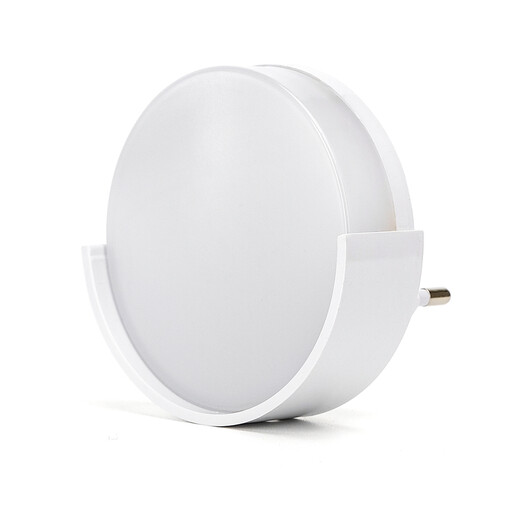
Why this product suits this profile: The plug-in light connects directly to the socket and works without batteries or a charger. It is suitable for hallways, bedrooms, children’s rooms and stairways in dry indoor environments.
According to the product details, the integrated twilight sensor switches on below 20 lux and off again when there is sufficient brightness. This removes the need to switch the light on and off manually.
1 W power consumption, 40 lumens, a 120° beam angle and 220–240-volt plug-in operation. The stated IP rating is IP20 for dry indoor areas.
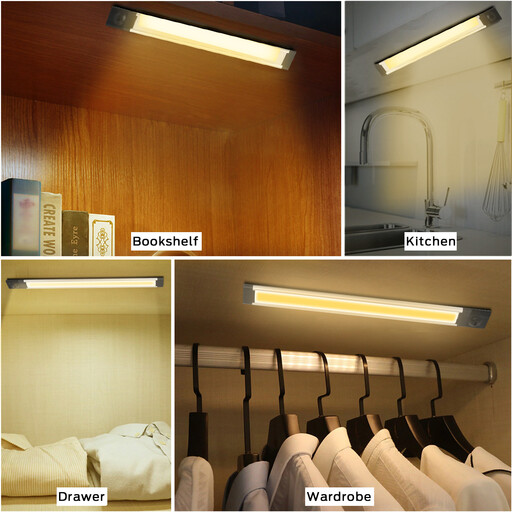
Why this product suits this profile: This cordless night light can be fitted flexibly to walls, cupboards or stair walls. It can be switched on and off and dimmed using gesture control.
The brightness is not limited to a single fixed setting. The stated range of 2800 to 6500 Kelvin and stepless gesture control allow you to adapt it to different rooms.
36 Epistar-4014 SMD LEDs, 400 lumens according to the product details, a PMMA light guide plate, plus magnetic mounting and hooks. The dimensions are 26 × 4 × 1 cm.

Why this product suits this profile: Two slim lights are suitable for kitchen cabinets, wardrobes, shelves and hallways. They can be installed without drilling using adhesive strips.
The three selectable colour temperatures prevent you from having to use one light for every application. According to the product details, the PIR sensor works at a distance of 3 to 5 metres.
41 LEDs, three colour temperatures ranging from 2800–3200 K to 6500–7000 K, and an integrated 1100-mAh battery with USB charging. The set contains two lights, each 30 cm long.
We have put together a complete, regularly updated list of products that fully meet these strict selection criteria and the safety regulations applicable in the EU.
Running costs depend on power consumption, usage time and electricity prices. A simple plug-in light with 0.5 to 1 watt uses considerably less energy during brief night-time use than a room light that stays on continuously. With a motion sensor, automatic switch-off reduces operating time, provided the switch-off delay suits the intended application.
Manufacturers’ lifespan figures, such as 10,000 or 25,000 hours, are technical estimates rather than a guarantee of a specific service life in the home. Heat, moisture, frequent switching and a covered sensor can affect performance.
Mount it so that the sensor can detect the desired route and is not obstructed by furniture, curtains or covers. For adhesive mounting, the surface should be dry and free from grease. Plug-in models must not be covered and are suitable only for the intended indoor environment.
For finding your way around at night, warm white light of around 2700 to 3000 Kelvin is often chosen because it appears less bright than cool white light. However, brightness, dimmability and the position of the light remain the key considerations. Avoid directing the light straight towards the bed.
A rechargeable night light is particularly worthwhile where there is no socket available or flexible mounting is preferred. For hallways that are used regularly, a plug-in night light may be more practical because there is no need to monitor the charge level. Before buying, compare the intended mounting location with the expected charging effort.