
Lieferung heute & morgen

Qualitätsgarantie

Willkommens-Angebote freischalten: KOSTENLOSE Lieferung | Bis zu 80 % RABATT | Kostenlose 30-Tage-JoyPlus-Testphase
App herunterladen
An LED night light with a motion sensor can automatically light up dark walkways, the inside of a wardrobe or work areas. To make sure it’s right for everyday use, households in the UK should look beyond a high LED count or claims such as ‘extra bright’. What matters is the sensor range, power supply, installation and suitability for the intended room.
A high number of LED chips doesn’t automatically mean a light will be bright enough for your needs. More useful details include luminous flux in lumens, light distribution and colour temperature. A compact light is often enough for a wardrobe. A longer under-cabinet LED light for the kitchen, on the other hand, should illuminate the worktop as evenly as possible.
A PIR sensor responds to movement, but it won’t necessarily detect whether a room is already bright. If a dusk sensor is also mentioned, check the conditions under which the light is activated. Without this distinction, a motion-sensor light may switch on during the day too.
A permanently installed light may need a mains connection and professional installation. A rechargeable LED light with a USB connection is more flexible, but needs regular charging. A plug-in light doesn’t need a battery, but it does need a suitable wall socket. The position of the socket and cable routing also matter.
The rechargeable lights featured here have a stated PIR detection range of around 3 to 5 metres. A shorter range may be sufficient in a narrow wardrobe, while a hallway may need broader coverage. Also check how the light switches off: some models turn off after a set time without movement, while others offer a continuous-light mode.
Don’t install a motion sensor directly behind doors, curtains or objects. For stairs and hallways, choose a position where the light can detect people approaching along the walkway.
Colour temperature is measured in kelvins:
A dimmable night light is particularly useful if you can adjust the brightness to suit the time of day and how you’re using it. Warm white light may be more comfortable in a bedroom than a cool white setting. It does not have a therapeutic or medical effect.
Measure the available space before you buy. A 20-centimetre wireless wardrobe light will fit in small compartments, while 30 or 40 centimetres can cover a longer area. Magnetic mounts and adhesive strips make installation easier in rented homes, without leaving drill holes.
Take care when using lights in bathrooms or near a sink. If no suitable IP rating is specified, keep the light away from water and high levels of moisture. Use rechargeable and plug-in models indoors only, in accordance with the manufacturer’s instructions.

Why this product suits this profile: Two compact lights, each 20 centimetres long, are ideal for small wardrobes, shelves and short hallways. They attach with adhesive strips, so there’s no need to drill.
The specifications clearly state PIR detection, three colour temperatures and USB charging, rather than referring to an unexplained automatic function.
21 LEDs, 800-mAh battery, 3 to 5-metre sensor range and a two-pack.
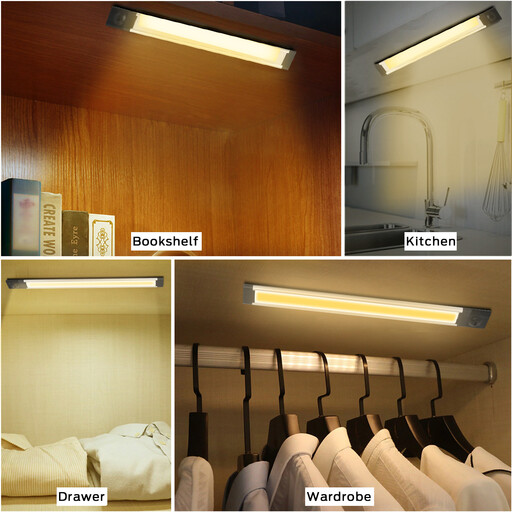
Why this product suits this profile: Its combination of aluminium, ABS plastic, a PMMA light guide and magnetic mounting will appeal to anyone who values clear material specifications and flexible installation.
The stated luminous flux of 400 lumens gives you a more useful point of comparison than the LED count alone. You can adjust the brightness using gesture control.
36 SMD LEDs, 2800 to 6500 kelvins, magnetic mounting and dimming function.
Why this product suits this profile: The 40-centimetre length and two-light pack are well suited to wide kitchen wall units, wardrobes or lighting several rooms.
You can check the available length and 3-to-5-metre sensor range against the intended location before installation.
61 LEDs, 1100-mAh battery, USB charging and three colour temperatures.

Why this product suits this profile: This plug-in light has motion and dusk sensors, offers five brightness levels and gives off warm white light at 2700 kelvins.
Five settings from 20 to 100 per cent make it easy to adjust the brightness, while the dusk function helps prevent the light switching on unnecessarily when it’s already bright.
0.5-watt power consumption, detection range of up to 3 metres and automatic switch-off after 60 seconds without movement.
We’ve put together a complete, regularly updated list of products that meet these strict selection criteria and fully comply with the safety regulations in force in the EU.
Position the light so the PIR sensor can detect movement along the route you expect people to take. In wardrobes, it’s best to install it near the front edge; in hallways, choose a position with a clear line of sight. Adhesive strips need a clean, dry surface and firm pressure when applied.
Actual battery life depends on brightness, how often the light switches on, sensor range and battery capacity. So an 800-mAh battery and a 1100-mAh battery can’t be directly compared in terms of a fixed operating time. Check whether the manufacturer gives specific battery-life figures for the mode you want to use.
It usually uses less power than a light that stays on all the time, because it only switches on when it detects movement. With plug-in models, standby power consumption may also be a factor. For a realistic comparison, consider power consumption, how long the light stays on and how often it’s used.