
Lieferung heute & morgen

Qualitätsgarantie

Willkommens-Angebote freischalten: KOSTENLOSE Lieferung | Bis zu 80 % RABATT | Kostenlose 30-Tage-JoyPlus-Testphase
App herunterladen
An LED night light with a motion sensor should switch on automatically in the dark and then switch off again. This is practical for families, older people and households with dark hallways or staircases. However, unclear product information often leads to unsuitable purchases.
A night light with a twilight sensor responds to the ambient light level. It switches on in the dark and, depending on the model, may remain on continuously. A motion sensor night light, on the other hand, usually uses a PIR sensor. It only lights up when movement is detected and switches off again after a set period.
Some models combine both functions: the light only responds when it is dark and movement is detected. For hallways, staircases or bathrooms, this combination can reduce unnecessary continuous operation.
A high lumen rating is not automatically beneficial. For finding your way around a bedroom or children’s room, 17 to 40 lm is often sufficient. A significantly brighter light may be more noticeable when getting up during the night. So, if you want discreet lighting, look for a warm white night light of around 2700 to 3000 K.
Cool white light of around 6500 K can make contours easier to see, but depending on the room and décor, it can appear considerably brighter. For an LED night light for a children’s room, the light source should also not be positioned directly at eye level or aimed straight towards the bed.
A plug-in night light is ready to use immediately and requires neither batteries nor a charger. However, it occupies a socket and is not suitable for cupboards or locations without a wall socket. A battery-powered night light can be installed flexibly, but incurs ongoing battery costs.
A rechargeable night light reduces the need to change batteries. Check the stated operating time, charging method and charging time. For adhesive mounts, the surface should be clean, dry and smooth. Adhesion may deteriorate on wallpaper or damp surfaces.
Three values are particularly important for an automatic night light:
Bear in mind that furniture, doors or an unsuitable installation position can obstruct the sensor. A sensor is not a substitute for general room lighting and should not be regarded as the sole measure for preventing accidents.
The specification lumens (lm) describes the luminous flux. Lower values are more suitable for orientation, while higher values provide additional illumination. The colour temperature in Kelvin (K) describes the colour of the light: lower values appear warmer, while higher values look whiter or cooler.
A dimmable night light is a useful option for households with different requirements. A low setting may be sufficient in the bedroom, while a higher setting may be needed in the hallway. When buying, check whether the brightness can be adjusted in steps or continuously, and whether the selected setting is saved.
For use in Germany, the operating voltage specifications are important. Depending on the product, the plug-in models in this selection are specified for 220–240 V or a range such as 100–240 V. Only use the device in accordance with the manufacturer’s instructions.
The IP20 rating indicates intended use in dry indoor areas. A model with a higher protection rating may offer other usage options, but this does not replace checking the specific manufacturer’s instructions. Night lights must not be covered, opened or used in water. For products intended for children’s rooms, small parts, batteries and cables must be kept out of reach of young children.
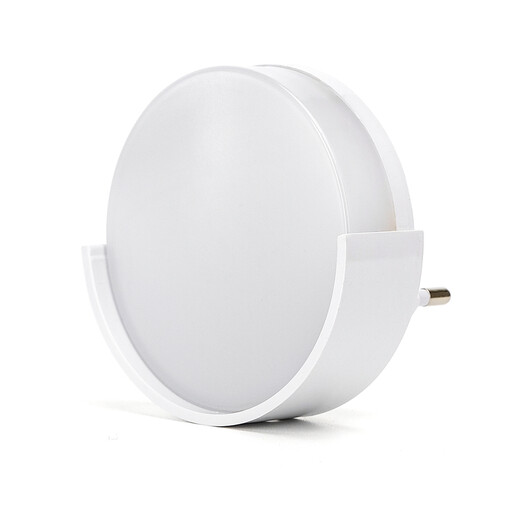
Why this product suits this profile: This plug-in model operates automatically using a light sensor and requires neither batteries nor charging. It is suitable for hallways, bedrooms, children’s rooms and staircases.
The stated switch-on threshold is below 20 LUX. This makes it clear when the twilight sensor is intended to respond.
1 W power consumption, 40 lm, 6500 K, 220–240 V, IP20 and a stated LED lifespan of 25,000 hours.
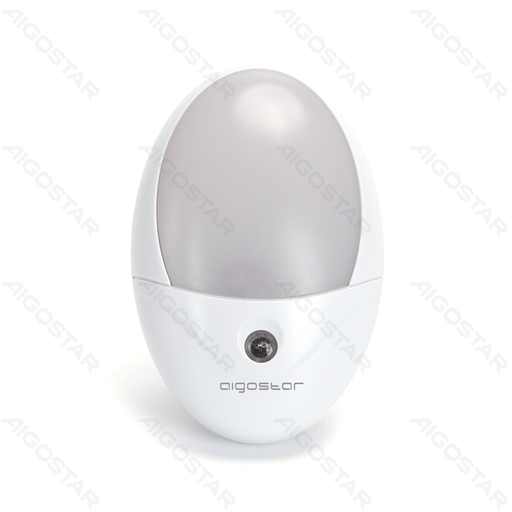
Why this product suits this profile: The PIR sensor combines motion detection with operation in low ambient light. The warm white light is well suited to bedrooms, bathrooms, hallways and staircases.
The technical specifications state a range of up to 7 m and a detection angle of 120°. This makes it easier to position the light correctly.
20 lm, 3000 K, 1 W, CRI Ra ≥ 80 and PIR motion detection without batteries.
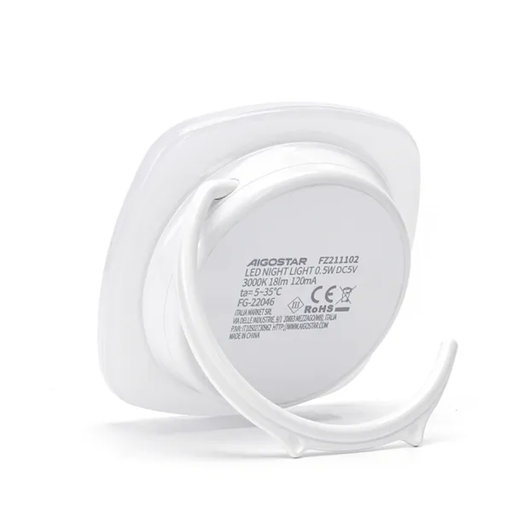
Why this product suits this profile: This compact, rechargeable solution is suitable for cupboards, hallways or under cabinets where there is no socket at the installation point.
It is powered via USB using an integrated 500-mAh battery. This eliminates the need to regularly buy disposable batteries.
18 lm, 3000 K, a detection range of 3,5 m and up to 6 hours of light according to the product specification.
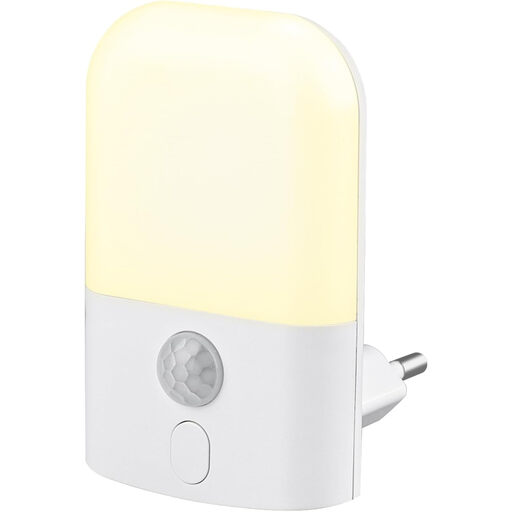
Why this product suits this profile: Five brightness levels and the combination of motion and twilight sensors allow the light to be adapted for children’s rooms, bathrooms, kitchens, hallways or staircases.
The brightness is not fixed at a single level. The automatic switch-off period of 60 seconds is also clearly stated.
0,5 W power consumption, 2700 K warm white, five levels and a range of up to 3 m with a 120° detection angle.
We have put together a complete, regularly updated list of products that fully meet these strict selection criteria and the safety regulations applicable in the EU.
Mount or plug in the device so that the sensor is not obstructed by furniture, curtains or decorative items. In a hallway, the detection direction should cross the usual path people take. In a children’s room, indirect positioning is recommended so that the light source does not shine directly into the bed.
The lifespan depends on the LED module, electronics, operating time and surroundings. Plug-in models often specify figures such as 10,000 or 25,000 hours. This figure describes the LED lifespan declared by the manufacturer and does not automatically constitute a guarantee for the entire device.
The costs depend on power consumption, daily operating time and the electricity tariff. A 1 W model uses around 0,008 kWh per day when operated for eight hours. At a tariff of 0,35 Euro per kWh, this works out at approximately 1,02 Euro per year. Motion or twilight sensors can reduce the actual operating time; batteries and charging cycles must also be taken into account for cordless models.