
Lieferung heute & morgen

Qualitätsgarantie

Willkommens-Angebote freischalten: KOSTENLOSE Lieferung | Bis zu 80 % RABATT | Kostenlose 30-Tage-JoyPlus-Testphase
App herunterladen
An LED night light with a motion sensor only switches on when it detects movement. This is useful for finding your way around at night in a hallway, bedroom, children’s room or on the stairs. However, models can vary considerably in their sensors, brightness, installation and power supply.
If you focus only on the product name or the number of LEDs, it’s easy to overlook important details. Three common buying mistakes are particularly worth avoiding:
A sensor night light may have a PIR motion sensor, a dusk sensor or a combination of both. A PIR sensor detects changes in heat radiation caused by movement. A dusk sensor only activates the light when the ambient light level is low.
For a hallway or staircase, check the following details:
For a cupboard or kitchen worktop, a shorter range is often enough. For a hallway or staircase, a wide detection angle is more important.
Brightness is measured in lumens (lm). An LED night light for a children’s room should generally provide enough light to help you find your way, while an LED cupboard light with a motion sensor is more suited to lighting a limited work area.
The colour temperature also affects how you use the light:
A dimmable night light lets you adjust the brightness to suit the room. Check whether it offers several fixed brightness levels or stepless adjustment. This is more useful than a vague marketing claim such as ‘particularly comfortable’.
A plug-in model is ready to use straight away and doesn’t need charging. Rechargeable models, on the other hand, can be positioned more flexibly on cupboards, under wall cabinets or on hallway walls.
Look out for:
Indoor lights that are sensitive to water and moisture shouldn’t be used in showers, baths or persistently damp areas unless the manufacturer specifically says they’re suitable.

Why it suits this need: This plug-in model doesn’t need batteries and offers five brightness levels for a children’s room, hallway, kitchen or staircase.
The integrated motion and dusk sensors limit activation to dark conditions; according to the product details, the light switches off after 60 seconds without movement.
Five brightness levels, warm white 2700 Kelvin light, 0,5 Watt power consumption and a detection range of up to 3 metres.
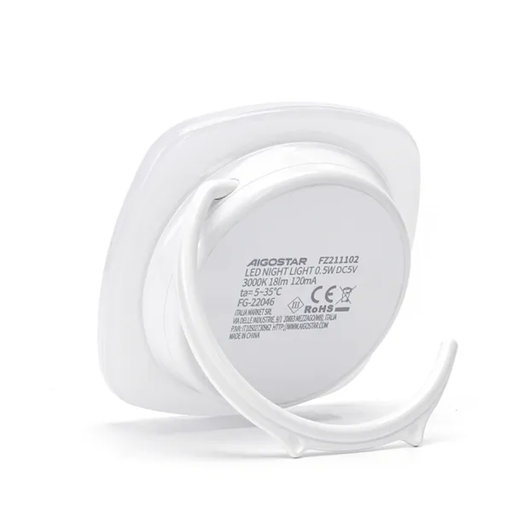
Why it suits this need: The combination of PIR and dusk sensors, along with the USB-rechargeable battery, makes it suitable for flexible positioning indoors.
The sensor specifications are clearly stated: a 3,5-metre range, 120-degree light spread and automatic activation when movement is detected.
Warm white 3000 Kelvin light, 18 Lumen, a 500-mAh battery and USB charging; according to the product details, the housing is made from ABS.

Why it suits this need: The two slim lights can illuminate cupboards, kitchen units, shelves or longer hallways without drilling.
Its slim dimensions of 200 × 38 × 10 Millimetres help it fit into tight spaces; according to the product details, PIR detection covers 3 to 5 metres.
800-mAh battery, USB charging, adhesive fixing with no drilling required, and three colour temperatures from warm to cool white.
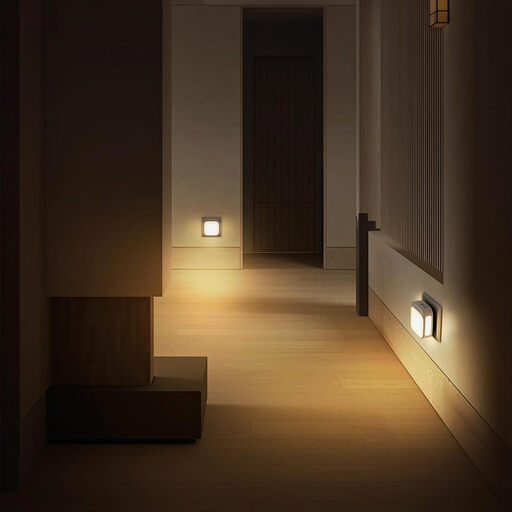
Why it suits this need: This set uses an automatic light sensor and is suitable for sockets that are always accessible in hallways, bedrooms or children’s rooms.
According to the product details, the automatic light sensor switches on at 20 Lux or below and off in daylight; there’s no battery to recharge.
0,3 Watt power consumption, stepless dimming from 10 to 100 per cent and warm white light at 2800 to 3000 Kelvin.
We’ve put together a complete, regularly updated list of products that meet these strict selection criteria and fully comply with the safety regulations in force in the EU.
Position the light so that the sensor faces the route where you expect movement. In hallways and on stairs, make sure furniture doesn’t block the detection area. For adhesive lights, the surface must be dry, clean and smooth. Test the position before fixing the light permanently.
Battery life depends on the battery capacity, brightness, how long the light stays on and how often it’s triggered. Claims such as ‘up to 6 hours’ refer to specific conditions of use and don’t necessarily mean several days on standby. A USB charging port makes it easier to recharge the light regularly.
Small LED lights often have a power consumption of 0,3 to 0,5 Watt, depending on the model. Actual consumption depends on how long and how often the light is switched on. A dusk sensor or automatic switch-off can help reduce unnecessary running time.