
Lieferung heute & morgen

Qualitätsgarantie

Willkommens-Angebote freischalten: KOSTENLOSE Lieferung | Bis zu 80 % RABATT | Kostenlose 30-Tage-JoyPlus-Testphase
App herunterladen
An LED night light with a motion sensor should switch on automatically when needed, then turn off without staying lit unnecessarily. In practice, buyers often end up with the wrong product because details about the sensor, battery or installation are unclear. So if you’re choosing lighting for your home, a family with children or the inside of a cupboard, it’s worth taking a closer look at the specifications.
A PIR sensor responds to movement and body heat. It switches on when someone moves within its detection range. A dusk sensor, on the other hand, detects the light level in the room. Some products combine both functions, while others don’t. A motion-sensor light can be useful in a hallway or on a staircase, while a plug-in light with a dusk sensor can switch on automatically when it gets dark in the bedroom.
Check the stated range, detection angle and switch-off settings. The sensor lights featured here, for example, have a stated range of 3 to 5 metres. A vague claim such as ‘responds instantly’ is no substitute for these technical details.
The number of LEDs alone tells you little about the actual light output. Lumens (lm) are a more useful measure. A 20 lm light may be enough for a bedside table, while a deep wardrobe or worktop may need more light. The model with 36 Epistar LEDs has a stated light output of 400 lm.
Colour temperature also affects how a light can be used:
A dimmable setting is useful if you want to use the same LED light in the kitchen and bedroom. For getting around at night, a lower brightness is often more comfortable than a bright light that stays on continuously.
A wireless LED light needs either batteries or a rechargeable battery. So check the battery type, capacity, charging port and power source. A rechargeable night light with a USB port can be charged flexibly using a mains adaptor, laptop or power bank. However, actual battery life depends on brightness, how often the sensor is triggered and the condition of the battery.
It’s easy to overlook the fact that the mounting surface needs to be clean, dry and as smooth as possible when using adhesive mounts. An LED light with no drilling required may not stay securely attached to wallpaper, in damp rooms or on heavily textured surfaces. If you’re using a magnetic mount, also check that you can securely attach the metal plate.
PIR sensors are useful in cupboards, on shelves and in hallways when you only want the light to come on when movement is detected. For children’s rooms and finding your way around at night, a low-brightness setting, switch-off delay or timer may also be useful. Don’t install lights where furniture, curtains or covers could block the sensor.
A USB LED night light should be charged using a compatible power source. The USB models mentioned here are designed for 5 V. Only use suitable chargers, and stop using the product if its battery is damaged or swollen. Plug-in models don’t need charging, but you’re limited to placing them near a socket.
Compact dimensions are important for narrow cupboard shelves. A profile measuring 200 × 38 × 10 mm or 300 × 38 × 10 mm may fit beneath wall cupboards and inside wardrobes. For bathrooms or outdoor areas, check that the light has a suitable IP rating. Unless a different rating is stated, the indoor lights described here are not designed for use with water or high humidity.

Why this product suits this profile: The two compact lights can be used in different spaces, such as the kitchen and hallway. They attach with adhesive strips, so there’s no need to drill.
The specifications are clear, with a PIR sensor that has a stated range of 3 to 5 m, three colour temperatures and USB charging.
21 LEDs, an 800-mAh battery, dimensions of 200 × 38 × 10 mm and a two-pack.
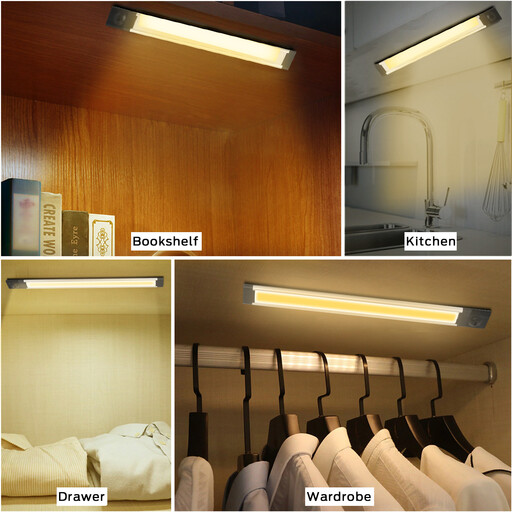
Why this product suits this profile: Its long, slim design works well in hallways, wardrobes, stairwells or work areas where stronger light is needed.
The light output, colour temperature range and mounting options are all clearly stated, rather than relying on vague descriptions of brightness.
36 SMD LEDs, 400 lm, 2,800 to 6,500 K, plus magnetic and hanging mounting options.
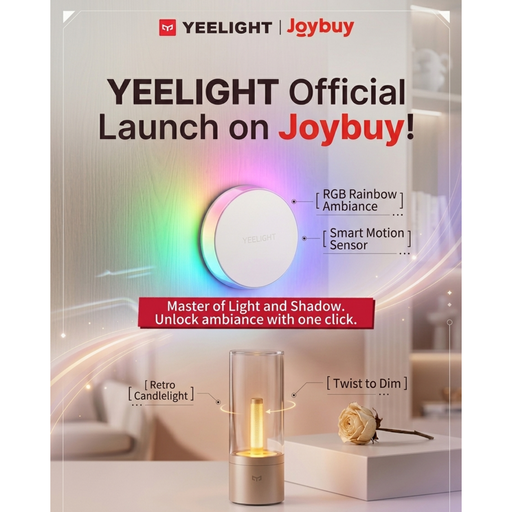
Why this product suits this profile: An RGB night light with multiple effects offers an alternative to simple low-level lighting in living rooms, bedrooms or gaming spaces.
Magnetic mounting, USB-C charging and a clearly specified sensor function reduce the need for a fixed socket or drilling.
11 preset effects, RGB lighting, a motion sensor and a USB-C rechargeable battery.
We’ve put together a complete, regularly updated list of products that meet these strict selection criteria and the safety regulations in force in the EU.
Clean and dry the mounting surface before attaching adhesive strips or a magnetic mount. Press the mount firmly into place as instructed by the manufacturer. Adhesion may be weaker on damp, dusty or heavily textured surfaces.
There’s no single answer. Battery life depends on battery capacity, brightness setting and how often the sensor is triggered. Check the stated capacity and charging port. If the light becomes noticeably dimmer, recharge the battery. Stop using the product if the battery is visibly damaged.
LED lights generally use less energy than many older types of bulb. However, power consumption, daily usage time and how often the sensor is activated all make a difference. A light that only comes on when it detects movement may use less energy in everyday use than one that stays on continuously.