
Lieferung heute & morgen

Qualitätsgarantie

Willkommens-Angebote freischalten: KOSTENLOSE Lieferung | Bis zu 80 % RABATT | Kostenlose 30-Tage-JoyPlus-Testphase
App herunterladen
An LED night light with a motion sensor should provide light at night exactly when you need it. In practice, however, models can vary considerably in their sensors, brightness, power supply and installation. So if you have children, a dark hallway or cupboards and worktops you’d like to light automatically, it’s worth taking a closer look at the technical details.
A motion sensor on its own will also react when the room is already bright enough. This can mean the light comes on during the day or when the room lights are on. For a night light for the hallway and bathroom, it makes sense to choose a model that combines motion and dusk sensors. The light will then only come on when it detects movement and the surrounding light levels are low.
A high wattage doesn’t automatically mean the light will be right for you. A moderate brightness can be more comfortable than a very bright light when you’re making your way to the bathroom at night. Check the lumen rating, available dimming levels and colour temperature. A warm white night light of around 2700 to 3000 Kelvin is often chosen for sleeping areas, while more neutral or cooler light can make it easier to see inside cupboards and kitchens.
A wireless night light is easy to position wherever you need it, but it will need regular charging. For a rechargeable night light, check the battery capacity, charging port and estimated operating time. Plug-in models don’t need charging, but they take up a socket and their position is limited by where the socket is. For cupboards, shelves and worktops, a motion-sensor cupboard light with magnetic or adhesive mounting is often more practical.
The range should suit the intended location. A few metres is often enough for a small hallway. Cupboards and kitchen units may only need a shorter range, while a larger detection angle can be useful on a staircase. Specifications such as a 3-metre range, a 120-degree detection angle or automatic shut-off after 60 seconds without movement make it easier to compare models objectively.
Make sure furniture, doors or curtains won’t block the sensor. Its actual detection range also depends on the installation height and the direction of movement.
A plug-in night light is ready to use straight away and doesn’t need batteries or charging. Figures such as 0.3 watts, 0.5 watts or 1 watt indicate the stated power consumption. Actual energy use depends on how long the light is on and how often it’s activated. For rechargeable and USB models, check the battery capacity, charging time and type of USB connection.
In wet areas, protect the light from water and high humidity unless it has a suitable IP rating, even if it’s advertised for bathroom use. Many indoor lights are designed for dry rooms only.
Colour temperature is measured in Kelvin:
A dimmable night light gives you more flexibility. Useful options include preset levels, stepless adjustment or a night mode. For products with a plastic casing, check details such as ABS or PC, information about heat build-up and whether the light is designed for indoor use. Don’t cover or dismantle the product, or leave it unattended within reach of young children.

Why it suits these needs: This plug-in model is designed for indoor use in children’s bedrooms, hallways, on stairs, and in kitchens and bathrooms. You can adjust the brightness across five levels.
The motion and dusk sensors work together. Automatic shut-off after 60 seconds without movement helps prevent the light staying on unnecessarily.
Warm white light at 2700 Kelvin, five brightness levels, 0.5 watts of power consumption and a stated detection range of up to 3 metres at 120 degrees.
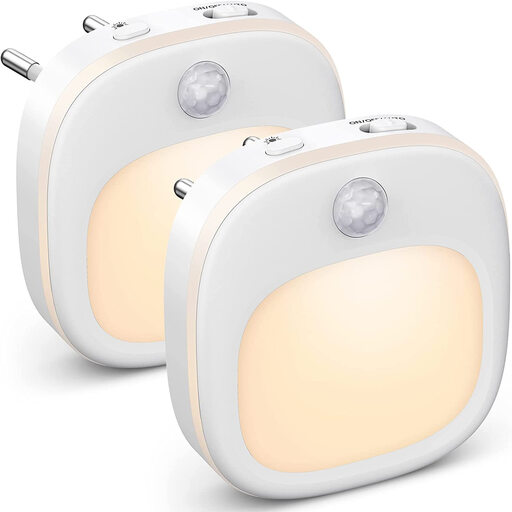
Why it suits these needs: The set includes two lights for different rooms. Five dimming levels and three stated colour temperature ranges give you plenty of flexibility.
The listed dimming levels and colour temperatures make it easier to choose the right setting, rather than relying on vague brightness claims with no specific figures.
Two lights, SMD LED technology, five brightness levels and a stated voltage range of 100 to 240 volts.

Why it suits these needs: Its slim design is ideal for kitchen units, cupboards, shelves and hallways. It attaches with adhesive tape, so there’s no need to drill.
The 1100 mAh battery capacity and USB connection are clearly specified, making it easier to plan for charging.
30 cm long, 41 LEDs, PIR detection from 3 to 5 metres, three colour temperature ranges and two lights per set.
We’ve put together a comprehensive, regularly updated list of products that meet these strict selection criteria and the safety regulations in force in the EU.
Position the light so the sensor can detect your route without being blocked by furniture. If it’s a plug-in model, make sure the socket remains accessible. Start with the lowest brightness setting, then adjust it to suit the room. Make sure the dusk sensor isn’t pointing directly at another light source.
Its lifespan depends on the LED components, electronics, operating time and power supply. Plug-in models don’t need recharging. Rechargeable lights, on the other hand, need regular charging; a drop in brightness may mean the battery needs charging or is starting to wear out. Treat manufacturers’ lifespan figures as a technical guide.
For a rough estimate, take the power consumption in watts, daily operating time and your household electricity rate into account. A 0.5-watt model uses far less energy when it only comes on briefly in response to movement than when it’s left on continuously. So wattage isn’t the only thing to consider: the automatic shut-off time and how often the light is activated also matter.