
Lieferung heute & morgen

Qualitätsgarantie

Willkommens-Angebote freischalten: KOSTENLOSE Lieferung | Bis zu 80 % RABATT | Kostenlose 30-Tage-JoyPlus-Testphase
App herunterladen
An LED night light with a motion sensor can light your way in the dark without leaving a lamp on all the time. It’s a practical choice for households with children, older people or hallways that are used frequently. However, sensor lights can vary considerably in detection, brightness, power supply and installation.
A motion sensor on its own can also be triggered in daylight. For night-time use, a dusk sensor is a useful extra. It switches the LED sensor light on only when the ambient light is low. So look for a description such as ‘PIR motion sensor and twilight sensor’, or specific details about the light threshold.
A long range might sound useful at first. But in a short hallway, it could mean the night light switches on as soon as someone walks past. So always check:
For a child’s room or bedroom, a short stay-on time is often more comfortable than a permanently active automatic night light.
A rechargeable night light doesn’t need a socket where it’s installed, but it does need regular charging. The stated battery capacity is only a guide: actual battery life depends on how often it’s triggered, its brightness and the temperature. A plug-in night light, on the other hand, doesn’t need its battery replacing, but it may block a socket.
Low light levels are often enough to light the way in a bedroom or child’s room. A warm white night light at around 2700 to 3000 Kelvin appears less bright in a room than cool white task lighting at 6000 Kelvin or more. A more neutral or cooler colour temperature may be more practical for under-cabinet kitchen lighting, drawers and work surfaces.
Look for specific details such as lumens, wattage and, where available, CRI or Ra rating. Wattage describes energy consumption, not brightness directly. A low consumption of 0.3 or 0.5 watts may be enough for orientation lighting, but it won’t replace general room lighting.
For a rechargeable model, compare the capacity, charging connection and charging instructions. The cabinet lights available with 800-mAh or 1100-mAh batteries are charged via USB. This makes them a flexible option for cupboards, shelves and under-cabinet lighting, but you’ll need a charging source within reach.
A plug-in light doesn’t need charging. Before buying, check whether it’s suitable for 220–240 volts and whether it’s intended for indoor use only. An indoor light shouldn’t be used in a bathroom close to water or outdoors.
Adhesive tape is suitable for smooth, dry surfaces. Before installation, make sure the surface is clean, grease-free and sturdy enough. With an under-cabinet light with a motion sensor or a cupboard light with a motion sensor, dimensions are particularly important. A 30-centimetre model won’t fit every narrow alcove.
For outdoor areas, check that the product is explicitly stated as suitable for outdoor use and has an appropriate IP rating. If this information isn’t provided, the product shouldn’t be used in the open air or in unprotected areas.
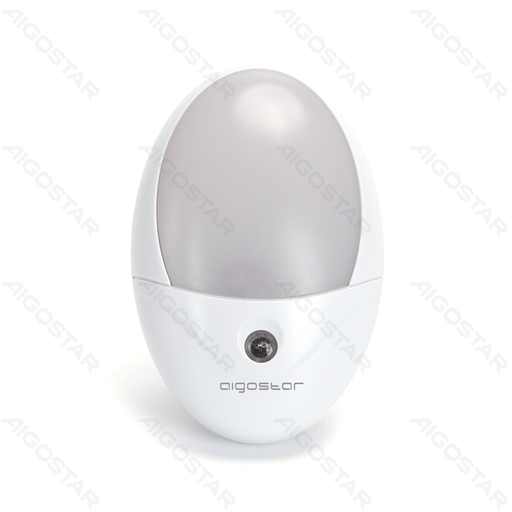
Why this product suits this profile: This plug-in light is designed for indoor hallways, bedrooms, bathrooms and stairs. It doesn’t need batteries and plugs directly into a suitable socket.
The specifications list a PIR sensor, a 120° detection angle and a range of up to 7 metres. They also specify 3000 Kelvin and 20 lumens.
Warm white light at 3000 K, 1 W power consumption, IP20 rating and direct operation from a 220–240-V socket.

Why this product suits this profile: Five brightness levels, from 20 to 100 per cent, let you adjust the light for a child’s room, hallway, kitchen or stairs.
The motion and dusk sensors are described separately. The light switches on in the dark and turns off after 60 seconds without movement.
2700 K warm white light, 0.5 W power consumption, a range of up to 3 metres and a 120° detection angle.

Why this product suits this profile: Two slim lights with PIR sensors are ideal for kitchen cabinets, wardrobes, shelves and hallways without fixed wiring.
The dimensions of 300 × 38 × 10 mm, detection range of 3 to 5 metres and recommended adhesive installation are all clearly specified.
1100-mAh battery, USB charging, 41 LEDs and three colour temperatures, from 2800–3200 K to 6500–7000 K.
We’ve put together a complete, regularly updated list of products that meet these strict selection criteria and fully comply with the safety regulations in force in the EU.
Install the light so the sensor detects the usual route from the side or straight on. If you’re using adhesive, the surface must be dry, clean and smooth. Don’t cover plug-in models. Also check that furniture, curtains or doors won’t block the sensor.
Lifespan depends on the LED components, electronics, operating time and surroundings. For rechargeable lights, you’ll also need to allow for battery ageing. If the brightness drops significantly or the battery shows signs of damage, stop using the device. Treat manufacturers’ lifespan figures as technical guidelines.
Consumption is usually low if the light is only on briefly. The key factors are power consumption, how often it’s triggered each day and how long it stays on. A 0.5-watt model that switches on briefly uses significantly less energy than a light that stays on all the time. So check the automatic shut-off as well as the wattage.