
Lieferung heute & morgen

Qualitätsgarantie

Willkommens-Angebote freischalten: KOSTENLOSE Lieferung | Bis zu 80 % RABATT | Kostenlose 30-Tage-JoyPlus-Testphase
App herunterladen
An LED night light with sensor is designed to provide guidance at night without shining brightly all the time or regularly needing new batteries. For families, parents with young children and adults in multi-person households, plug-in models are particularly appealing: they run directly from an existing socket and switch on automatically, depending on the type of sensor.
However, some common marketing claims can lead to the wrong choice. It is not just the light colour and design that matter, but the combination of sensor type, brightness, placement and technical safety specifications.
A night light with dusk sensor responds to the ambient light level. For example, it switches on when it gets dark and off again when there is enough daylight. An LED night light with motion sensor, on the other hand, only activates when movement is detected. Many models combine both functions: they only respond to movement when the room is already dark.
For a hallway that should remain softly lit throughout the night, a dedicated light sensor may be suitable. For stairs, a bathroom or a passageway, a PIR motion sensor is often more practical, as the light only comes on when needed.
Colour temperature is measured in Kelvin. 2700 to 3200 Kelvin is generally described as warm white. A specification of 4000 to 4500 Kelvin is much closer to neutral white, even though some product descriptions also refer to it as warm white.
Colour temperature also says nothing about the amount of light produced. This is determined by the luminous flux in lumens (lm). 20 lm is more suitable for subtle guidance, while 40 lm can illuminate a larger area more visibly. For a bedroom or children’s bedroom, a softer brightness is often more comfortable than strong illumination.
A plug-in night light must not unnecessarily block neighbouring sockets, switches or furniture. Therefore, check the dimensions and the position of the sensor. If the sensor is blocked by a piece of furniture, a curtain or a cover, the automatic night lighting may respond unreliably.
The IP rating is also important for indoor use. IP20 indicates protection for dry indoor areas, not against direct contact with water. An IP20 model should therefore not be used in damp areas or close to splashing water.
A light sensor is suitable for constant orientation lighting. A motion sensor is better suited to routes where people only pass through briefly.
For a night light for a children’s bedroom or bedroom, warm-white versions with around 2700 to 3000 Kelvin are an obvious choice. They create a less cool-feeling atmosphere than cool white at 6500 Kelvin. However, this does not mean that a particular colour temperature is automatically suitable for everyone.
A dimming function expands the possible uses. The Grifema model, for example, offers five brightness levels from 20 to 100 per cent. Also check whether it is operated using buttons, touch controls or a switch, and whether the last selected setting is saved.
An energy-saving night light using 0.5 or 1 watt requires comparatively little electrical power during operation. Plug-in models do not need batteries and do not have to be recharged. Rechargeable models can be positioned more flexibly, but need to be charged regularly.
Check whether the light stays on continuously or switches off automatically after a set period. The actual running costs depend on how long the product is lit each day. With a motion sensor and a short switch-off delay, everyday consumption may be lower than with continuous lighting.
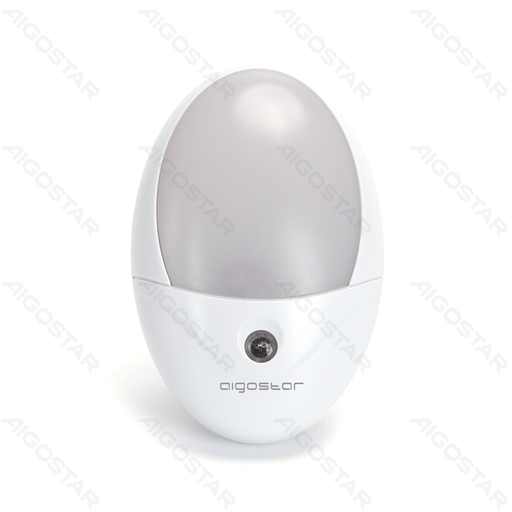
Why this product suits this profile: This plug-in model works without batteries or a charger and uses a PIR sensor for automatic lighting in dark indoor areas.
The product specifications clearly state PIR detection, a 7-metre range, a 120-degree detection angle and IP20 for dry indoor areas. This makes it easier to assess where it can be used before buying.
3000 Kelvin, 20 lm, 1 watt power consumption and automatic switch-off after inactivity is detected.

Why this product suits this profile: The combination of motion and dusk sensors, together with five brightness levels, offers several adjustment options for children’s bedrooms, hallways and stairs.
The brightness is not limited to a single fixed level. Automatic switch-off after 60 seconds without movement can also help prevent unnecessary continuous lighting.
2700 Kelvin, five levels, 0.5 watt power consumption, a detection range of up to 3 metres and 120 degrees.
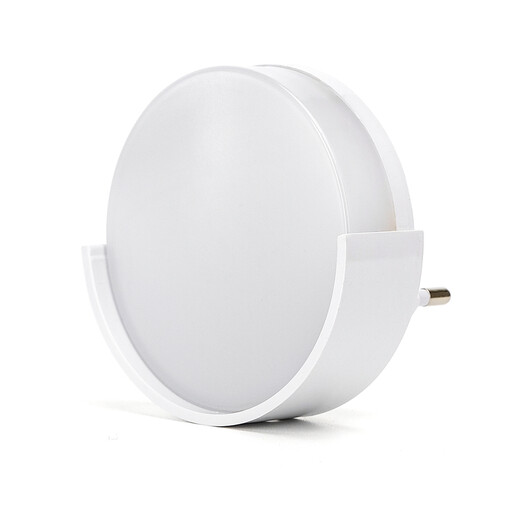
Why this product suits this profile: For hallways or stairs that should provide continuous guidance in the dark, a model with a light sensor and direct plug-in operation is an obvious solution.
The stated switch-on level of below 20 lux makes the sensor principle clear. The product data also specifies IP20 and use exclusively indoors.
1 watt, 40 lm, 120-degree beam angle, 220–240 volts and a stated LED lifespan of 25,000 hours.
One important difference should be noted with this selection: the technical specifications for the Aigostar model state 6500 Kelvin, meaning white, relatively cool light, even though the product name describes an orientation lamp. If you are specifically looking for a warm-white night light, check the colour temperature particularly carefully before buying.
We have put together a complete, regularly updated list of products that fully meet these strict selection criteria and the safety regulations applicable in the EU.
Position a night light for hallways and stairs so that the sensor detects the usual direction of movement. In a children’s bedroom, the socket should remain freely accessible and the device should not be covered. Plug-in models with IP20 are intended for use in dry indoor areas.
Unplug the light before cleaning it. Use a soft, dry cloth, and do not open or modify the device. The socket and mains voltage must match the manufacturer’s specifications; for the plug-in models mentioned, 220–240 volts or 100–240 volts are specified, depending on the product.
A PIR sensor detects changes in heat radiation caused by movement. With combination models, motion detection is additionally restricted to dark ambient conditions. Depending on the model, the lamp then switches off again after a short period or following a set switch-off delay.
The models mentioned use around 0.5 to 1 watt. Actual running costs depend on the electricity price, operating time and sensor behaviour. A night light with a dusk sensor may remain lit for many hours, while a motion sensor usually limits the lighting time to individual activations.
The stated lifespan varies from model to model. The product specifications, for example, list 10,000 or 25,000 hours. This figure is a technical manufacturer specification and is not a guarantee of the total lifespan of the entire device. Frequent switching, heat and ambient conditions can affect how long it remains usable.