
Lieferung heute & morgen

Qualitätsgarantie

Willkommens-Angebote freischalten: KOSTENLOSE Lieferung | Bis zu 80 % RABATT | Kostenlose 30-Tage-JoyPlus-Testphase
App herunterladen
An LED night light with sensor should provide automatic guidance at night without shining brightly all the time. For families, older people and households with dark hallways or staircases, however, choosing the right model is not simply a question of design. The sensor type, light output, power supply and intended location are all crucial.
Many disappointing purchases result from three common marketing pitfalls:
A night light with a dusk sensor switches on and off depending on the ambient brightness. Specifications such as “below 20 lux” describe the threshold at which the sensor detects darkness. These models are suitable for providing continuous guidance in hallways, bedrooms or children’s rooms.
A night light with a motion detector also responds to movement. Look out for:
For stairs and hallways, combining a motion sensor with a dusk sensor is practical because the light is only activated when it is dark and movement is detected. In a child’s room, on the other hand, a permanently dim orientation light may be more comfortable.
Colour temperature is measured in Kelvin:
Brightness is measured in lumens. 8 to 20 lumens are often enough for guidance close to a socket. 30 lumens or more can illuminate a larger area. A dimmable night light with several settings allows you to adjust the brightness more precisely to the room and time of day.
An LED plug-in night light should be designed for 220 to 240 volts and fit fully into a suitable UK socket. Also check whether adjacent sockets remain accessible and whether the housing is made from heat-resistant or flame-retardant plastic.
The following details are also relevant for electrical household devices:
Even if a model is advertised as a bathroom night light, it should not be used directly beside a washbasin, shower or bath unless an adequate moisture-protection rating is specified.
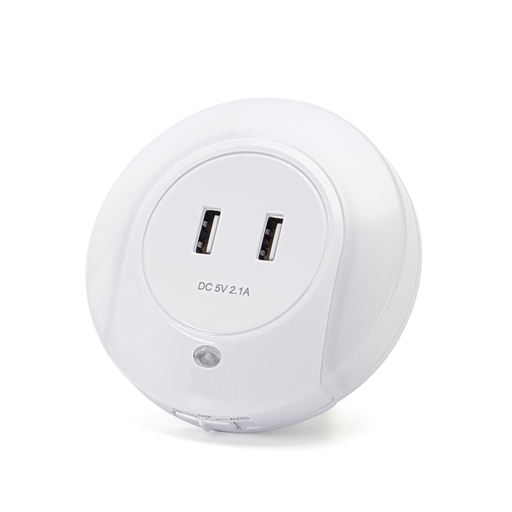
Why this product suits this profile: This plug-in model combines a discreet orientation light with two USB ports for charging small devices. Its specified power consumption of 0.4 W and warm white 3000 K light are suitable for hallways, bedrooms or children’s rooms.
The low light output of 8 lm reduces the risk of excessively bright illumination. Before buying, check whether the desired sensor function is included in the specific version.
0.4 W power consumption, 3000 K colour temperature, 120-degree beam angle and two USB ports.

Why this product suits this profile: Five brightness levels, warm white 2700 K light and a specified detection range of up to 3 metres allow precise adjustment for children’s rooms, hallways or stairs.
According to the product details, movement is detected only in dark surroundings. The automatic switch-off after 60 seconds without movement reduces unnecessary operating time.
Five brightness levels, 0.5 W power consumption and a combined motion and dusk sensor.

Why this product suits this profile: Two independently positionable lights with a USB connection are suitable for areas without a spare socket, such as inside a cupboard, in a hallway, beside a bed or on a stair landing.
The 500 mAh battery capacity and specified runtime of up to 10 hours in sensor mode make the power supply easy to assess. Regular charging is still required.
Three colour temperatures, five brightness levels, PIR sensor with a range of 3 to 5 metres and USB charging at 5 V/1 A.
Power consumption is measured in watts. A model using 0.4 W consumes approximately 0.4 kWh over 1,000 operating hours. With a motion detector, actual consumption is usually lower because the LED is not illuminated continuously. For an accurate cost calculation, multiply the consumption in kilowatt-hours by your current electricity tariff.
The stated service life of 10,000 to 25,000 hours is a manufacturer’s figure based on defined conditions. It does not automatically indicate how long the sensor, housing or charging electronics will function in everyday use. For this reason, keep the light in dry indoor areas, ensure the sensor surfaces remain unobstructed and use the power supply specified by the manufacturer.
We have put together a complete, regularly updated list of products that fully meet these strict selection criteria and the safety regulations applicable in the EU.
Position the light so that the sensor is not obscured by curtains, furniture or other lights. In a hallway, the beam should reach the floor and any potential trip hazards. With a motion detector, an unobstructed view of the usual route is important.
Service life depends on the LED, electronics, heat generation and operating time. Manufacturer specifications of 10,000 or 25,000 hours generally refer to the light source. With a rechargeable night light, you should also take battery ageing into account.
With power consumption of 0.5 W, 1,000 hours of operation uses 0.5 kWh. Consumption may be lower when the sensor is active. The actual cost depends on your electricity tariff and the amount of time the light is switched on.