
Lieferung heute & morgen

Qualitätsgarantie

Willkommens-Angebote freischalten: KOSTENLOSE Lieferung | Bis zu 80 % RABATT | Kostenlose 30-Tage-JoyPlus-Testphase
App herunterladen
An LED night light with sensor should provide guidance at night without staying on constantly or using unnecessary electricity. In practice, however, unclear information about the sensor type, light colour and intended use often leads to unsuitable purchases. Three common pitfalls are particularly important:
By checking these points before buying, you can more easily find the right LED orientation light for a hallway, stairs, bedroom or children’s room.
An LED night light with motion sensor switches on when movement is detected. The key factors are its range, detection angle and switch-off time. A model with a range of 7 metres and a detection angle of 120 degrees will cover a hallway differently from a night light with a range of 3 metres.
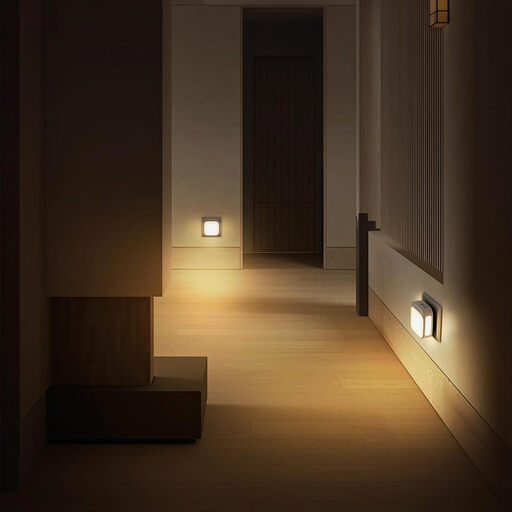
A night light with dusk sensor, on the other hand, measures the ambient brightness. It switches on when it gets dark and off in daylight. This is ideal for areas where continuous night-time guidance is preferred, such as next to a socket in the hallway or bedroom.
Combined models use both principles: they only respond to movement when the surroundings are sufficiently dark. This often makes them suitable for bathrooms, stairs and passageways.
Colour temperature is measured in Kelvin:
You should also consider the luminous flux in lumens. A night light with 20 lumens provides subtle guidance, while 300 lumens can deliver significantly stronger illumination from a portable outdoor light. A dimming function is useful if you plan to use a model in several different locations.
A plug-in night light is ready to use immediately and requires neither battery changes nor a charger. This option is suitable for indoor areas where the light will be used continuously. Check the stated mains voltage of 220–240 V, and make sure that both the socket and the product are undamaged.
A battery-free night light may run on mains electricity, USB power or an integrated rechargeable battery. Rechargeable models can be mounted flexibly on cupboards or walls, but they need to be charged regularly. With battery-powered versions, keeping replacement batteries available and checking the charge level are part of the ongoing maintenance.
For indoor use, housings made from PC or ABS are standard. Products with a direct mains connection should not be covered, so that heat can escape properly. A marking such as CE indicates compliance with relevant EU requirements; electronics may also carry the RoHS marking.
The protection rating is crucial for the intended location:
A children’s room night light should be installed out of the reach of small children. It is not a toy. For stairs and hallways, choose a position where the sensor will not be blocked by furniture, curtains or decorations.
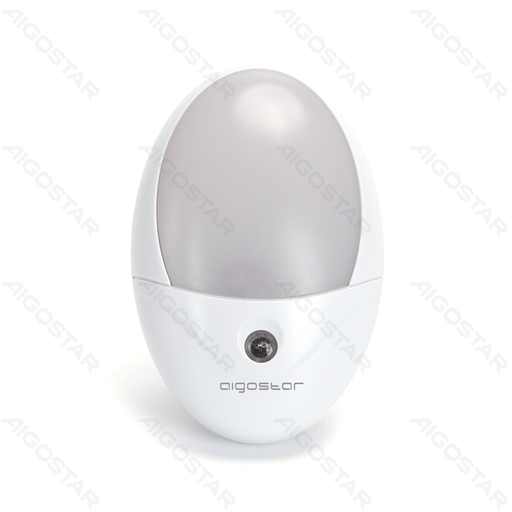
Why this product suits this profile: This compact plug-in model combines warm white light with a PIR motion sensor and is suitable for indoor hallways, bedrooms, bathrooms and stairs.
According to the product information, the sensor operates in darkness and when movement is detected. This prevents the light from being activated unnecessarily during the day.
3000 K warm white light, 20 lumens, a detection range of 7 metres and a detection angle of 120 degrees; no batteries required.
Why this product suits this profile: Two lights with dusk sensors and stepless dimming allow you to tailor the lighting for a baby’s room, hallway or bedroom.
The stated automatic switching on and off is linked to the ambient brightness. Dimming reduces the risk of the light being too intense for the room.
0.3 W power consumption, 10–100 per cent stepless dimming, 2800–3000 K and two lights in the set.

Why this product suits this profile: This portable light with rechargeable battery, USB charging cable, magnetic mounting and IP44 protection is suitable for sheltered entrances, patios or paths.
The stated IP44 protection rating sets it apart from indoor lights rated IP20 only. However, it is not designed for constant exposure to moisture or high-pressure water.
300 lumens, 3000 K, integrated rechargeable battery, USB charging and motion sensor; it also features magnetic mounting.

Why this product suits this profile: Five brightness levels plus motion and dusk sensors make this plug-in model adaptable for children’s rooms, hallways, kitchens or stairs.
According to the product description, the combination of darkness detection and motion prevents unnecessary activation. The light switches off automatically after 60 seconds without movement.
0.5 W power consumption, 2700 K warm white light, five brightness levels, a range of 3 metres and a detection angle of 120 degrees.
We have put together a complete, regularly updated list of products that fully meet these strict selection criteria and the safety regulations applicable in the EU.
Plug a plug-in model into a suitable, intact socket and position it so that the sensor and light outlet remain unobstructed. With a motion sensor, the expected route should be within the stated detection range. A dusk sensor must not be blocked by furniture or other objects.
The service life depends on the model and the number of switching cycles. For example, the Aigostar model with light sensor is specified as having 25,000 hours and 12,500 switching cycles. These manufacturer figures are guidelines and do not guarantee an identical service life in every household.
Many orientation lights have a power consumption of between 0.3 and 1 watt. A 0.5-watt model used for 10 hours a day would theoretically consume 5 watt-hours per day. The actual electricity costs depend on your individual tariff and the operating time. Dusk or motion sensors can limit the lighting duration even further.