
Lieferung heute & morgen

Qualitätsgarantie

Willkommens-Angebote freischalten: KOSTENLOSE Lieferung | Bis zu 80 % RABATT | Kostenlose 30-Tage-JoyPlus-Testphase
App herunterladen
An LED night light with sensor is designed to provide orientation at night without anyone having to search for the light switch. For families with children, parents of babies and toddlers, and adults living in flats or houses, different locations may be relevant: children’s bedrooms, bedrooms, hallways, bathrooms, stairs, cupboards and outdoor areas.
Many products look similar at first glance. However, differences in sensor type, light colour, power supply and protection rating determine whether a night light with motion sensor is genuinely practical for everyday use. The following criteria can help you avoid unnecessary poor purchases.
A night light with dusk sensor responds to the brightness in the room. It switches on, for example, when the ambient light falls below a certain lux value, and remains switched off when there is sufficient light.
A night light with motion sensor, on the other hand, uses a PIR sensor. It activates when movement is detected – usually only when it is dark enough at the same time. This combination can be useful in a hallway or on a staircase, while a permanently dimmed orientation light in a child’s bedroom is more likely to use a dusk sensor.
Moderate brightness is often sufficient for finding your way around at night. Light that is too bright can be distracting in a bedroom or child’s bedroom. This means that it is not just the lumens that matter, but also the beam angle, mounting position and light colour.
An LED night light in warm white at around 2700 to 3000 Kelvin is often perceived as less harsh. Neutral or cool white light, by contrast, can make outlines more clearly visible. The right choice depends on the room and your personal requirements.
A rechargeable LED night light can be fitted flexibly to cupboards or walls, but it needs to be recharged regularly. A plug-in model requires neither batteries nor charging cycles, but remains tied to an existing mains socket.
Before buying, you should also check whether the product is intended for dry indoor areas. The IP20 rating is designed for indoor use and offers no protection against water. For covered outdoor areas, a model with a suitable protection rating such as IP44 should be used.
Pay attention to the specific sensor information:
For a hallway light with motion sensor, the detection angle and range are particularly important. A model with a 120-degree detection angle may be suitable for a passageway, while a shorter range may be sufficient in a small bathroom.
Light colour is measured in Kelvin. Warm white typically falls within the range of around 2700 to 3000 Kelvin. For a night light for a child’s bedroom, low brightness with gentle light distribution can be a sensible choice. For a night light for stairs or a longer hallway, sufficient lumens and good illumination are more important.
A dimmable night light offers additional flexibility. Check whether the brightness can be adjusted in steps or continuously, and whether the setting is retained after the light is switched off.
With plug-in models, you should consider the mains voltage, design and whether the second socket is still accessible. A compact plug-in night light should avoid unnecessarily blocking the adjacent socket wherever possible.
Magnetic or adhesive models are suitable for cupboards, shelves or kitchen units. A cupboard light with sensor should be securely attached so that it cannot fall down. With rechargeable devices, battery capacity, charging port and stated runtime are important points for comparison.
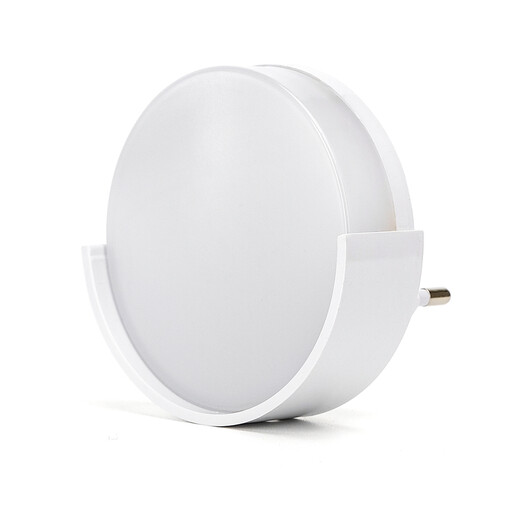
Why this product suits this profile: This plug-in night light requires neither batteries nor a rechargeable battery and, according to the product details, switches on automatically below 20 lux.
The dusk sensor eliminates the need for manual operation. Use is limited to indoor areas with an IP20 rating.
1 W power consumption, 40 lm, 6500 K and a stated LED lifespan of 25,000 hours.

Why this product suits this profile: Five brightness levels, warm white light at 2700 K, plus motion and dusk sensors make it suitable for households with different requirements.
Automatic switch-off after 60 seconds without movement limits unnecessary operating time. According to the product details, the device is intended for dry indoor areas.
0.5 W power consumption, detection range of up to 3 m and five adjustable brightness levels.
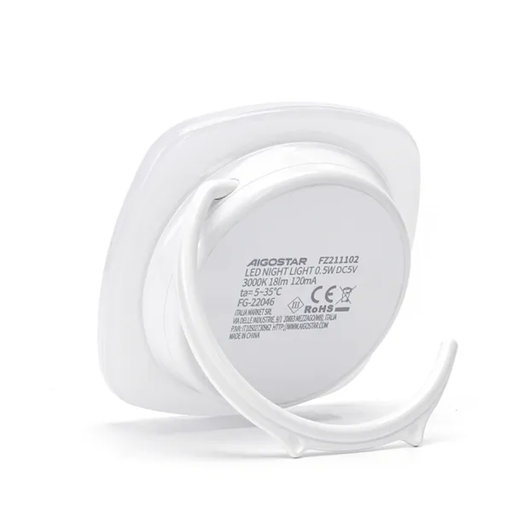
Why this product suits this profile: This rechargeable LED night light is designed for cupboards, hallways and areas without a suitable socket.
The combination of PIR and dusk sensors reduces accidental activation in daylight. The rechargeable battery needs to be topped up regularly.
500-mAh battery, USB charging, 3000 K, 18 lm and a stated detection range of up to 3.5 m.

Why this product suits this profile: For entrances, patios or garages without a fixed power connection, this light offers battery power and magnetic mounting.
The IP44 rating is intended for the specified outdoor area. Before installation, you must still ensure that the light is protected from direct high-pressure water.
4 W, 300 lm, 3000 K, integrated rechargeable battery, USB cable, magnetic mounting and IP44 rating.
We have put together a complete, regularly updated list of products that fully meet these strict selection criteria and the safety regulations applicable in the EU.
A plug-in model should be positioned so that neither the sensor nor the LED is obscured by furniture, curtains or decorations. With a motion sensor, a position that captures the usual walking route is recommended. On stairs, the light should not be installed in a way that causes glare or obscures the edge of the steps.
Lifespan depends on the LED, electronics, switching cycles and operating time. Product specifications such as 10,000 or 25,000 hours are the respective manufacturer’s guidelines and are not a guarantee of identical service life in the home. With rechargeable models, you should also take into account the ageing of the integrated battery.
The power consumption of the models mentioned here ranges from 0.3 to 4 W. A dusk sensor can switch the light off during the day, while a motion sensor limits how long it stays on. Ongoing costs therefore depend on power consumption, actual operating time and your electricity tariff. The specific calculation should be based on the energy consumption shown on the product label.