
Lieferung heute & morgen

Qualitätsgarantie

Willkommens-Angebote freischalten: KOSTENLOSE Lieferung | Bis zu 80 % RABATT | Kostenlose 30-Tage-JoyPlus-Testphase
App herunterladen
An LED night light with sensor is designed to provide orientation at night without shining permanently or needing to be switched on manually. For families, older people and adults, this sounds straightforward at first. In practice, however, unclear sensor specifications, unsuitable light colours and inappropriate designs often lead to disappointing purchases.
A night light with a dusk sensor reacts to ambient brightness. It switches on, for example, when the light level drops below 20 lux and stays active in darkness. A night light with a motion detector, on the other hand, reacts to movement and switches off again after a set period.
For a hallway or staircase, a motion detector can be useful because the light only activates when you walk past. In a child's or baby's room, a dusk sensor may be more suitable if you need a constant, gentle source of orientation. Product descriptions that only vaguely mention "automatic activation" should therefore be examined more closely.
The label "LED night light nursery" says nothing about the light colour on its own. 6500 Kelvin corresponds to a rather cool white light, whereas 2700 to 3000 Kelvin is considered warm white. Warm white night light is often seen as more subtle for bedrooms, hallways and nurseries. What matters are the specific manufacturer specifications, not just the product photos.
Brightness should also suit the surroundings. 20 lumens can be enough for discreet orientation, while a stronger light in a small bedroom may feel intrusive. A dimmable night light offers more flexibility.
An energy-saving night light should be listed with a clear power rating. Models using 0.3 or 0.5 watts consume less energy with daily use than lights with higher power draw. With a night light that has a motion detector, the short activation time can also help limit ongoing consumption.
Also pay attention to whether batteries, a rechargeable battery or a plug socket is required. A plug-in night light is ready to use immediately and doesn't need charging. A rechargeable night light, on the other hand, can be placed flexibly but requires regular charging cycles.
Check whether the product has a dusk sensor, a PIR motion sensor or both functions. Also relevant are:
A model with a 3-metre range and a 120-degree detection angle is suitable for short stretches in a hallway. For larger rooms, positioning needs particularly careful thought. A blocked sensor can impair performance.
For sleeping areas, 2700 to 3000 Kelvin is often chosen. Cool white 6500 Kelvin may be more suitable for hallways, stairs or entrance areas. Alongside colour temperature, lumens, CRI value and dimmability are important points of comparison.
A CRI value of at least 80 describes colour rendering based on the stated technical parameter. It is not a medical quality guarantee. With a dimmable model, the description should state whether brightness is adjusted in fixed steps or continuously.
A plug-in model should ideally not block neighbouring sockets. Compact dimensions are especially helpful in hallways and tight spaces. For bathrooms or damp rooms, the stated IP rating must be checked. A model with IP20 is, according to the product information, intended only for dry indoor areas and is not splash-proof.
For products made from PC or ABS, follow the care instructions and notes on heat generation. The night light must not be covered, taken apart or submerged in water. Plug-in models rated for 220–240 volts should only be used with suitable, intact wall sockets.

Why this product fits the profile: Two plug-in lights with an automatic dusk sensor and three brightness levels are suitable for several rooms, such as a nursery and hallway.
The specifications state 2700 Kelvin, 0.5 watts and three adjustable brightness levels rather than just vague marketing claims.
Warm white light, 3-level dimming, 2-pack and automatic on/off based on ambient daylight.

Why this product fits the profile: This model combines a motion sensor and dusk sensor, and offers five defined brightness levels for different indoor areas.
The product information clearly distinguishes between motion detection and darkness. The automatic shut-off occurs after 60 seconds without movement.
2700 Kelvin, 0.5 watts, up to 3 metres detection range, 120-degree detection angle and five brightness levels.
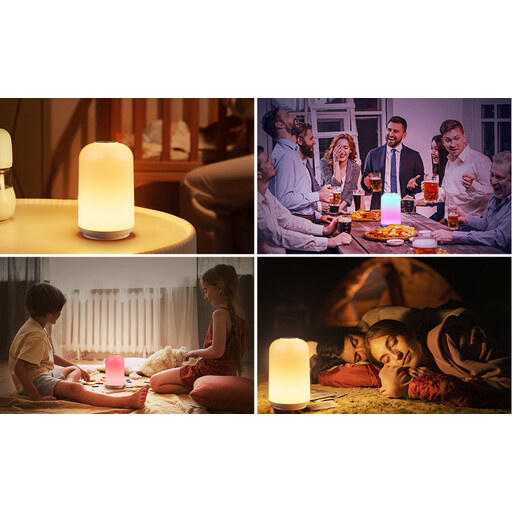
Why this product fits the profile: The rechargeable night light is ideal for users who want flexible placement without a permanently occupied socket.
The specifications mention automatic activation at a maximum of 40 lux and an integrated rechargeable battery. This makes the sensor type and power source clear.
Warm white light at 2600–2800 Kelvin, stepless brightness control, 40 lumens and USB charging at 5 volts/1 amp.
We've put together a complete, regularly updated list of products that fully meet these strict selection criteria and the safety regulations in force in the EU.
The sensor should not be blocked by furniture, curtains or decorations. In a hallway, a position near the walking path is recommended, but not directly opposite a strong light source. With a plug-in model, the light should sit freely and not be covered.
The lifespan depends on the model and the manufacturer's specifications. One product, for example, states an LED lifespan of 25,000 hours, while another states 10,000 hours. With rechargeable models, the battery capacity and stated run time are also relevant. The VIVREAL model offers up to 6 hours at maximum brightness, according to the product information.
The cost depends on the power rating, daily operating time and your electricity tariff. With a power consumption of 0.3 watts, the consumption with continuous use is theoretically low. Models with a motion detector can also only light up when movement is detected. For an accurate estimate, you should calculate the wattage, usage time and your own electricity price together.