
Lieferung heute & morgen

Qualitätsgarantie

Willkommens-Angebote freischalten: KOSTENLOSE Lieferung | Bis zu 80 % RABATT | Kostenlose 30-Tage-JoyPlus-Testphase
App herunterladen
An LED night light with sensor should provide guidance at night without keeping the room brightly lit. Automatic control is practical for families, older people and households with dark hallways or staircases: depending on the model, the light responds to ambient brightness, movement or both conditions.
However, some marketing claims can lead to poor purchasing decisions. A high lumen rating is not automatically suitable for a bedroom, a motion sensor does not replace a twilight sensor, and a long service life says little about everyday usability if the device is installed in the wrong place.
A night light with motion sensor switches on when it detects movement. A night light with twilight sensor, on the other hand, responds to ambient brightness and often stays on continuously when it is dark. Some models combine both functions.
For a hallway where light is only needed briefly, a PIR motion sensor with automatic switch-off is a sensible choice. In a children’s room or plugged into a socket beside the bed, a twilight sensor on its own may be more comfortable, provided the brightness remains low.
An LED generally uses very little electricity. However, the decisive factors are power consumption, operating mode and switch-off behaviour. A 1-watt plug-in light that remains active for many hours may use more energy in everyday use than a battery-powered night light that only comes on briefly when movement is detected.
For rechargeable devices, you should also check the charging time, battery capacity and runtime. With battery-powered models, the required batteries are not always included.
Higher brightness can be helpful in hallways and on staircases. In bedrooms, nurseries or bathrooms at night, however, subdued lighting is often preferred. Warm white light at around 2700 to 3200 Kelvin looks less cool than 6500 Kelvin.
The lumen rating describes luminous flux. It should suit the intended location: 8 to 20 lumens are often enough for orientation lighting, while 30 to 40 lumens can illuminate a larger area.
Pay attention to the exact description:
With a model offering a 7-metre detection range and a 120-degree detection angle, the socket should be positioned so that the sensor is not obstructed by furniture, curtains or decorations. On staircases, it is also important that movement is detected from the usual direction of travel.
An LED plug-in night light requires neither batteries nor regular charging. It is suitable for sockets that are used continuously in hallways, bedrooms or children’s rooms. When installing one, check whether the sensor blocks neighbouring sockets or switches.
A battery-powered night light can be installed independently of a socket on cupboards, shelves or in the cellar. A rechargeable night light can be charged via USB and used flexibly. The stated runtime usually refers to a specific operating mode and should not be understood as a general usage duration.
Warm white versions with 2700 to 3200 Kelvin are a natural choice for sleeping areas. Models with several colour temperatures and dimming levels allow you to adjust the lighting for children’s rooms, bathrooms or hallways.
For indoor use, specifications such as 220–240 volts, IP20 or IP25, CE marking and suitable housing material are relevant points to check. IP20 is intended only for dry indoor areas. Even a device with a higher protection rating is not automatically suitable for direct contact with water. Plug-in night lights should not be covered and should be disconnected from the mains before cleaning.
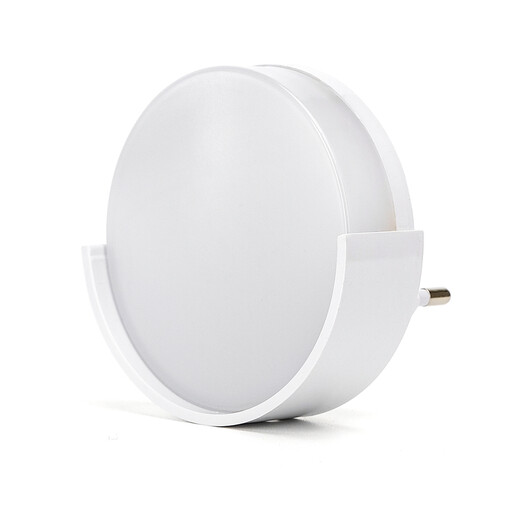
Why this product suits the profile: This plug-in model is ideal for households looking for straightforward automatic lighting without batteries or a charger.
According to the product specifications, the integrated light sensor switches on below 20 lux and off when there is sufficient brightness. Power consumption is 1 W.
6500 K, 40 lumens, a 120-degree beam angle and a stated service life of 25,000 hours.
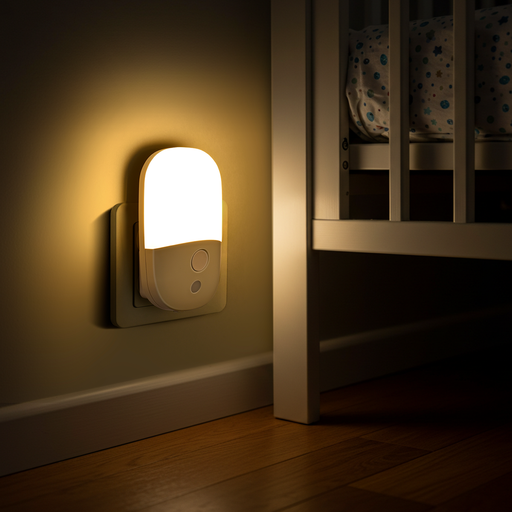
Why this product suits the profile: This version offers warm white light and adjustable brightness for bedrooms, children’s rooms, hallways and staircases.
The stated colour temperature of 2700 K and adjustable brightness help prevent lighting that is excessively cool or bright.
Plug-in operation, twilight control and warm white light for continuous orientation lighting.
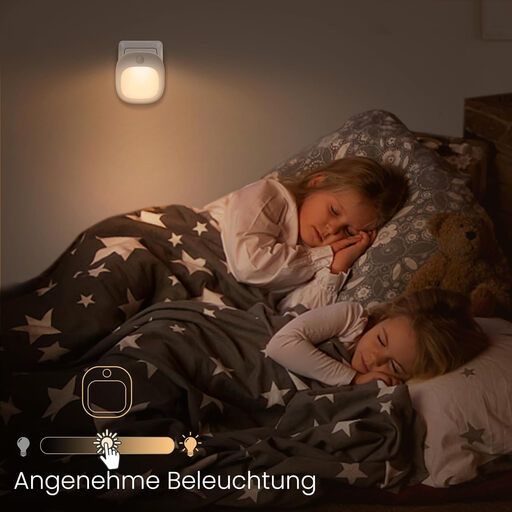
Why this product suits the profile: This set is suitable for rented homes, cupboards, hallways or areas without an available socket, and can be charged via USB.
The product specifications state a motion detection range of 3 to 5 metres, a darkness threshold of no more than 20 lux and a runtime of up to 10 hours in sensor mode.
500-mAh battery, three colour temperatures and five brightness levels at 30 lumens.

Why this product suits the profile: The combination of motion and twilight sensors is designed for children’s rooms, bathrooms, kitchens, hallways and staircases.
According to the description, the light switches on when movement is detected in dark surroundings and off after 60 seconds without movement.
Five brightness levels, 2700 K warm white light, 0.5 W power consumption and a detection range of up to 3 metres.
We have put together a complete, regularly updated list of products that fully meet these strict selection criteria and the safety regulations applicable in the EU.
Consumption depends on the power rating and operating time. At 0.3 watts, 1,000 operating hours use 0.3 kilowatt hours. A motion sensor can reduce the amount of time the light is active. To calculate the exact cost, multiply the consumption in kilowatt hours by your electricity price.
Depending on the model, product specifications may state an LED service life of between 10,000 and 25,000 hours, for example. For rechargeable and battery-powered models, the runtime per charge or battery set is also important. Sensor range, switch-off time and daily use all affect the practical maintenance required.
Warm white light at around 2700 to 3200 Kelvin is often chosen for bedrooms and children’s rooms because it looks less cool than 6500 Kelvin. The actual brightness, positioning and the ability to dim the light when needed remain decisive. It is not possible to make a general statement about suitability for every individual situation.