
Lieferung heute & morgen

Qualitätsgarantie

Willkommens-Angebote freischalten: KOSTENLOSE Lieferung | Bis zu 80 % RABATT | Kostenlose 30-Tage-JoyPlus-Testphase
App herunterladen
An LED night light with sensor can provide orientation at night without having to keep a bright room light on permanently. For families with children, parents of babies and toddlers, as well as households with dark hallways or stairs, automatic activation is incredibly practical. However, the type of sensor, light colour, mounting method and power supply vary significantly.
If you only focus on a low price or a high lumen rating, you might end up buying a model that is too glaring for the bedroom, reacts too slowly in the hallway, or has no suitable mounting point in a cupboard. The selection below is based on verifiable product data and typical usage scenarios.
An LED night light with motion detector reacts to movement. A night light with twilight sensor, on the other hand, measures the ambient brightness and switches on when it gets dark. Some models combine both functions.
For a hallway where you only need the light when you enter, a PIR sensor makes sense. For a socket in a child’s room, a twilight sensor can be more practical if you want a steady source of orientation throughout the night.
For finding your way next to the bed or on the way to the toilet, just a few lumens are often enough. A very bright light can be disruptive in a dark room. So pay attention to luminous flux in lumens, colour temperature in Kelvin and any available dimming levels.
A warm white night light between roughly 2700 and 3200 Kelvin looks visually more subdued than cool white light at 6500 Kelvin. This isn’t a medical statement, but a practical assessment of how the light affects the room.
A wireless LED night light with a rechargeable battery doesn’t need a socket at the mounting location. However, it does need to be charged regularly. With a USB rechargeable night light, you should check the battery capacity, charging port and stated run time. A plug-in model, on the other hand, doesn’t require a charging cycle, but it does block the respective power outlet.
With a PIR motion sensor, range and detection angle are crucial. The Aigostar NL01 variant, for example, states a detection range of up to 7 metres and an angle of 120 degrees. Other models are designed for 3 to 5 metres and are better suited for beds, cupboards or short hallway sections.
Check the mounting location: a sensor behind furniture, curtains or objects will detect movement less effectively. A twilight sensor should not be directly illuminated by another lamp.
For bedrooms, children’s rooms and nighttime routes, a warm white night light of around 2700 to 3000 Kelvin is often chosen. For work surfaces or searching in a cupboard, more neutral or cool white light can be more useful.
Dimming functions increase adaptability. According to the product specifications, the GRIFEMA model offers five brightness levels from 20 to 100 percent. Other lights offer three colour temperatures, for example warm white, neutral white and cool white.
The power consumption of the plug-in models described is between 0.4 and 1 watt. A device using 0.4 watts theoretically consumes less than 1 kWh over 1,000 hours of operation. The actual cost depends on your electricity tariff and the real operating time.
For a night light plug-in model, the mains voltage must match your household supply; the models mentioned are designed for 220 to 240 volts. For cupboards and shelves, USB models with 5 volts are suitable. The IP20 rating indicates use in dry indoor areas only. Such products are not intended for use near water, sinks or showers.
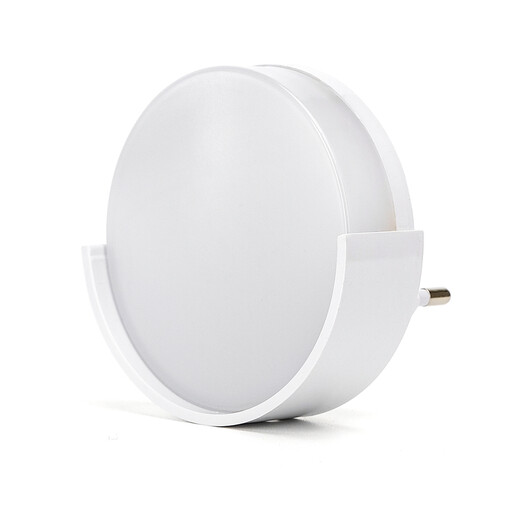
Why it fits: This plug-in model is ideal for households wanting automatic background lighting in hallways, children’s rooms or stairwells without the need for battery changes.
According to the product description, the built-in sensor switches on below 20 lux and switches off again when there is sufficient brightness. This means no manual switching on and off is required.
1 W power consumption, 40 lm, 6500 K, 120-degree beam angle and direct use from a 220–240 volt socket.
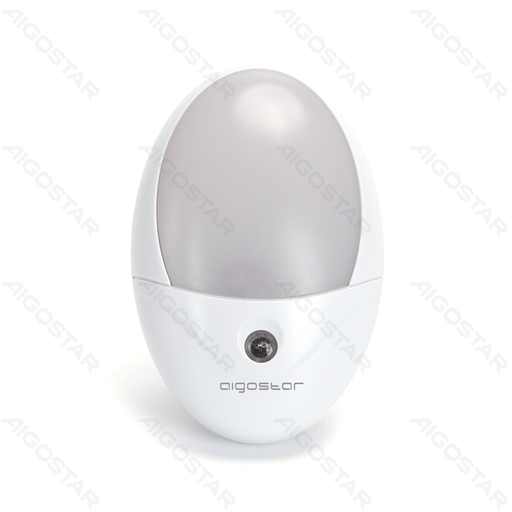
Why it fits: The warm white 3000 Kelvin version is designed for bedrooms, hallways and as a children’s room night light when a subtle light colour is preferred.
The product is clearly described as a PIR motion sensor model with additional activation in the dark. This makes it easier to distinguish its intended use from a pure twilight light.
20 lm, 3000 K, 7 metre detection range and 120 degree detection angle; no batteries required.

Why it fits: This cupboard light with motion sensor is aimed at users who want to illuminate kitchen base units, wardrobes, shelves or small hallway areas without drilling.
The specifications state a PIR range of 3 to 5 metres, USB charging and adhesive mounting. Before buying, you should check that the adhesive surface is clean, dry and sufficiently stable.
41 LEDs, 1100 mAh battery, 30 cm length and three colour temperatures from warm white to cool white.

Why it fits: For households with multiple locations, a 2-pack offers a flexible solution for bedrooms, nurseries, hallways or stairwells.
Power is supplied via a built-in 500 mAh battery. This means no fixed socket is needed at the mounting location, but the charge level must be checked regularly.
Three colour temperatures, five brightness levels, motion detection up to 3–5 metres and USB charging at 5 V/1 A.
In the full category you’ll find a current selection of products for different rooms, sensor types and mounting styles.
A PIR sensor detects changes in heat radiation caused by moving people. Many models only activate the LED when the ambient light is low and switch it off again after a short period without movement. The range and switch-off delay vary depending on the product.
That depends on the application. A twilight sensor is suitable for automatic background lighting in the dark. A motion detector typically saves light during unused periods and is practical for hallways, stairs or cupboards. Combined sensors link both functions.
The costs depend on the wattage, operating time and electricity price. A 0.4-watt model theoretically consumes 0.4 kWh over 1,000 hours, while a 1-watt model uses 1 kWh. With USB rechargeable variants, there are additional charging losses; however, the light can be mounted independently of a socket.