
Lieferung heute & morgen

Qualitätsgarantie

Willkommens-Angebote freischalten: KOSTENLOSE Lieferung | Bis zu 80 % RABATT | Kostenlose 30-Tage-JoyPlus-Testphase
App herunterladen
An LED outdoor floodlight should reliably illuminate your garden, courtyard, garage or driveway. In practice, however, wattage and lumens alone do not determine whether a light is suitable. Unclear protection ratings, an unsuitable colour temperature or an incompatible power supply can mean that the light cannot be used effectively in its intended location.
This buying guide explains which specifications are genuinely relevant before purchasing an LED outdoor floodlight, and which product features suit different usage profiles.
Lumens describe a light’s total luminous flux. However, they do not indicate on their own how bright a particular area will appear. For example, a narrow beam can illuminate a path precisely, while a wide beam angle is better suited to a courtyard, patio or garden.
With a garden floodlight featuring an adjustable head, you can change the direction of the light. This reduces dark areas around the edges and prevents light from unnecessarily shining into windows or neighbouring properties.
The description “waterproof outdoor floodlight” is of limited value without a specific protection rating. The IP rating consists of two digits:
A different design may be sufficient for a covered patio than for a light installed in an exposed position on the driveway. The key factors are the installation location, the side of the building exposed to the weather and the quality of the cable sealing.
Some outdoor lights require a fixed electrical connection, while others operate via a plug. Fixed-wired models should be installed by a suitably qualified electrician. Before buying, check the mains voltage, frequency, connection cable and installation accessories.
This is particularly important for imported products: according to the product details, the LUTEC Twin LED Spotlight with 5000 Kelvin operates at AC 120 V, 60 Hz. This specification is not directly compatible with a typical UK household connection. The model should therefore only be purchased once its electrical compatibility has been clearly confirmed.
For meaningful comparisons, consider lumens and watts together. Lumens indicate luminous flux, while watts indicate electrical power consumption. A light with a motion sensor can reduce electricity consumption in everyday use because it only activates when movement is detected. With an LED security light, the sensor’s detection angle and range are also important.
The manufacturer’s claim of “3000 lumens” for a solar outdoor floodlight often describes the maximum output under specific conditions. With solar lights, sunlight, battery capacity, temperature and the selected operating mode all affect the actual runtime.
Colour temperature is measured in Kelvin:
An LED outdoor wall light with 4000 Kelvin may feel more comfortable in an entrance area than cool white light. For a garage, shed or driveway, a higher colour temperature can make outlines stand out more clearly. The best choice depends on your personal lighting goals and the surrounding environment.
Aluminium housings can dissipate heat more effectively than basic plastic housings not designed for this purpose. Tempered glass protects the LED surface from external influences. Even so, the light should be installed so that water cannot collect around cable entries or connection points.
An adjustable bracket or two independently adjustable heads are useful when you want to illuminate both a wall and a path at the same time. Before installation, check:
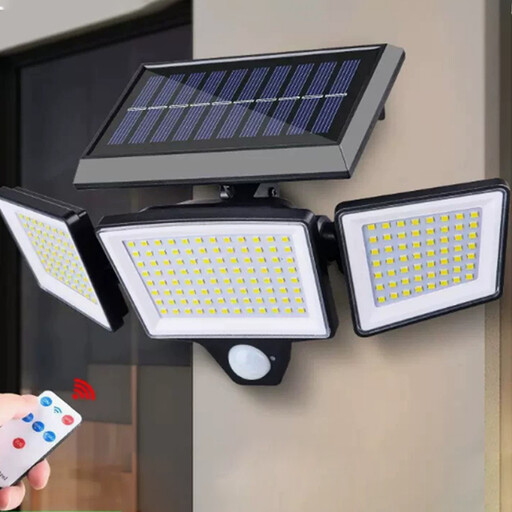
Why this product suits this profile: According to the product description, this solar outdoor floodlight does not require a fixed electrical connection. It is therefore suitable for gardens, patios, sheds or driveways without existing outdoor wiring.
The stated IP65 rating is more specific than a general advertising claim about weather resistance. For the best performance, it is still important to install the light in a position that receives as much sunlight as possible.
302 LEDs, up to 3000 lumens according to the supplier, three operating modes and three adjustable heads providing 270° coverage in total.
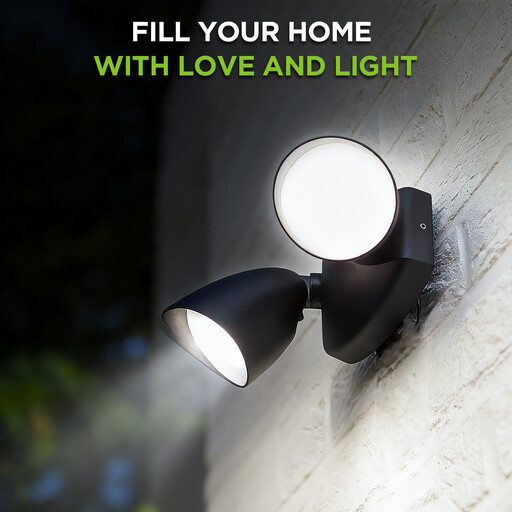
Why this product suits this profile: According to the product name, this LED outdoor floodlight combines 20 watts, 1800 lumens, 4000 Kelvin and two floodlight heads for versatile wall installation on a patio, in a garden or in a courtyard.
The clearly stated colour temperature and power rating make planning easier. Nevertheless, before installation, check whether an IP rating is explicitly specified for the installation location.
Two heads, 1800 lumens and neutral white 4000-Kelvin light according to the product details; metal construction according to the description.
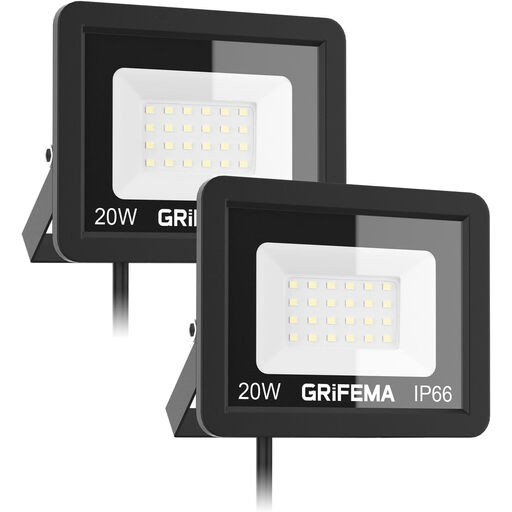
Why this product suits this profile: The twin pack is a practical choice for larger areas such as garages, courtyards or gardens when several installation points are needed. The lights can be mounted on a wall, ceiling or floor.
The stated IP66 rating and adjustable 180° bracket provide clear selection criteria. Note that the lights do not include a plug and require a protected connection to the power supply.
Two lights, each rated at 20 watts according to the specification, 6500 Kelvin, IP66 and an adjustable bracket; 2200 lumens in total according to the supplier.
We have put together a complete, regularly updated list of products that fully meet these strict selection criteria and the safety regulations applicable in the EU.
Models with IP65 or IP66 are often chosen for areas exposed to the weather. However, suitability depends on the installation location, connection and manufacturer’s specifications. A light with an IP rating is not automatically suitable for submersion or use in standing water.
Running costs depend on the power rating, daily operating time and electricity tariff. A 20-watt light uses 0.02 kilowatt-hours when operated for one hour. A motion sensor or timer-controlled use can limit the operating time. Solar lights do not incur ongoing mains electricity costs during operation, although the battery and sunlight affect how they can be used.
That depends on the intended use. A sensor can be practical for driveways, entrances and paths when light is only needed when movement is detected. For permanently used work areas or consistent outdoor lighting, a model without a sensor is often easier to plan. Pay attention to the detection angle, range, activation time and the ability to position the sensor correctly.