
Lieferung heute & morgen

Qualitätsgarantie

Willkommens-Angebote freischalten: KOSTENLOSE Lieferung | Bis zu 80 % RABATT | Kostenlose 30-Tage-JoyPlus-Testphase
App herunterladen
An LED outdoor floodlight should reliably illuminate gardens, paths, garages or work areas. In practice, however, wattage and advertising claims alone do not guarantee the right choice. Key factors include luminous flux, IP rating, power supply and the intended installation method.
Wattage describes power consumption, not brightness itself. For comparisons, luminous flux in lumens is more meaningful. A modern LED floodlight can produce a high amount of light with comparatively low power consumption. Also check whether the stated lumen output applies to one device or to a set.
The term “waterproof” does not replace a careful check of the IP rating. An IP65 outdoor light is protected against dust and water jets from various directions. IP66 also provides protection against powerful water jets. IP67 refers to temporary immersion under conditions specified by the manufacturer.
This does not automatically mean that every light is suitable for every installation position. Cable entries, plug connections and the orientation of the housing must also be protected against moisture.
An LED floodlight with motion sensor can reduce electricity consumption by only switching on when movement is detected. However, range, detection angle, activation time and sensitivity all affect how practical it is in everyday use. With a solar outdoor floodlight, location, sunlight, panel position and battery capacity are also important. For consistently bright lighting in shaded areas, a mains connection is often more predictable.
For a garage, driveway or outdoor security light, lumens and beam angle are particularly important. A wide beam angle distributes light over a large area, while a narrower angle can highlight specific areas more strongly. Neutral or cool colour temperatures are often used for functional outdoor lighting.
6500K cool white creates a clear, daylight-like effect. 4000K is closer to neutral white and may feel more pleasant for patios, entrances or outdoor wall lights. The right choice depends on the intended use and the surrounding area.
A waterproof outdoor floodlight should have an IP rating suited to the expected exposure to rain, dust and splashing water. A higher IP rating is often sensible for unprotected façades, carports or garden areas. An IP66 outdoor light or IP67 outdoor light can offer additional protection, provided the installation instructions are followed.
Check the following before buying:
For mains-powered models, the voltage, cable length and connection type must suit the installation location. A model without a plug requires a suitable, weather-protected connection. Work on fixed electrical installations in Germany should be carried out by an appropriately qualified person.
With solar lights, the separate panel should be positioned where it is exposed to as little shade as possible. A longer cable between the panel and light makes installation on house walls, sheds or fences easier.
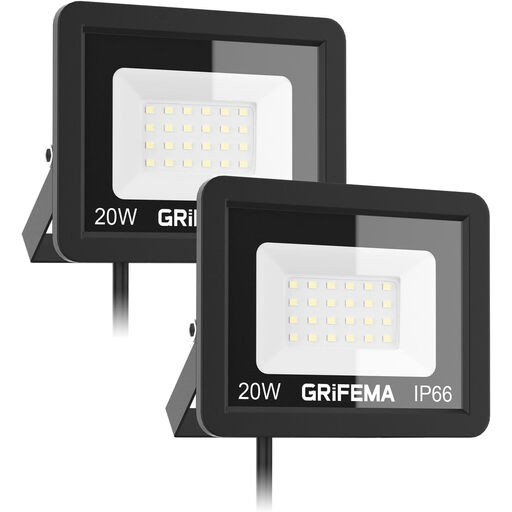
Why this product suits this profile: This set of two LED outdoor floodlights is ideal for users who want to equip a garden, courtyard, garage or patio with several light sources.
The specifications state the combined luminous flux of 2200 lm, the 6500K colour temperature and the IP66 rating. This makes it possible to check important comparison data before buying. According to the product description, a plug is not included.
Two lights, each rated at 20 W, with an adjustable 180° bracket for wall, ceiling or floor mounting; according to Grifema’s product specifications, up to 2200 lm for the set.
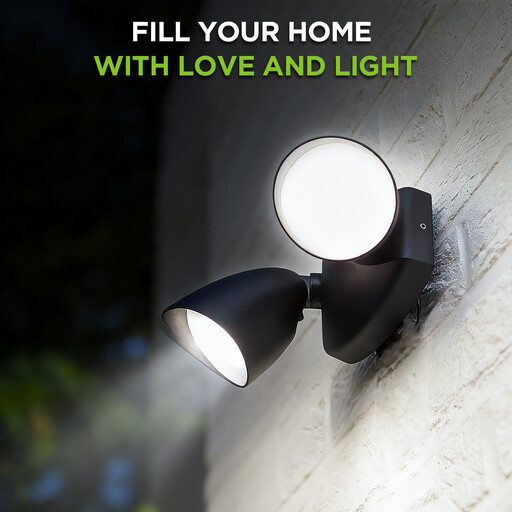
Why this product suits this profile: This outdoor dual floodlight directs two light heads towards different areas, making it suitable for entrances, patios, courtyards or larger wall surfaces.
Splitting the light between two heads reduces the need to point a single floodlight over an extremely wide area. The product name states 1800 lm, 20 W and 4000K; the specific IP rating should be checked before installation.
Metal construction according to the product name, plus two separately adjustable light heads; 4000K provides a more neutral colour temperature than 6500K cool white.
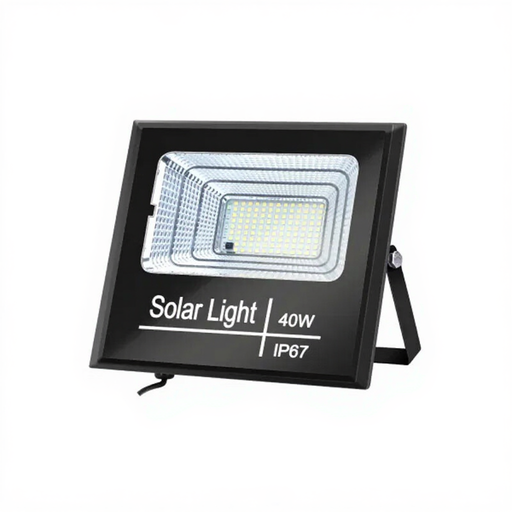
Why this product suits this profile: The separate-panel design is ideal for gardens, sheds, paths or remote areas where no mains connection is available.
According to the product description, the light does not require mains wiring. The separate panel can be positioned in a sunnier location than the floodlight itself. In areas that remain shaded, expect a shorter operating time.
IP67 according to the product specifications, a 10,000-mAh battery and a stated operating time of up to 12 hours; 6500K for a crisp cool-white effect.
We have compiled a complete, regularly updated list of products that fully meet these strict selection criteria and the safety regulations applicable in the EU.
Position the floodlight so that paths, doors or driveways are illuminated without unnecessarily dazzling neighbours or road users. With an outdoor security light, the motion sensor should not point directly at busy roads, pavements or swaying branches. A suitable activation time prevents unnecessary continuous lighting.
For garage outdoor lighting, adequate cable routing, a protected connection and a secure wall mount are important. Check the screws, seals and visible cables regularly after installation. Lights should be disconnected from the power supply before work is carried out on the connection.
This depends on the area, distance and beam angle. A moderate amount of light may be sufficient for a small entrance area. A large driveway or work area will usually need more lumens or several lights. With sets, check whether the stated figure is the total output or applies to just one floodlight.
IP65 protects against dust and water jets and may be suitable for many sheltered outdoor areas. For highly exposed installation locations or greater exposure to water, IP66 or IP67 may be worth considering. The installation instructions and protection of the connection and cable joint remain crucial.
A motion sensor can reduce consumption because the light does not remain switched on continuously. The saving depends on the power rating, activation time, detection range and frequency of use. Solar outdoor floodlights do not incur ongoing mains electricity costs, but the available operating time depends on the amount of sunlight and battery capacity.