
Lieferung heute & morgen

Qualitätsgarantie

Willkommens-Angebote freischalten: KOSTENLOSE Lieferung | Bis zu 80 % RABATT | Kostenlose 30-Tage-JoyPlus-Testphase
App herunterladen
An LED outdoor floodlight should reliably illuminate an area, withstand rain and dust, and be suitable for installation with your existing power supply. In practice, however, poor purchases are often caused not by brightness, but by unclear product specifications, unsuitable IP ratings or the wrong light colour.
The wattage describes power consumption, not brightness directly. For that, the luminous flux in lumens is the key factor. You should also check whether a lumen rating applies to one light or to a set. For example, the Grifema model specifies 2,200 lumens for both floodlights together, while each floodlight is rated at 20 watts.
A waterproof LED floodlight should have a clearly stated IP rating. The first digit describes protection against foreign bodies and dust, while the second indicates protection against water. An IP65 LED floodlight is protected against dust and can withstand water jets. IP66 outdoor lighting offers a higher level of water protection, but is not automatically suitable for every type of permanent submersion.
Even a high IP rating cannot protect against incorrectly sealed cable connections. For permanently connected lights, the connections, cable entries and wall mounting must also be suitable for outdoor use.
4000K, 5000K and 6500K LED outdoor lighting look noticeably different:
The higher the colour temperature, the cooler the light appears. This means 6500K may not be suitable for a cosy seating area, while it can be a practical choice for a driveway or shed.
When choosing a light, it is not just the lumen rating that matters. The beam angle, mounting height and area to be illuminated are equally important. A narrow-beam LED garden spotlight can highlight a tree or a particular object. An outdoor LED floodlight with a wide beam is more suitable for a yard, patio or garage drive.
With a dual outdoor floodlight, the two beams can be aimed independently. This is useful when, for example, you want to illuminate a door and a pathway at the same time.
Wired models require a suitable outdoor socket or a permanent connection. Before buying, check the following:
The LUTEC model with 5000K is described in the product specifications as AC 120V, 60Hz. Before installing it in the UK, you must therefore check whether the specific model is designed for the local mains voltage. Permanently wired lights should be installed in accordance with the manufacturer’s instructions and, where necessary, by a qualified electrician.
An LED floodlight with a motion sensor can reduce everyday energy consumption because the light does not need to remain on continuously. Important factors include a suitable detection range, an adjustable lighting duration and the sensor’s position. Movement on pavements, roads or caused by plants can trigger the sensor unintentionally.
A solar outdoor floodlight, on the other hand, needs to be installed in a location that receives sufficient sunlight. With an LED floodlight featuring a solar panel, the panel and light head should not necessarily have to be installed in the same place. A separate panel offers greater flexibility, provided the connecting cable is long enough. During winter or after several overcast days, the available lighting duration may decrease.
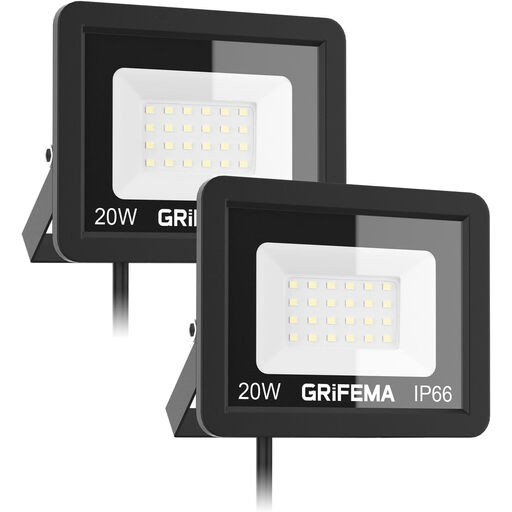
Why this product suits this profile: The two-floodlight set can be used for garages, gardens, yards or work areas when cool-white illumination is preferred. According to the product specifications, the mounting bracket can be adjusted through 180°.
The IP66 rating is more specific than a general description such as ‘weatherproof’. Buyers should note that the 2200 lumens are stated for the complete 2-floodlight set.
Two lights, 6500K and adjustable 180° brackets; according to the listing, supplied without a plug.
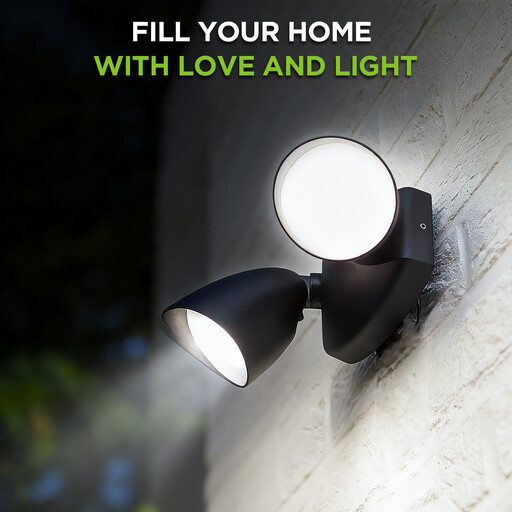
Why this product suits this profile: The metal construction with two adjustable heads is well suited to permanent wall mounting on patios, in gardens, yards or garages. 4000K provides a neutral-white light colour for general outdoor areas.
The independently adjustable heads help illuminate the area around the mounting position more precisely, rather than creating just a narrow spot of light.
Full-metal construction according to the product specifications, two 180° adjustable heads and 4000K light colour.
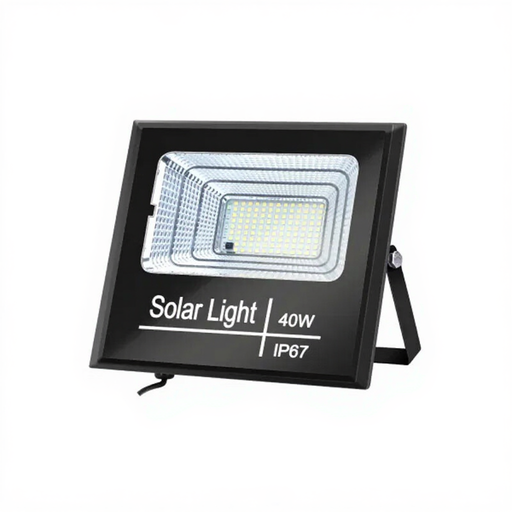
Why this product suits this profile: For sheds, garden areas or parts of a property without a mains connection, a separate panel offers greater freedom when choosing where to install it. The specifications state that it has a 10,000-mAh battery.
Solar power eliminates the need for a permanent mains connection. Before buying, check the orientation, cable length and expected sunlight levels.
Separate solar panel and wireless installation option; the product specifications state up to 12 hours of illumination under the intended conditions.
We have put together a complete, regularly updated list of products that fully meet these strict selection criteria and the safety regulations applicable in the EU.
Consumption depends on the wattage and how long the light is used each day. A 20-watt floodlight running for five hours uses 100 watt-hours, or 0.1 kilowatt-hours. With a motion sensor, the actual operating time may be lower. Solar lights draw their energy from a battery and do not use mains electricity directly, but they do require suitable light conditions for charging.
IP44 may be sufficient for many covered or sheltered installation locations. For areas fully exposed to the weather, models with IP65, IP66 or a comparable rating are often more suitable. The right choice depends on the installation location, exposure to splashing water and the manufacturer’s specifications. Cable connections must also be properly protected.
Service life is affected by LED quality, heat dissipation, switching cycles, moisture and ambient temperature. A metal housing can help dissipate heat, but it does not replace correct installation. Before buying, check not only the advertised service life, but also the warranty terms, whether components can be replaced and how accessible the solar panel or battery is.