
Lieferung heute & morgen

Qualitätsgarantie

Willkommens-Angebote freischalten: KOSTENLOSE Lieferung | Bis zu 80 % RABATT | Kostenlose 30-Tage-JoyPlus-Testphase
App herunterladen
An LED outdoor floodlight with a motion sensor can automatically light paths, front doors, driveways and patios. In practice, however, poor buying decisions are often caused not by the LED technology itself, but by unclear product information, unsuitable IP ratings or inadequate installation planning.
Names such as “Security Light”, “Floodlight” or “Solar Outdoor Floodlight” initially describe only the intended use. What matters are the specific details, including:
For example, a floodlight with a motion sensor may illuminate a large area without the sensor reliably detecting movement throughout it. So check the positions of the light and sensor separately.
For outdoor installation, look for a clearly stated IP rating. The first digit indicates protection against solid objects, while the second indicates protection against water. An IP65 outdoor light, for example, is protected against dust and water jets. This does not automatically mean it can be used underwater for extended periods.
If the IP rating is missing, take care. This also applies to product pages whose titles suggest outdoor use, while the technical specifications state that the product is for indoor use only.
In Germany, permanently connected outdoor lighting generally uses the existing mains installation. Specifications such as 120 V, 60 Hz are not automatically suitable for the German 230 V mains supply. If the light is to be connected to the household electrical installation, a qualified electrician should carry out the installation and testing.
If you rent your home, you should also consider drilling, cable routing and getting your landlord’s permission. A solar outdoor floodlight can reduce the need for wiring, but it needs a suitable position with enough sunlight and an appropriate mounting angle.
Luminous flux is measured in lumens (lm). More lumens do not automatically mean better illumination: glare, beam angle, installation height and the colour of walls or flooring also affect the result.
Colour temperature is measured in kelvins:
For LED courtyard lighting, choose a colour temperature that suits its surroundings. Very cool white light can be more conspicuous in residential areas than a neutral white LED outdoor light.
Look for details on:
A sensor with a long range may be triggered more often by traffic, branches or pets. An adjustable time delay makes it easier to tailor the lighting to a path, garage or entrance.
Aluminium housings can be mechanically robust, but glass covers and seals also need to be taken into account. Before installation, check:
Positioning is particularly important for a garden security light: the beam should cover the area you want to illuminate without unnecessarily lighting neighbours’ properties or public paths.
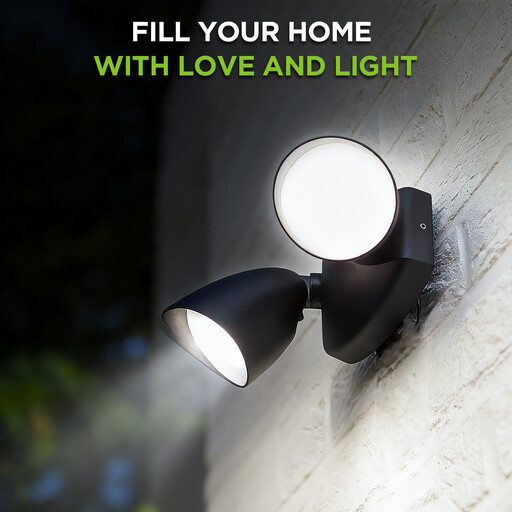
Why this product suits these needs: With two floodlight heads and 1,800 lumens according to the product name, it’s suitable for buyers who want to illuminate a front door, courtyard or patio with a single wall-mounted light.
The independently adjustable heads can help direct the light more precisely, rather than illuminating just a small spot on the wall. Check the full product specifications for the IP rating and sensor details before buying.
20 watts, 1,800 lumens according to the title, 4,000 kelvins and a twin-head design.
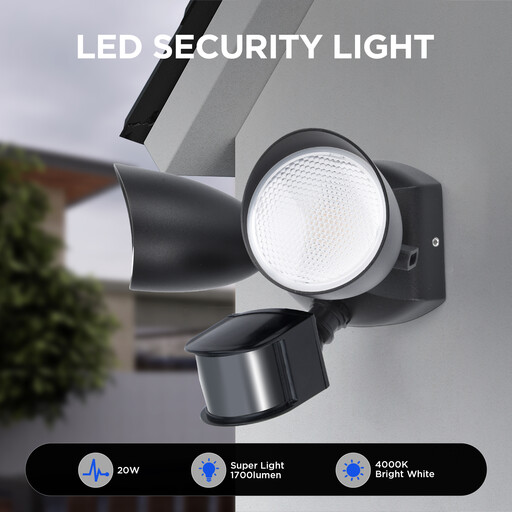
Why this product suits these needs: The combination of 1,700 lumens, 20 watts, 4,000 kelvins and two adjustable heads makes it suitable for entrances, garages and smaller courtyards.
The key technical details are clearly stated in the product name. Before ordering, check the IP rating, sensor range and connection type.
Integrated LED, 1,700 lumens, 4,000 kelvins and adjustable twin heads according to the product name.
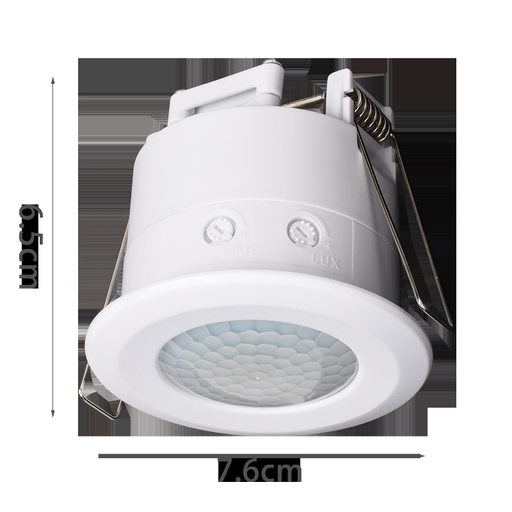
Why this product suits these needs: The product name describes a solar outdoor floodlight. However, the listed technical specifications refer to a FOCO sensor for indoor use and state an IP20 rating.
The conflicting information shows why you should check the title, images and technical specifications together. According to the data sheet, the FOCO sensor described is for indoor use only and should not be considered an outdoor light.
The listed features include 360° detection, a maximum diameter of 8 metres and an adjustable delay. These specifications relate to indoor use.
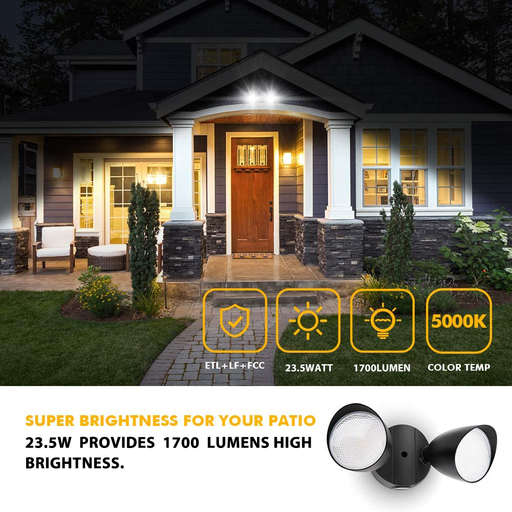
Why this product suits these needs: With two heads adjustable through 180° and an aluminium housing with toughened glass covers, this light is designed to direct illumination towards a garage, shed or driveway.
The stated 120 V, 60 Hz is not automatically compatible with a German household electrical installation. Check electrical compatibility before buying; the listed specifications do not confirm that it can be connected directly to 230 V.
Die-cast aluminium, toughened glass, integrated LED and two adjustable heads according to the product specifications.
We’ve put together a complete, regularly updated list of products that meet these strict selection criteria and fully comply with the safety regulations in force in the EU.
A mounting height of around 2 to 3 metres works well for many homes and garage areas. However, the manufacturer’s instructions, detection angle and desired range are what matter. The sensor should not point directly at a heat source, a busy road or branches that move in the wind.
Consumption depends on the power rating and how long the light is actually on. A 20-watt floodlight that runs for 30 minutes a day uses around 0.01 kWh per day. A motion sensor therefore usually means much lower consumption than leaving the light on continuously. Standby consumption and sensor operation can also affect the total.
Its lifespan depends on factors including heat dissipation, switching frequency, mains quality, seals and ambient temperature. Check the lifespan stated by the manufacturer and whether the LED module can be replaced. For a weatherproof outdoor light, also check the housing, cable entry and seals regularly for visible damage.