
Lieferung heute & morgen

Qualitätsgarantie

Willkommens-Angebote freischalten: KOSTENLOSE Lieferung | Bis zu 80 % RABATT | Kostenlose 30-Tage-JoyPlus-Testphase
App herunterladen
The right LED outdoor lighting for the garden can make paths more visible, highlight flower beds or illuminate driveways and garages. However, product names and marketing claims do not always lead directly to the right purchasing decision. The key factors are the technical specifications, the installation location and the amount of light actually required.
Wattage describes power consumption, not brightness directly. Lumens are more meaningful for comparisons. A decorative solar light with just a few lumens is suitable for subtle marking, but it cannot replace a powerful LED garden floodlight at a driveway.
Specifications such as “35-watt equivalent” should also be considered alongside the actual luminous flux. When choosing an outdoor LED floodlight, beam angle, mounting height and orientation also matter.
The ratings IP44, IP65, IP66 and IP67 describe protection against the ingress of foreign objects and water under specific testing conditions:
An outdoor light described as waterproof should therefore not automatically be installed in areas where water collects or where it will be permanently exposed to flooding. Cables, connections and wall penetrations must also be protected against moisture.
A garden solar light needs sufficient daylight for its solar panel to charge the battery. Under dense trees, on a north-facing wall or next to high walls, the operating time can be significantly shorter. The stated charging and operating times generally apply under suitable conditions.
For consistently bright security lighting, mains-powered LED garden floodlights or a separate solar floodlight with a remote solar panel are often more suitable than small decorative lights.
Colour temperature is measured in Kelvin:
A warm-white solar light can mark paths without brightly illuminating the entire garden. For a driveway or garage, however, a 4000K or 6500K outdoor floodlight may be more practical. RGB garden lighting offers coloured scenes, but should not be planned as the only source of guidance lighting.
Before buying, you should establish whether you need a solar ground light, a ground spike, an outdoor wall light or a permanently mounted floodlight.
For 220- or 230-volt products, installation must follow the manufacturer’s instructions and the applicable safety regulations. Work on the fixed mains supply should be carried out by a qualified electrician. Particularly important: a product marked AC 120 V, 60 Hz is not automatically suitable for German power networks. This applies, for example, to the LUTEC Twin-Spotlight with 5000 K; electrical compatibility must be clearly confirmed before ordering.
Aluminium housings and glass covers can provide a robust construction for permanently mounted floodlights. Plastic lights, on the other hand, are often lighter and easier to use as solar or decorative lights. Adjustable light heads make it easier to direct light precisely at tree canopies, paths, walls or parking spaces.
Solar panels should be cleaned regularly with a soft cloth. Batteries and electronic components must not be opened or modified independently. When disposing of the product, follow the regulations for waste electrical equipment and batteries.
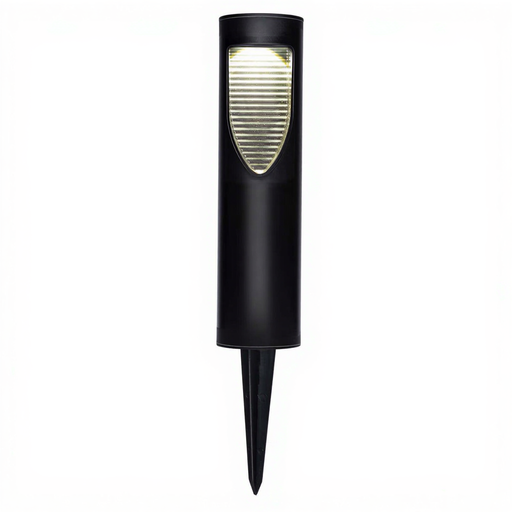
Why this product suits this profile: This freestanding solar light does not require a direct mains connection and is suitable for simple marking along garden paths or flower beds.
The technical specifications state that it uses solar power, a Ni-MH battery and automatic dusk-to-dawn switching. This removes the need for wiring, which is often underestimated.
Warm-white SMD LED light, 8 cm diameter, 31 cm height and freestanding installation.
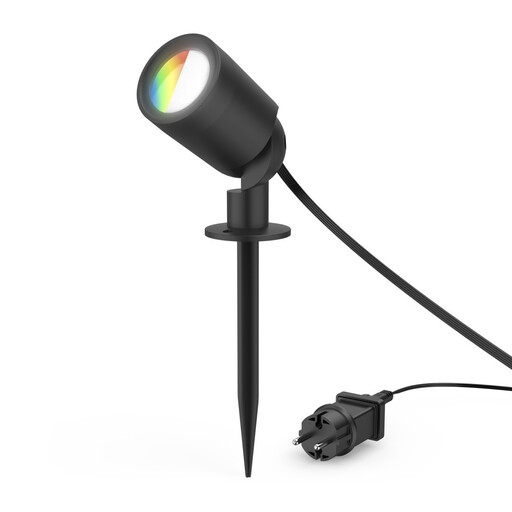
Why this product suits this profile: For users who want to manage their garden lighting via an app, voice control or a Matter-compatible smart home system.
The IP65 rating is clearly specified. Brightness, schedules and colours can also be controlled via the app.
16 million colours, continuous dimming, Matter support, plus ground, wall, ceiling and floor mounting.
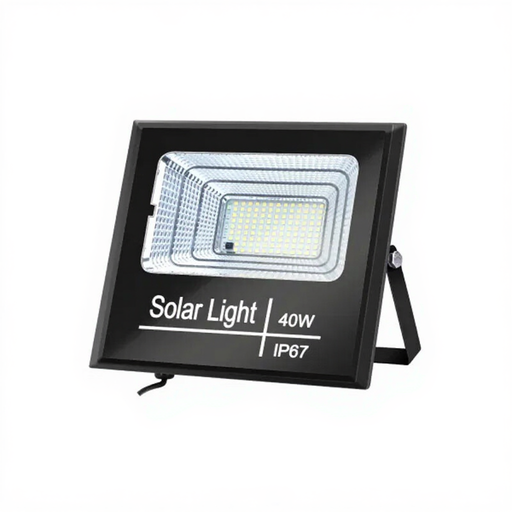
Why this product suits this profile: The separate solar panel makes positioning easier when the floodlight itself needs to be installed in a relatively shady location.
The separate-panel design reduces dependence on the light’s installation location. Nevertheless, the stated IP67 rating should not be equated with permanent underwater installation.
6500K light, 10,000-mAh battery, separate solar panel and aluminium-and-glass construction according to the product description.

Why this product suits this profile: The ground-spike installation is designed for lawns, flower beds and garden paths, and does not require a fixed electrical installation.
The IP44 rating clearly indicates the intended protection against splashing water. This rating is not designed for areas at risk of flooding.
6500K light, charging time of around 4 to 6 hours and a stated operating time of 8 to 12 hours under suitable conditions.
For pleasant garden path lighting, warm-white tones between 2700 and 3000 K are usually suitable. Neutral-white light can improve visibility and orientation. 6500 K appears significantly cooler and is better suited to practical or security-related applications.
Operating time depends on sunlight, battery capacity, temperature and battery age. Product specifications such as 8 to 12 hours should be understood as guidelines under suitable charging conditions. If performance decreases, the battery should only be replaced if this is intended by the manufacturer.
Consumption can be calculated using the formula Wattage × operating hours ÷ 1000. A 10-watt light that operates for five hours a day uses 0.05 kWh per day. For mains-powered lights, installation and connection costs must also be taken into account; solar lights do not require ongoing mains electricity, but they do depend on the battery and available daylight.