
Lieferung heute & morgen

Qualitätsgarantie

Willkommens-Angebote freischalten: KOSTENLOSE Lieferung | Bis zu 80 % RABATT | Kostenlose 30-Tage-JoyPlus-Testphase
App herunterladen
LED outdoor lighting can illuminate pathways, highlight seating areas or serve as a decorative light source. However, solar lights, battery-powered fairy lights and app-controlled lighting differ considerably in terms of IP rating, power supply and intended use. If you focus only on brightness or eye-catching design, you may end up buying a product that does not work reliably where you plan to use it.
The IP65 rating describes the protection provided by the relevant housing against dust and water jets. It does not mean that the light can be submerged. With solar fairy lights, for example, only the light strand may have the relevant protection, while the solar panel or battery compartment must be positioned somewhere protected from water.
Products with an IP44 rating are protected against splashing water from various directions and are suitable for many covered outdoor areas. For permanently exposed locations, check the manufacturer’s information for the specific installation position.
For garden solar lights and LED solar lights, the operating time is specified under particular charging conditions. Shade from buildings or trees, or an unfavourable orientation, reduces the available charging energy. Operating time may also be shorter in winter or after several cloudy days.
A solar light should therefore be positioned where the solar panel receives several hours of direct daylight wherever possible. A decorative light with low brightness is not automatically suitable for pathway lighting.
A string light with IP20 is intended for dry indoor areas. It should not be used on a balcony, terrace or in the garden. For outdoor LED string lights, the IP rating, the position of the battery compartment and the power supply instructions are crucial.
Warm white LED lights of around 2700 to 3000 Kelvin create a more homely lighting effect. This is often a good choice for decorative outdoor lighting and seating areas. Brightness is measured in lumens. A product with 350 lumens can illuminate a larger area than a small decorative light with only a few lumens.
For functional garden lighting, consider the beam angle, installation height and distance from the area together. A wide beam angle spreads the light over a broader area, while a directional light can highlight individual features.
Battery capacity, charging time and operating temperature provide useful information about practical use. The Aigostar Smart Solar Globe Pendant Light, for example, is specified with a 10 W monocrystalline solar panel, an 8 Ah LiFePO4 battery, 350 lumens, a 120-degree beam angle and a stated operating time of up to 24 hours. These figures apply under the conditions described by the manufacturer.
The solar panel should be cleaned regularly with a soft, damp cloth. Battery compartments and connections must not be left standing in water. Every light must also be installed securely to protect it against wind and accidental falls.
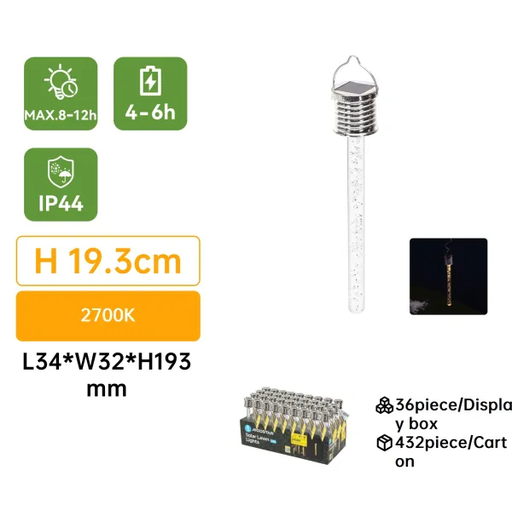
Why this product suits this profile: This compact solar light requires no mains connection and is ideal for adding decorative accents to a balcony, terrace or garden.
The specifications state an IP44 rating, a charging time of around 4–6 hours and an operating time of around 8–12 hours. This makes it easier to plan how and where to use it realistically.
Warm white light at 2700 Kelvin, an integrated Ni-MH battery and a low weight of around 40 grams.
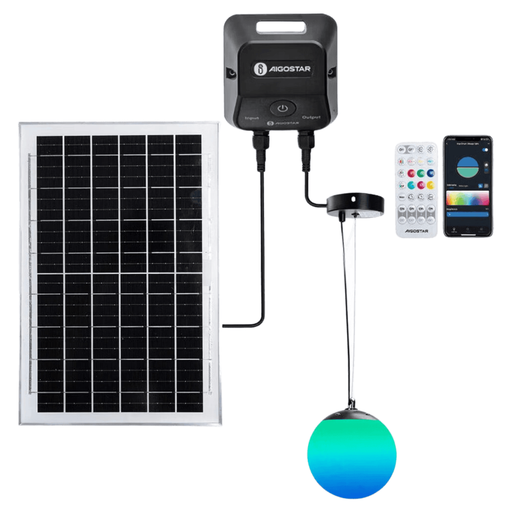
Why this product suits this profile: Ideal for larger outdoor areas and users who want to manage schedules, brightness and switching on and off via a Bluetooth Mesh app.
The IP65 rating is clearly stated, while the product information also points out that the light is not suitable for submersion.
350 lumens, a 120-degree beam angle, a LiFePO4 battery and Bluetooth Mesh support for more than 200 devices according to the product description.
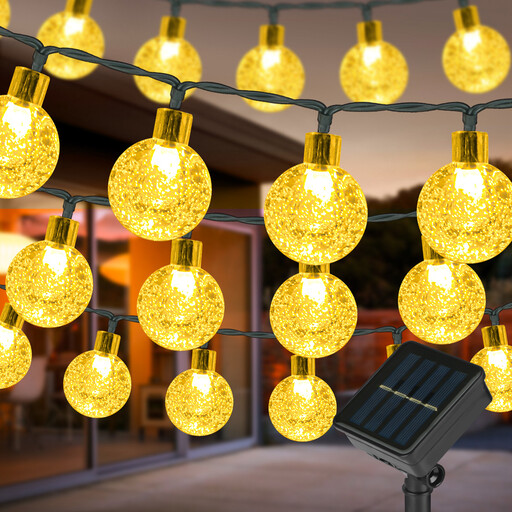
Why this product suits this profile: At 7 metres long, this solar string light is designed for users who want to decorate gardens, balconies, parties or seasonal displays on a larger scale.
The charging time, expected operating time and eight lighting modes are clearly specified. Pay attention to the instruction to position the panel and battery compartment separately.
50 warm white LEDs, a length of 7 metres, automatic activation in the dark and a stated IP65 rating for the light strand.
We have put together a complete, regularly updated list of products that fully meet these strict selection criteria and the safety regulations applicable in the EU.
Consumption depends on the electrical power rating in watts and the daily operating time. A low-wattage mains-powered light can incur low running costs when used for short periods. Garden solar lights do not use mains electricity while operating, but they depend on daylight and battery charge. For battery-powered products, remember to factor in the cost of replacement batteries.
For outdoor use, the product should at least be explicitly stated by the manufacturer as suitable for outdoor conditions. IP44 may be sufficient for sheltered areas. In harsher weather, a higher rating such as IP65 is relevant, although even with IP65 neither the light nor its connection may be submerged. The product instructions remain the definitive source of information.
Service life depends on the LED module, electronics, battery, temperature, moisture and duration of use. With solar lights, the battery is often a key wear component. Regularly cleaning the solar panel, keeping connections dry and storing the light properly out of season can help maintain reliable everyday performance.