
Lieferung heute & morgen

Qualitätsgarantie

Willkommens-Angebote freischalten: KOSTENLOSE Lieferung | Bis zu 80 % RABATT | Kostenlose 30-Tage-JoyPlus-Testphase
App herunterladen
A suitable LED outdoor lighting setup should illuminate paths, the terrace, balcony, garden or entrance reliably, while matching your existing power supply, the weather conditions and your preferred level of convenience. In practice, bad purchases often stem not from the lighting tech itself, but from unclear performance details and unsuitable installation.
With LED lights, the wattage primarily indicates energy consumption, not brightness. For comparisons, the more important figure is luminous flux in lumens. A solar light with 200 lumens is better suited to decorative or wayfinding lighting, while a stronger outdoor LED floodlight for a driveway, garage or work areas will need more luminous flux.
Statements like “equivalent to 40 W” or “50 W” sometimes refer to comparison with a traditional incandescent bulb. With solar products, you should therefore check whether the figure refers to actual consumption, a theoretical maximum output or merely a brightness comparison.
An IP65 outdoor light is protected against dust and water jets. However, it is not intended for submersion. IP44 offers a lower level of protection and is better suited to sheltered areas where no constant, direct rainfall is expected.
For a waterproof garden light, it also matters whether cable connections, plugs and the solar panel have the same protection rating. A protected light can lose its suitability if a connector is left exposed to the rain.
A solar light needs a suitable position for its panel. Trees, walls, roof overhangs and dirt reduce the available charging energy. With solar pendant lights featuring a separate panel, you can place the light more flexibly, but the panel must still be mounted as clear and correctly oriented as possible. The stated run time also depends on sunlight, temperature, charge level and the brightness you select.
A decorative solar garden light doesn’t need to achieve the same luminous flux as an outdoor LED wall light by the entrance. Lower values are often sufficient for orientation; for security or task lighting, the luminous flux should suit the area.
Solar lights work independently of the mains, but they do require direct or at least sufficiently bright sunlight. Check:
For mains-powered lights, voltage and connection type are crucial. A product with 120 V, 60 Hz is not readily suitable for the German grid at 220–240 V and 50 Hz. Hard-wired lights should be installed by a qualified electrician in accordance with local regulations.
Before buying, measure the mounting surface, cable length and fixing points. A solar pendant light with a separate panel can make sense for gazebos and covered terraces. An outdoor LED wall light, by contrast, needs a suitable wall and electrical installation.
For smart home users, protocol and range are key. A smart LED light with Matter and Wi‑Fi can be integrated into compatible systems. Bluetooth Mesh lighting can group multiple lights, but depends on the app, device compatibility and the radio environment. Only pay for features such as RGBW, schedules, colour temperature and dimmable control if you actually need them.
The following products cover different use cases. Technical data is based on the respective product descriptions and should be verified on the product page before purchase.
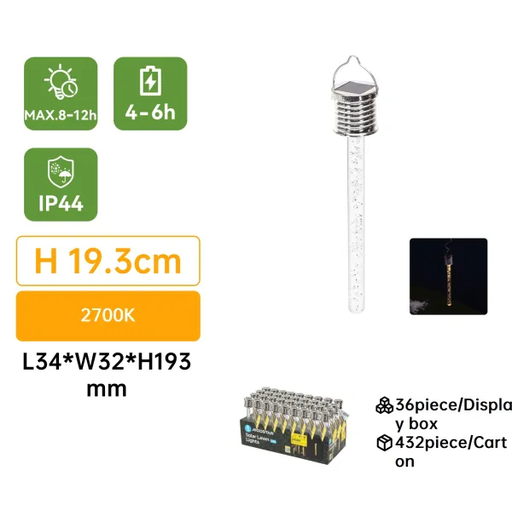
Why this product fits the profile: This compact solar light runs at 0,006 W, offers warm white light at 2.700 K and needs no mains connection. It’s suitable for decorative areas in the garden, on the balcony or in sheltered spots.
The product description specifies charging time, battery type, run time and IP44 rating. This makes it easier to classify it as decorative rather than safety-relevant lighting.
2700 K warm white light, 4–6 hours charging time and 8–12 hours stated battery life under suitable conditions.
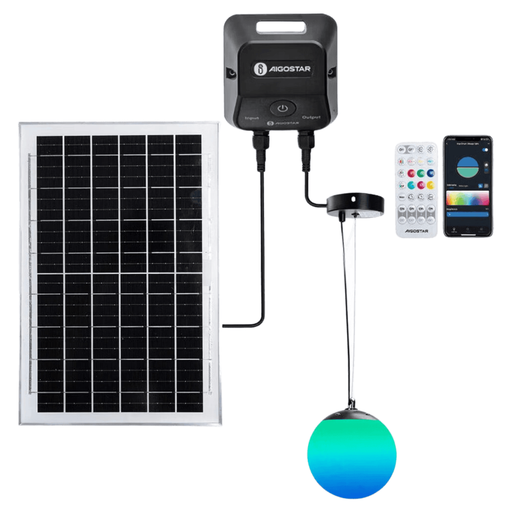
Why this product fits the profile: The combination of a separate solar panel, Bluetooth Mesh and RGBCCT light control suits terraces, gazebos and gardens where multiple lights need flexible management.
With 350 lumens, a 120° beam angle, IP65 and a stated LiFePO4 capacity of 8 Ah, key technical data is provided. The panel must still be installed free from obstructions.
Bluetooth Mesh for group control with more than 200 devices according to the product description; schedules and brightness adjustment via app.
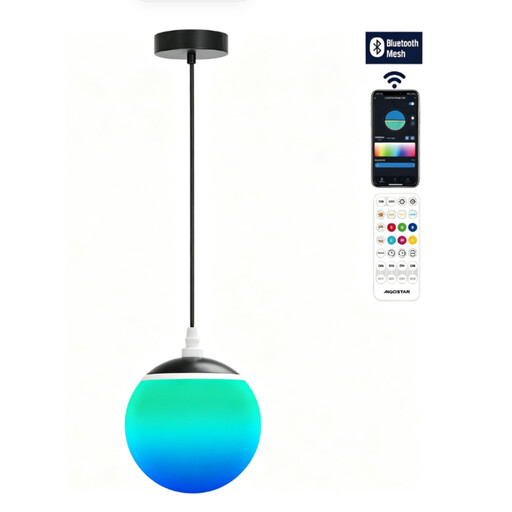
Why this product fits the profile: This solar pendant light combines a separate panel installation with 200 lumens, RGBW colours and adjustable colour temperature. That’s relevant for gazebos, covered seating areas and decorative lighting concepts.
The product data distinguishes brightness, colour temperature, battery capacity and IP65 protection. This helps differentiate it from a brighter security light.
RGBCCT with 2.700–6.500 K, Bluetooth Mesh 5.0 and a stated maximum run time of up to 24 hours.
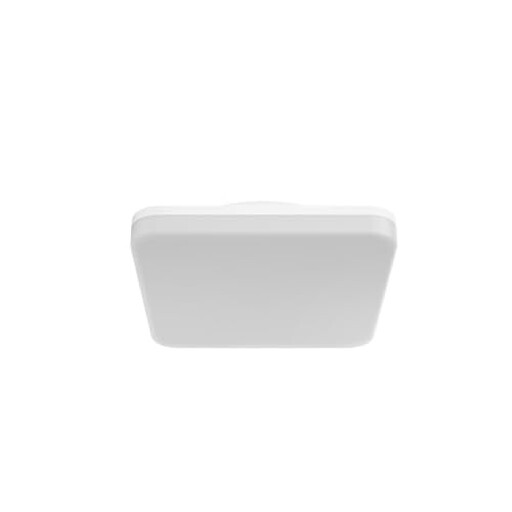
Why this product fits the profile: Designed for indoor spaces such as kitchens, bathrooms, basements or living areas, this light combines Matter, Wi‑Fi, app and voice control with dimmable RGBW light.
The IP54 classification is clearly stated as splash protection and not as approval for unsheltered outdoor use. This places clearer limits on where it can be used.
18 W, up to 1,800 lumens, infinitely dimmable, and a colour temperature of 2.700 to 6.500 K; Matter integration without an additional hub according to the product description.
We’ve compiled a complete, continually updated list of products that fully meet these strict selection criteria and the safety regulations in force in the EU.
For hard-wired lights, isolate the power supply before installation. For an outdoor LED wall light or a hard-wired outdoor LED floodlight, we recommend installation by a qualified electrician. Use appropriate wall plugs, weather-protected cable connections and ensure a secure fixing against wind.
For energy-efficient lighting, dusk sensors, motion detectors and schedules can help. Constantly high brightness increases electricity use on mains-powered devices; with solar lights, it often shortens night-time run time. Integrated LEDs require little maintenance, but if a fault occurs you will usually need to replace the entire light.
That depends on the purpose. Decorative garden lights manage with a few up to several hundred lumens. For paths, entrances or garages, higher values make sense. Mounting height, beam angle and the size of the area to be illuminated are also crucial.
For sheltered areas, IP44 may be sufficient. In direct rain and higher dust exposure, an IP65 outdoor light offers greater protection. Neither of these ratings allows submersion. Connectors and cables must also be suitable for the respective outdoor area.
Consumption depends on its actual wattage and daily operating time. A 10 W light running five hours a day uses 50 Wh per day in theory. With solar lights, there is no direct mains consumption during operation; however, run time depends on the panel, battery, weather and brightness setting.