
Lieferung heute & morgen

Qualitätsgarantie

Willkommens-Angebote freischalten: KOSTENLOSE Lieferung | Bis zu 80 % RABATT | Kostenlose 30-Tage-JoyPlus-Testphase
App herunterladen
An LED outdoor wall light should reliably illuminate entrances, patios, garages or paths, while complementing the look of your home. However, some common marketing claims can lead to the wrong choice. A high lumen rating doesn’t automatically mean even illumination. And the term ‘weatherproof’ tells you little without a specific IP rating.
Lumens measure the amount of light emitted, not how bright it will be in a particular spot. An outdoor LED wall floodlight with 1,800 lumens might be suitable for a driveway, but could be too powerful for a small entrance. For decorative patio lighting, the beam angle matters as well as the light output.
A weatherproof outdoor light should have a clearly stated IP rating. An IP44 outdoor light is protected against solid objects 1 mm or larger and splashing water from different directions. However, IP44 doesn’t mean the light is suitable for a direct jet of water or prolonged submersion.
An outdoor light with a motion sensor can make life easier if its detection range suits your path or entrance. Some products also let you adjust the dusk sensor, timer or sensitivity. For a dimmable outdoor light, you’ll need to check whether it requires a compatible LED dimmer. A dimmer designed for traditional bulbs won’t necessarily work.
IP44 may be sufficient for a sheltered entrance or covered patio. For an exposed wall, consider the location carefully: the light shouldn’t be exposed to prolonged direct driving rain unless the manufacturer says it’s suitable. Seals, the connection to the wall and correctly fitted covers all play an important part in maintaining its protection.
Fixed-wired lights operating at 220–240 volts should be installed by a qualified electrician. Disconnect the power before installing or carrying out maintenance. This applies even if installation looks straightforward.
Two adjustable lamp heads can direct light more precisely onto paths, driveways or walls than a fixed beam. For small entrances, a compact wall light with even light distribution is often enough.
With an integrated LED, there’s no need to buy a compatible bulb. Still, compare the power consumption, light output and colour temperature before you buy. For example, the Westinghouse Winslett is described as having an integrated 10 W LED module and a light source producing 1,000 lumens.
A light with an E27 fitting gives you more flexibility. You can choose a bulb to suit your preferred colour temperature, brightness or shape, and replace it later. Just make sure you don’t exceed the maximum wattage.
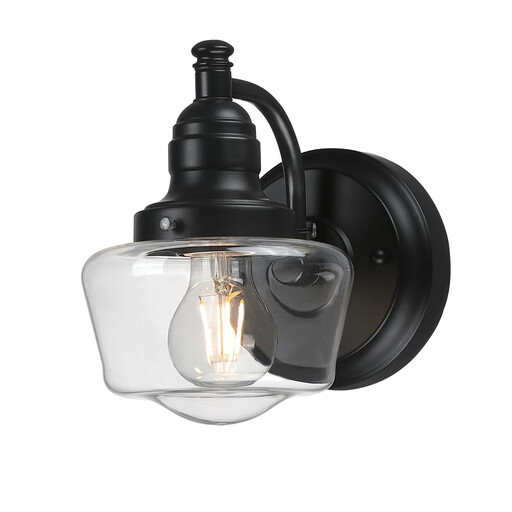
Why it suits this profile: The E27 fitting lets you choose a suitable LED bulb. It’s a practical option if you’re looking for a simple black outdoor wall light that you can adapt later.
You’re not tied to the light output of a permanently fitted module. The bulb can be replaced when needed.
IP44 splash protection, a matt black metal finish and an E27 fitting for bulbs up to 60 watts.
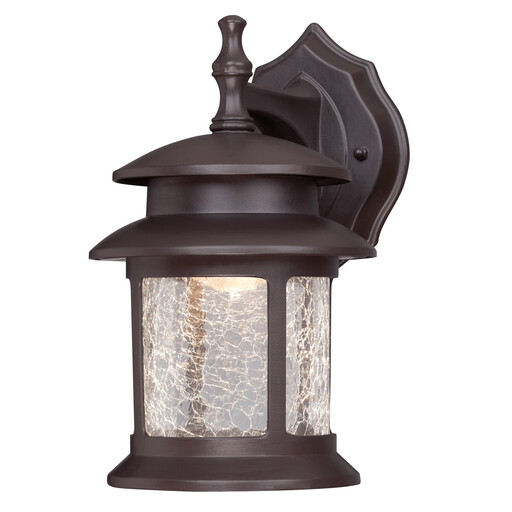
Why it suits this profile: This model has clearly specified technical details, making it a good choice for entrances and patios where you want warm white light and adjustable brightness.
The specifications distinguish between a 1,000-lumen light source and an effective light output of 670 lumens. This gives you a more realistic idea of how bright the light will be.
9 W integrated LED, 3,000 kelvin, IP44 and dimmable with a suitable LED dimmer.
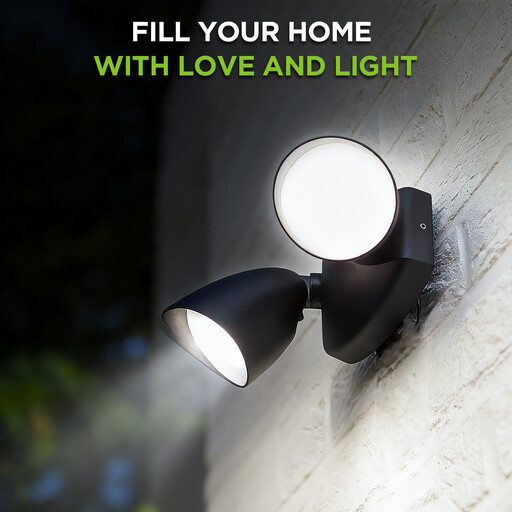
Why it suits this profile: With two lamp heads and 1,800 lumens, this light is suited to larger courtyards, gardens or driveways where wider coverage is needed.
The adjustable heads let you direct the light to suit the installation location, rather than concentrating all the light on a small area.
20 W power consumption, 4,000 kelvin and a dual-head design with a metal housing.
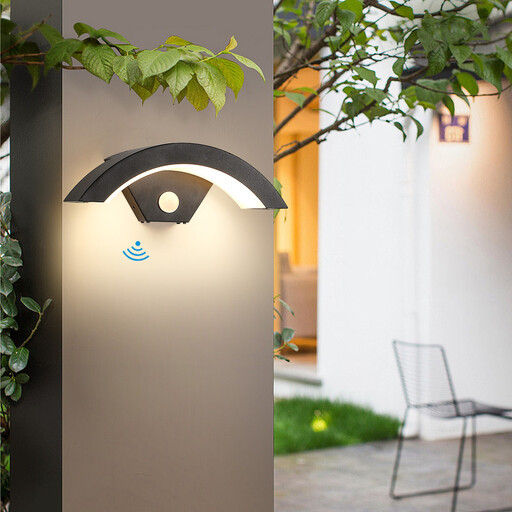
Why it suits this profile: The integrated light and motion sensor is designed for entrances, paths, balconies, garages or stairways where you don’t want the light left on all the time.
Automatic activation means you rely less on manual switches. Before buying, check that the detection range and sensor position suit the installation location.
We’ve put together a complete, regularly updated list of products that meet these strict selection criteria and fully comply with the safety regulations in force in the EU.
Annual electricity costs depend on the light’s power consumption, how many hours it’s used each day and the price of electricity. Use this simple calculation:
Power in kilowatts × operating hours × price per kilowatt-hour = annual electricity costs.
A 10-watt light running for four hours a day uses around 14.6 kilowatt-hours a year. A sensor light may be on for less time in practice, but actual usage depends on its settings, how it’s used and where it’s installed.
Manufacturers’ lifespan figures are averages, not a guarantee of how long a light will last. With integrated LEDs, it’s also worth checking whether the module can be replaced. Lights with an E27 fitting offer a different maintenance option.
IP44 is used for many sheltered outdoor areas. However, whether it’s suitable depends on the installation location and exposure to rain, splashing water and dirt. For more exposed locations, follow the manufacturer’s installation guidance.
A moderate light output may be enough for a small entrance. For a courtyard, garage or driveway, a higher lumen rating and wider beam angle are often useful. Installation height, distance from the wall and the colour temperature you want are also important.
No. An outdoor light must be explicitly labelled as dimmable. Integrated LEDs usually require a compatible LED dimmer. With an E27 light, both the bulb and dimmer must be suitable for dimming.